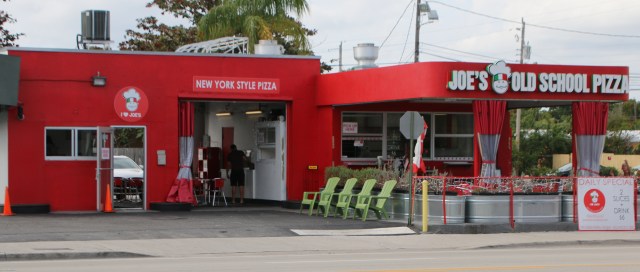
Found this superbly recycled gas station recently just down the road in Hollywood, FL: Joe’s Old School Pizza. See the whole collection of old gas stations here.
(Photo by Ron Haines)
Found this superbly recycled gas station recently just down the road in Hollywood, FL: Joe’s Old School Pizza. See the whole collection of old gas stations here.
(Photo by Ron Haines)

Frog legs and gator tails
One of the paddling MeetUp groups I belong to recently planned an outing to Lake Cara, a tiny little postage stamp of a lake in the Fort Drum Wildlife Management Area up east of Yehaw Junction off Route 60. Nearly two hours north of me.
A long trip from my house for a very short paddle, was my first thought. But I read on. Perhaps, the organizer suggested, participants would like to afterwards head on up to nearby Fellsmere, FL, for the annual Fellsmere Frog Leg Festival.
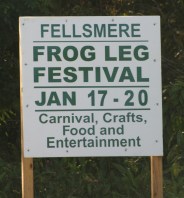 That rang a huge bell, all the way back to 2012, when I ran across this sign when I decided to detour off of I-95 near Fellsmere. Unfortunately, the festival was a week AFTER I passed through the area, so I never saw it.
That was not going to happen this year. I could combine a nice paddle with friendly folks with a visit to the Frog Festival. And, because Lake Cara would only take about an hour to explore, I could also pop up the road a few miles and check out Blue Cypress Lake, a massive body of water surrounded by dense stands of cypress trees, and still have time for the Festival.
Time to organize a trip. So, I rounded up a couple traveling partners, brother-in-law Michael and recent paddling buddy Leslie, and off we went at the crack of dawn last Sunday. It was a chilly 47 when I got up in the morning and it wasn’t much warmer by the time we’d traveled a couple hours north to Lake Cara.
Fortunately, the sun was bright and the wind low, so with a few layers on we were fine. We met up with the rest of the Meetup folks and spent a nice, sociable hour paddling around Lake Cara and viewing the wildlife.
From there, Leslie, Michael and I loaded up the trailer again and headed off to Blue Cypress Lake, a few miles west on Route 60 and five miles north on a two-laner. The origin of the St. Johns River, this huge, 6,500-acre lake is 21 miles in circumference. A lake this size is not normally a pleasant environment for human-powered craft, but this one has a nice feature. It is surrounded by a shallow-water cypress forest, very extensive on the eastern and northern borders, but pleasantly wide too on the western side, where we launched from the lake’s only access point, Middleton’s Fish Camp.
We spent an hour or more poking around a portion of the swamp along the lake’s western border, 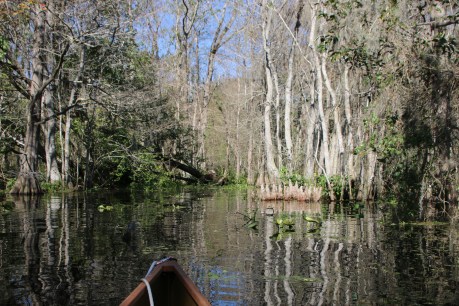 pleasantly protected from the wind and surrounded by nesting osprey, roosting turkey vultures and lots of other bird life. It was way more fun and interesting than Lake Cara had been.
From there it was on to the finale of the day: the 25th Anniversary Fellsmere Frog Leg Festival. As events go, it isn’t the biggest, a small midway/carny games area and a couple rows of craft vendors don’t take a whole lot of time to see. But it is one of those things you have to go to once in your life. Not unexpectedly, the yard art booth was full of Mexican imports. Read this to see what I think of that.


I had the frog leg/gator tail combo dinner (sorry, forgot to take any food pix), served efficiently through a window from the school building, where there was an assembly line of cookers and servers, all volunteers, filling the orders.
The meat came with a side of slaw and grits in a three-sectioned Styrofoam take out container. The grits I ignored, the slaw was good, the frog legs, about five pair of them, were meaty, lightly breaded, and tasted slightly swampy…or fishy…or something. At least they weren’t bland and didn’t taste like chicken. The gator tail bits were heavily breaded and about as tasteless as those I have had elsewhere.
Washed down with a Mountain Dew, the food, eaten under a large tent at a wooden table while seated on a rickity plastic folding chair, capped off a terrific day of traveling and paddling with friends and finally getting to experience the Fellsmere Frog Festival.
And of course, adding to my T-shirt collection…and my photography collection:
These two guys were on Lake Cara:


And these were over at Blue Cypress Lake:


The fellow with the yellow kayak is the Lake Cara organizer, Corky. Michael is in the blue kayak and Leslie in the white one. I’m in the final photo:


For more than a decade, the manatees that spend the winter clustered in the relatively warm water coming out of the Florida Power and Light power plant in Palm Beach County have had their privacy. Sure, the occasional FPL employe or teenaged trespasser might have been able to take a peek at what they’re doing, but the public at large has been kept out by chain link fences and signs.
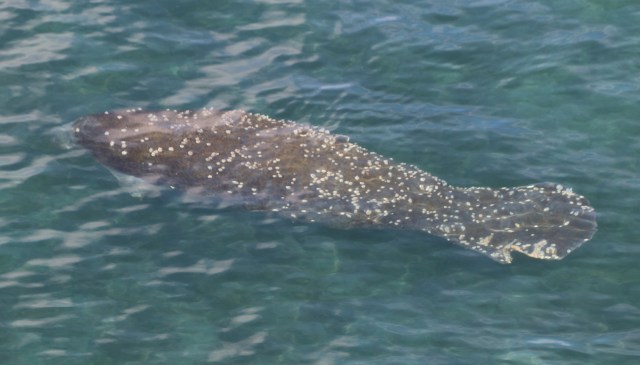
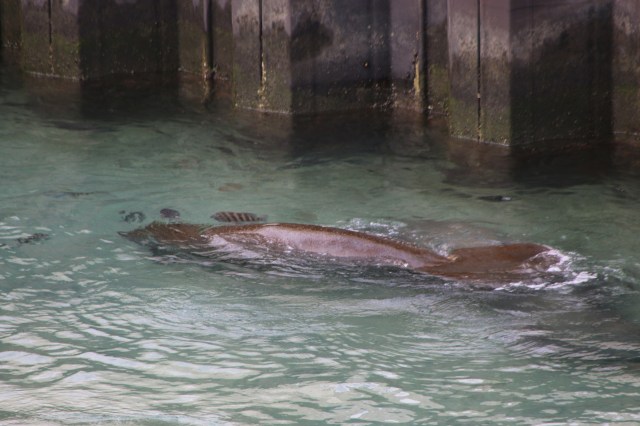
Manatee seen from the second floor viewing area of the new Manatee Lagoon. Photo by Ron Haines
Manatees, AKA sea cows, are those chubby mammals that hang out in the water, and the warmer the water the better. In the winter in Florida, as water temperatures fall, they seek warm places, such as the water discharge areas of power plants. They are classified as ‘endangered’ by federal wildlife officials, who recently announced plans to reclassify them to the less serious status of “threatened.”
The discharge canal at the FPL plant in Riviera Beach has been a popular spot for decades for both the manatees and their human viewers. It was a great place to take out-of-town visitors.
But public access to the ‘cooling canal’ (a three-sided concrete enclosure, with the fourth side open so they could come and go into the intercoastal waterway—Lake Worth Lagoon—as they pleased) was closed after 9/11 for security reasons. Our anti-terrorist measures sure were quaint back then, weren’t they?
All that will change February 6, when FPL opens Manatee Lagoon, a nice, two-story building with ample parking, complete with viewing platforms on both floors, meeting and events space, educational exhibits, a gift shop and a cafe.
And, of course, a Manatee Cam.
Goodby privacy, hello world!
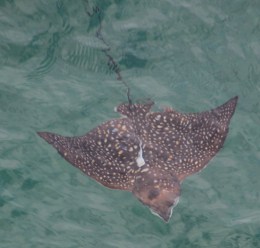
Rays hang out there too. Photo by Ron Haines
I was there last week for a meeting of the Lake Worth Lagoon Initiative Public Outreach Working Group (I attend to represent the Sierra Club when I am in town). Construction was still going on, as you can see in the photos.
The Visit Florida website lists ‘five great places’ to see manatees. The closest is nearly three hours away from West Palm Beach, so I’m happy to see this place finally finished and opening.
Short of stuffing the tourists into a canoe or kayak and going where one is only likely to see one, there is no place nearby one can count on for a good manatee viewing experience. And captive viewers are easy targets for educational attempts. They just troop along and read the exhibits. The Manatee Lagoon is set up is nice for this, as visitors are gently forced to wind their way through the exhibits to get to the viewing areas.
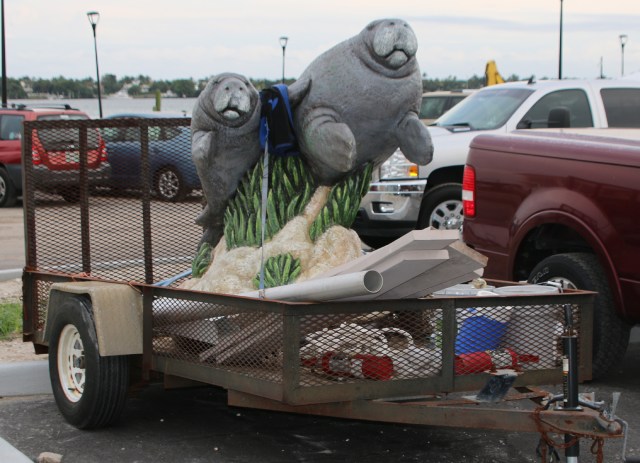
One of the displays sits out in the parking lot on a trailer waiting to be installed. Photo by Ron Haines
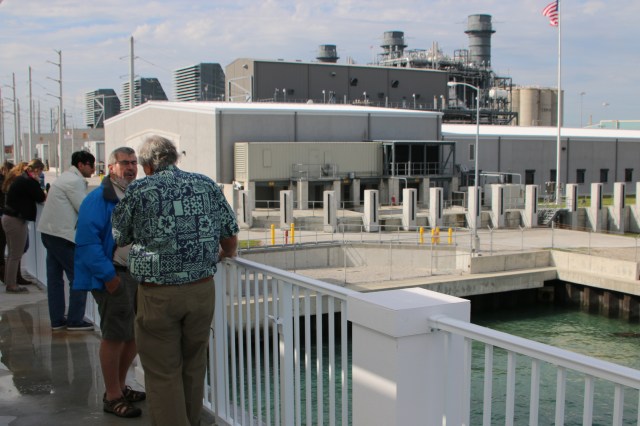
On the upper balcony looking over the cooling canal. Photo by Ron Haines

Architectural rendering of the Manatee Lagoon building from the east. To the left of the building is the parking lot and to the right of it is the cooling lagoon.
Below is the Cousteau quote that greets visitors and a few of the display panels.


Look, up in the tree!
I have iguanas at my house in Florida. They are not pets, they just live around me. I live by the water, they like to live by the water, I live in a warm climate, they like warm climates.
Central Palm Beach County is at the northern end of their range, and if we have a winter with a stretch of really cold weather the population dies off a bit (and the ‘Iguanas dropping from trees’ stories hit the internet).
But that hasn’t happened for four or five years, and the population is robust.
They’ve bounced back so well from the last cold weather, in fact, that I saw something today I haven’t seen in several years: an iguana way up in a neighbor’s tree. And it is not a small tree. It towers over the two-story house next to me.
Good thing the big adults are orange. If this one were green I’d never have seen it. Can you spot him?
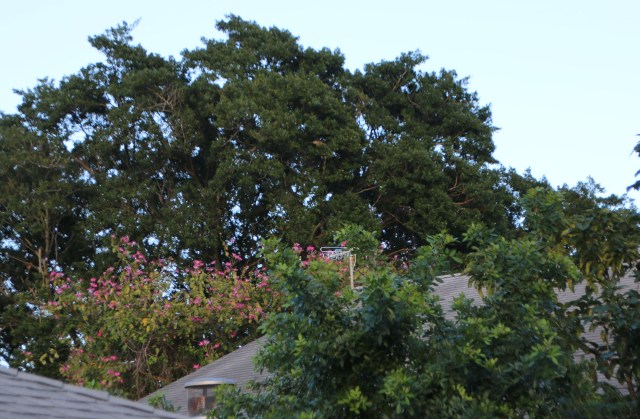
Here’s a closer look:
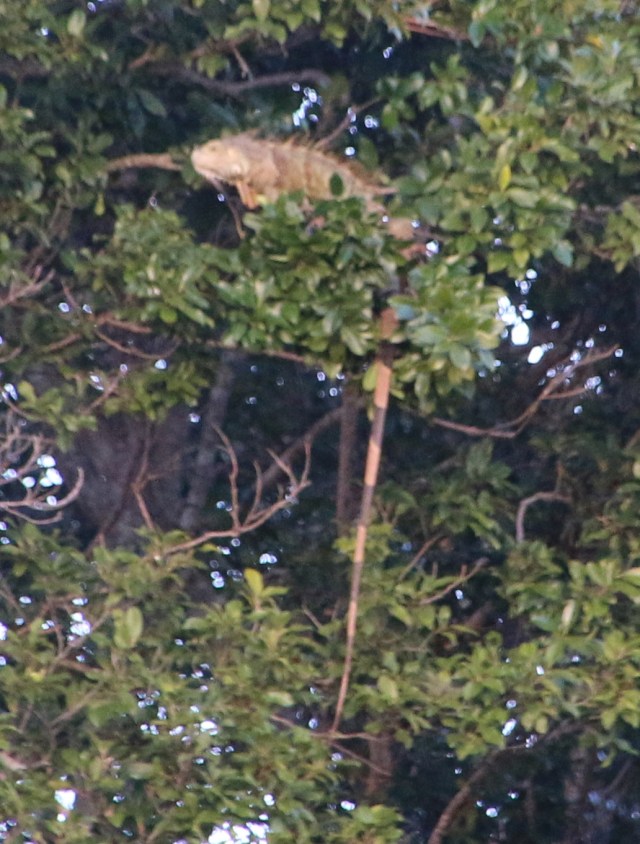
And here’s what one like this looks like up close and personal:

All Photos by Ron Haines


This is Chubs. He’s a foot-long, red-footed tortoise. He had a pretty lousy holiday season, but all has ended well for him.
On Christmas day he dug his way out of a pen in the yard of the family he’s been living with for the last four of his seven years. They live a block or so away from me, in a neighboring housing development.
They searched everywhere around the house and yard for their pet, who’s been in their lives nearly as long as their six-year-old daughter, who loves him dearly. They put up a few signs near the house too.
Busy with celebrating Christmas, I was not aware of any of this.
I met Chubs three days later, on Dec. 28, when he wandered across my driveway, THREE TIMES. The first two times, we put him over the fence into a neighboring patch of woods, thinking that’s where he came from.
After the second time, I posted his photo on Facebook, asking what kind he was, what he liked to eat, etc. A couple friends said he was a red-footed tortoise, not native and most likely someone’s pet. I did a google search for lost pets in the Lantana/Lake Worth area and didn’t find anything. I knew my immediate neighbors didn’t own a tortoise.
One of my friends, Grant, said he has a red-footed tortoise that he keeps in an old, very overgrown, dog run and he kindly offered a home for this one if he came back again.
Later that same afternoon he reappeared a third time, under my wife’s Toyota (hence the name we gave him: Yoda), which sits low to the ground, but not low enough fortunately to cause him harm when my son-in-law moved the car and heard a slight scraping sound.
Back to Facebook and a message to Grant: Heee’ssss Baaaack!
I dropped him off at Grant’s that evening with the understanding that if the owner surfaced I’d be back to get him.
Fast forward a week, to January 4. A woman and small girl come up the front walk in the afternoon. They didn’t knock and they left right away so I didn’t bother to get up, just figured they’d left a flyer or something.
When I checked the front door later I found that they had indeed left 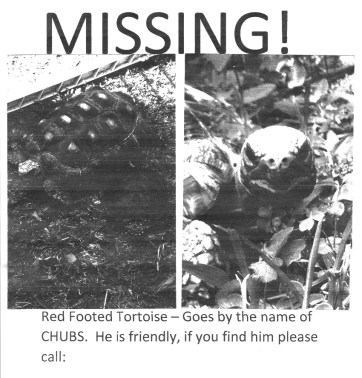 something: a Missing flyer for a red-footed tortoise named Chubs.
I left a message on the number on the flyer that I knew where Chubs was and also contacted Grant and told him the tortoise’s owner had surfaced and I wanted to pick him up. He said he’d be home after dark and hoped we could find Chubs in the thick weeds of the pen, which is about 12 by 12. Because it’s been getting cooler at night both tortoises have been hunkering down half-buried to stay warm, he explained.
So Grant and I poked around with flashlights for about a half hour that night and eventually found both tortoises, his and Chubs.
I had been updating the owner and letting him know it would take a while to find Chubs (and also about Grant’s hour or so delay getting home because a commuter train had hit a garbage truck earlier in the day.)
So it was nearly 9 pm when I drove up to Chubs’ owner’s house and the six-year-old and her parents greeted me in the driveway.
I’d been musing to myself semi-seriously whether Chubs would wag his tail when he got home, like a self-respecting dog pet would do.
Amazingly enough he did what is probably the turtle equivalent: Popped his head and feet out of his shell when the little girl grabbed him and hugged him.
That made my day. And so did this nice thank you note and hand colored plastic turtle medallion.


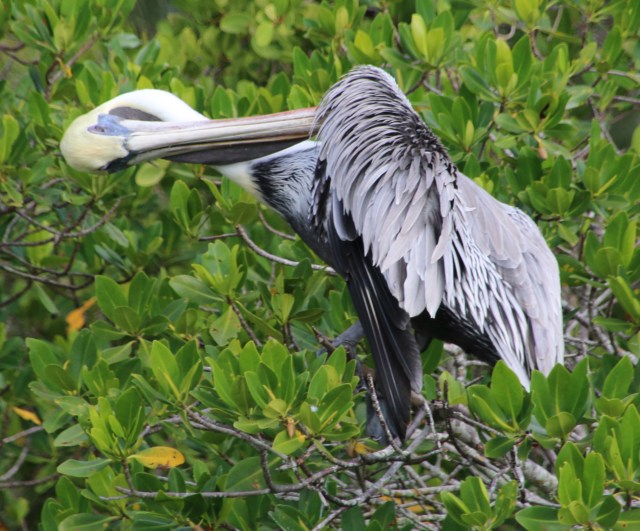
Pelican at Round Island Park, Vero Beach, FL (Photo by Ron Haines)
Had a nice paddle yesterday with a bunch of friends from a Meetup Group at Round Island Park up in Indian River County. A tough, unpredicted wind kicked up, but fortunately there are sheltered places in which to paddle. Saw a group of manatee also.
Meanwhile, I’m sensing an oncoming photo collection. See here and here.

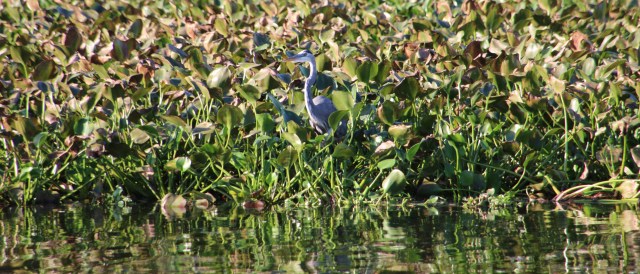
You’d think a big blue heron in a patch of green water plants would stick out like a sore thumb, but the pattern of light and shadow among the leaves nearly hides this guy. Taken on Lake Osborne. (Photo by Ron Haines)

I took my new-fangled, ultralight canoe for its maiden Florida saltwater ride this past week. An earlier paddle since coming south, in freshwater, was a couple weeks ago at nearby John Prince Park.
I have been wanting to take it to the intercoastal, where the bottom is sandy, visible and clean, so I could dump it over. I hadn’t wanted to do that in the colder waters of the northeast or with the alligators and mucky bottoms of Florida freshwaters.
(If you own a canoe or kayak, by the way, you should take it somewhere safe and dump it over on purpose. It’ll teach you just how far you can go before it’ll flip and even more important you’ll have some experience for the first time it happens accidentally.)
I’d been planning to do this since I bought it in June, but a good opportunity hadn’t come up. With the Florida summer weather still in force, even this far into winter, it seemed to be the time. So I rounded up a friend and we set off for a beachy area on the intercoastal off on the Southern Boulevard causeway. With temps in the 80s and the humidity probably higher than that, it felt very good to fall in the water.
What did I learn? This thing’s about as tippy as I figured it would be, way more sensitive than my Grumman. I figured as much, as it’s far lighter, more than a foot narrower, not nearly as tall and two feet shorter.
When swamped it floated, but just barely. Trying to ride inside it while swamped doesn’t work. It sinks. (The solid foam seat and back are what keeps the swamped boat afloat.)
Among other things that day, I also found out it’s pretty good in the waves. There was a decent wind from the southeast, with some whitecaps and waves of up to two feet. We headed south about two miles to Hunter’s Island. The boat handled the oncoming waves just fine. Coming back the wind and waves were coming from behind and I had to work to keep from getting pushed sideways. I did get pushed sideways a couple times and the feeling was a bit precarious. Wake from powerboats from both directions combined with the waves from the wind made for a pretty deep, messy chop happening at times, both coming and going. Stability in the boat seemed higher when it was moving than when standing still.
Below are some photos from the day, and a couple from the John Prince Park ride.
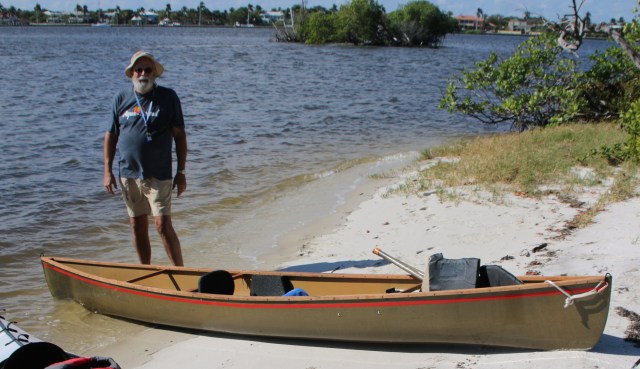
Here I am with my canoe. My paddling buddy is in the photo below with his Oru folding kayak.
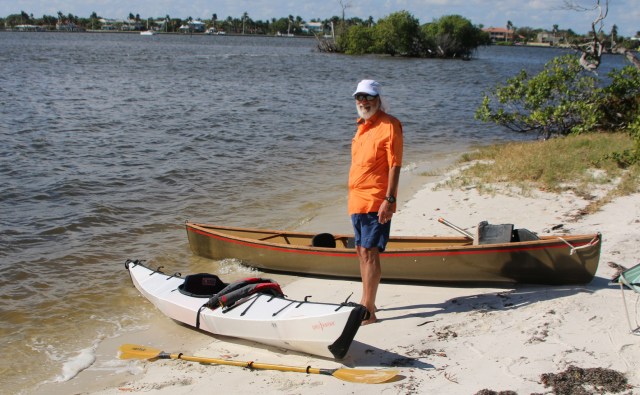

The area where we launched is a great spot to watch osprey hunting for dinner. (Photo by Ron Haines)
Below are some birds from the John Prince Park paddle; a little blue heron stretching his wings, a tri-colored heron fishing in shallow water, and an anhinga resting on a rock. (Photos by Ron Haines)


Yes, Mintonette. That was almost the name for what we now know as volleyball. And how do I know that? Because I drove past this sign.
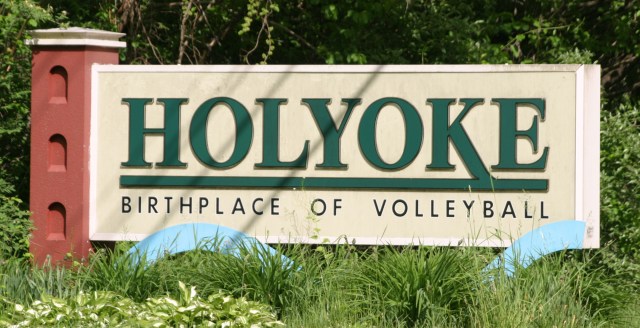
Holyoke, Massachusetts. (Photo by Ron Haines)
And then I took a stroll on the internet. Where I unearthed Hooverball too.
But I will start with Mintonette. It began just before the turn of the century (the one before the most recent one, for you youngsters) in that hotbed of indoor team sports inventionship, central Massachusetts.
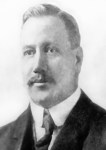
William G. Morgan
In 1895, William Morgan, a physical education director at the Holyoke YMCA was looking for a gentle alternative to basketball for older members of the YMCA. The rougher, more physically demanding basketball had been invented by a YMCA Training School professor, Dr. James Naismith, just four years before in nearby Springfield, and was increasing in popularity. Naismith had been looking for a vigorous indoor game to keep his students fit and busy during the winter.
Morgan borrowed from tennis, handball and badminton and it was in honor of the latter that he named his new sport: Mintonette.
However, that changed early on. At its first exhibition match in 1896, an observer noted the constant volleying nature of the game and it quickly became known as volleyball, through originally spelled as two words. The original name hung on though, and is still in use today with the Volleyball Hall of Fame’s Mintonette Medallion of Merit, awarded in recognition of significant individual achievement in the sport.
It spread, following its cousin basketball, through the YMCA system and became popular across the country.
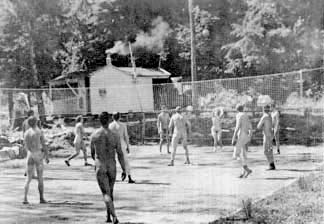
Has the term ‘nude volleyball’ ever crossed your lips? That took off as early as the late 1920s and by the 1960s a volleyball court was standard at nearly all naturist clubs.
In the 1924 Olympics in Paris volleyball was part of an American sports demonstration event and in 1964 it was officially included in the Summer Olympics.
On the heels of the traditional indoor sport came beach volleyball, played as early as 1915 on the sand in Hawaii and quickly picking up popularity in California. It stayed a six-on-a-side sport until the 1930s, when the two-on-a-side version began developing. In the 1980s that took off as a professional sport. And in this modern era I somehow can’t watch it without thinking of good old nude volleyball.
Not so popular these days is Hooverball, named after President Herbert Hoover, whose personal physician came up with it to help the Commander In Chief stay fit.
Teams of three men on a side take turns heaving a six-pound leather ball over an eight-foot net.
“This cannot be accomplished graciously.” says Sports Illustrated.
The game is a spin-off of an old military pastime where a circle of men tossed a heavy ball to one another and a man in the middle tried to intercept it.
Hooverball activities are sensibly and understandably centered in West Branch, Iowa, where the Hoover Presidential Library Association and the town co-host a national championship each year, usually won by a local team.
And there’s always Ultimate Hooverball, where the rule is that if there are more than four players on each team, there must be two medicine balls in play at all times.
Badminton anyone?

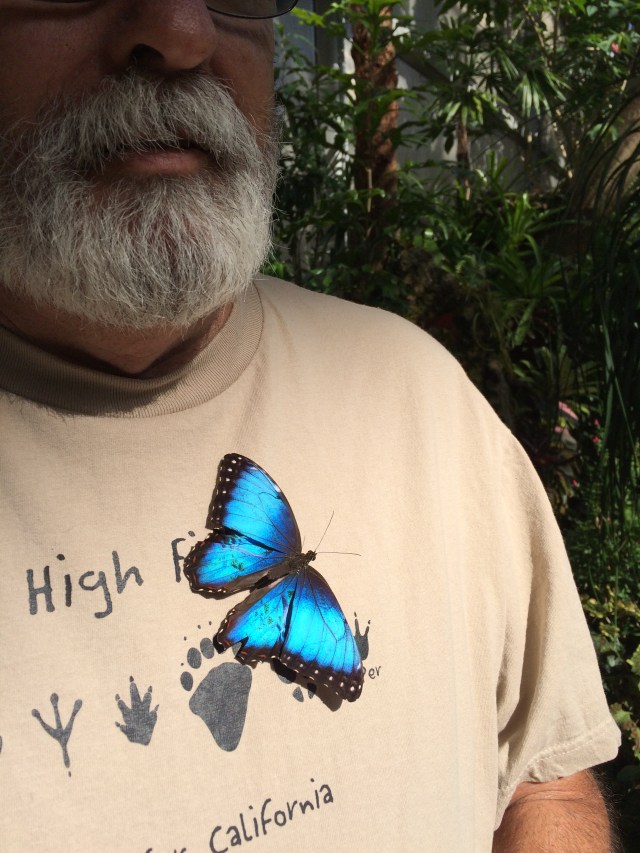
Blue morpho at Butterfly Rainforest, Gainesville, FL (Photo by Roger Haines)
This iridescent blue fellow latched onto me at the Butterfly Rainforest in Gainesville, FL, this week and stayed there long enough for brother Roger to whip out his phone and take a picture.
If you’re up that way, this is a very pleasant place to spend an hour or so on a weekday morning. Don’t go on a busy day, and be sure you saunter along slowly and even take advantage of the many benches scattered about. And pay as much attention to the foliage as you do the butterflies because it’s all pretty interesting. In fact there are two picture books available for browsing while you’re there; one for identifying the butterflies and one for figuring out what all the green stuff is.
But back to my hitchhiker. It’s a blue morpho, found in Central America as well as Mexico and South America including Brazil, Costa Rica and Venezuela, and, of course, a certain screened-in structure in Gainesville. It’s one of about 70 species found in the exhibit (including the dead ones pinned down in display cases, the museum has over nine million specimens).
Butterflies don’t breed in the exhibit because of some complicated rules about exotics, so the supply needs to be replenished constantly. The fellow on my shirt will live only about 115 days, for example. There is a lab-based breeding program dependent on imported chrysalises, and about 900 new adults are added weekly to the enclosure.
Fascinating fact: My friend isn’t really the color blue, he just looks that way. I’ll let Wikipedia explain it (and when you can describe it in plain English send me an email):
Meanwhile, I’m very happy I didn’t try to brush this fellow away, because, as I also read, “When threatened they release a strong smell from a gland that opens between their front legs.”
That would not have looked at all good on that nice T-Shirt I picked up in Big Sur a few months ago.

History, Travel, Sports, Art, and Nonsense
Improvise, Adapt, Overcome ... and never ever give up.
Traveling one day at a time
Mississippi River - Source to Sea - Solo … but never alone.
Horses & Other Interests
I love a person, it's people I can't stand
Hear it straight from a self published author: A new post every Saturday!
Family, Running, Paddling, Life
...and where it's taken me.
...and where it's taken me.
Fitness, Adventure and Art on the High Seas!
...and where it's taken me.
...and where it's taken me.
Notes, thoughts, excerpts
. . . at least from where I'm standing.
News for those who served with the Peace Corps in Eritrea and Ethiopia.
A little red pen goes a long way.
The latest news on WordPress.com and the WordPress community.
 The Urge to be Someplace Else