But Mr. Pope was long gone from this earth by the time Jim Bolen came up with the big ideas that have put Casey, Illinois, on the map.
Had they met I think they’d have gotten along really well.
Gene Pope turned a small, local New York publication into a massive supermarket tabloid called the National Enquirer. In its heyday it sold more than 6 million copies a week. He believed in doing things large.
In fact, he delighted every year in bringing to tiny Lantana, Florida, the World’s Largest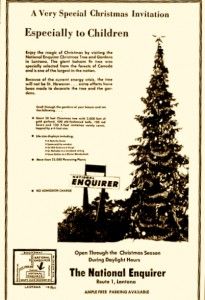 Decorated Christmas Tree (Guinness Book of World Records, 1979).
He started the tradition in 1971, the year the National Enquirer moved to Florida, and it continued until 1988. The final tree was lit two months after his death. It was a 126-foot Douglas fir with 15,200 colored lights, 1,200 colored balls, 250 red bows, 180 candy canes and snowflakes, and was topped with a 6-foot lighted silver star.
Here’s a good read about the tree: https://ronhaines.org/wp-content/uploads/2021/12/the-last-christmas-tree-ne.pdf
The tree, a huge model train set, hundreds of thousands of decorative lights and numerous animated displays around the grounds of the Enquirer office drew up to a million visitors every year.
About the time Mr. Pope’s life was coming to an end, Jim Bolin’s father, Ed, was establishing Bolin Enterprises Inc., in Casey (pronounced KAY-zee). The company today is a major pipeline and tank maintenance firm with projects across nearly half the US.
Jim, co-owner of his family’s firm, had for years watched business after business close down and his hometown wither. He decided to build something big, to attract visitors to the town and perhaps give it a boost. He decided on a huge wind chime, and modeled it after one hanging on his porch.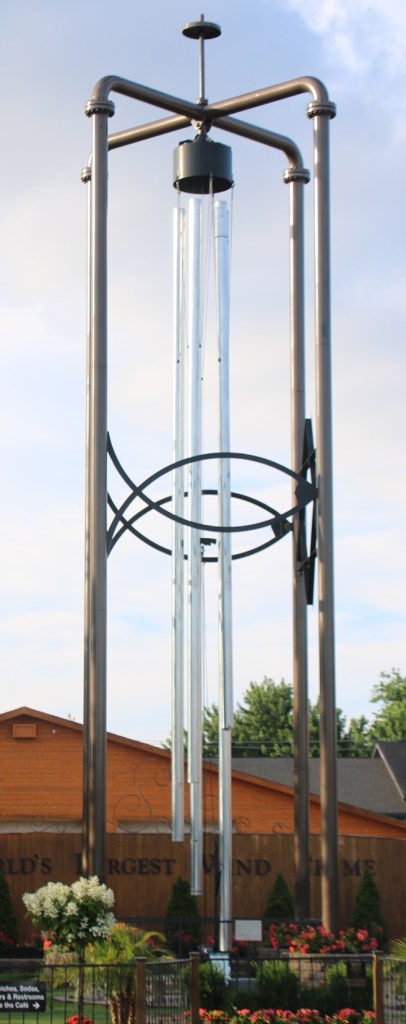
Aided by the engineering and fabrication resources of his company, Bolin’s dream of the world’s biggest wind chime became reality two years later, in 2011. It stands 55 feet high. The largest of its five 8-inch-wide chime pipes is 42 feet long. A flat, 75-pound disc-shaped granite hammer can be swung by visitors to produce the sound.
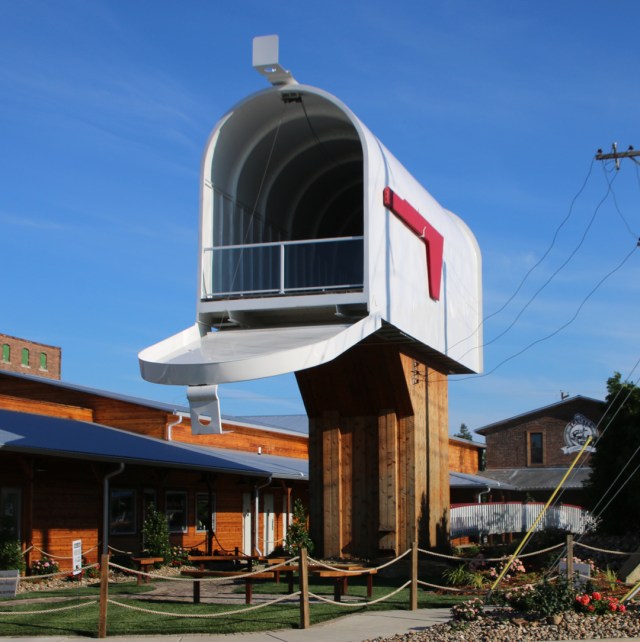
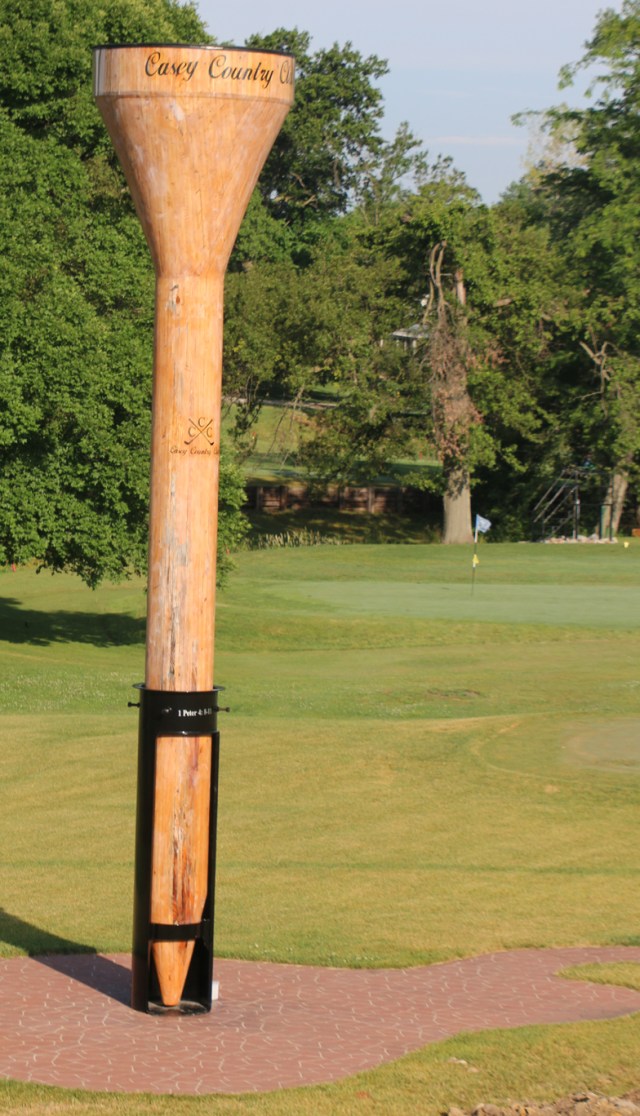
Other certified World’s Largest projects followed quickly: rocking chair, knitting needles and crochet hook, mailbox, wooden shoes, golf tee, and pitchfork, all displayed in and around Casey.
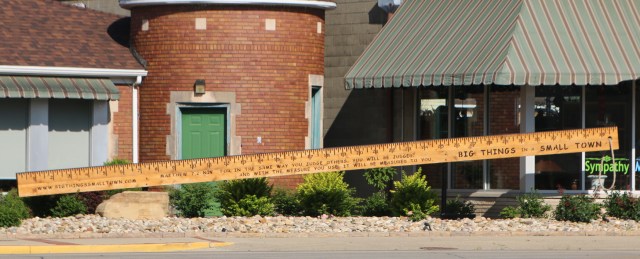
Also scattered around town are numerous other big things, including an ear of corn, a bird cage, a pencil, a yard stick, a wooden coin, and a balsa wood plane.
Casey calls itself The Small Town with a Big Heart. Small in a very nice way, as I found soon after I arrived. Driving in I had noticed a sign that said “Camping,” so I checked it out. (I have found that many small towns run their own campgrounds, sometimes free, but always at a decent price.)
The signs took me to Fairview Park and a nice, shady grassy area with water and electric hookups. I didn’t see an office so I went off sightseeing, figuring I’d see a policeman or someone eventually and find out how to book a campsite.
Right next to the wind chimes is a café called the Whitling Whimsy. It turns out the place is run by Jim Bolin’s wife and daughter and uses his grandmother’s last name, Whitling.
I stopped in for lunch and asked the waitress about arranging for a campsite. Immediately, a fellow at the neighboring table spoke up: “Just go pick a site and set up. Larry lives across the street and he’ll see you and come over to collect the fee.”
And that’s precisely what happened. That’s what small towns are all about. The campsite was $5.

One last note about the big things. Bolin thoroughly enjoys seeing his creations draw folks to his hometown. “The stuff is cool,” he says. “But the thing is really the people, the visitors in town. That’s what makes my heart happy about what is going on.”
His attitude reminds me of watching Mr. Pope beaming at the crowds who flocked to his annual Christmas display.
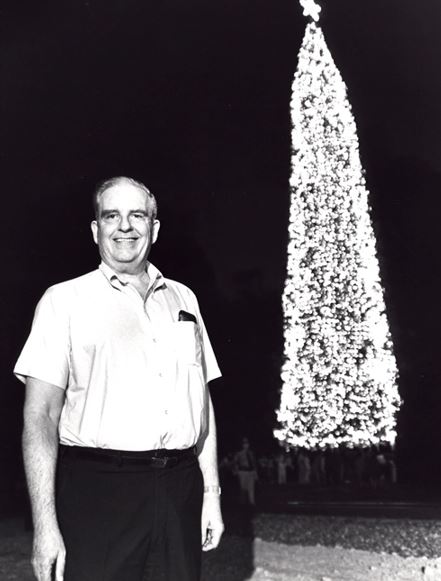
Generoso Pope Jr. and the National Enquirer Christmas Tree (Photo from Deeds of My Fathers, by Paul David Pope)





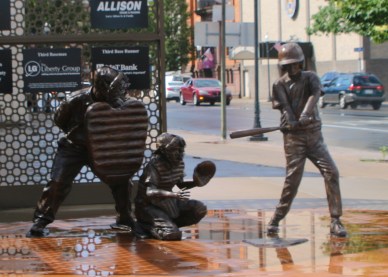 the sandlot baseball games played by his nephews and their friends. He wanted to eliminate the on-field bickering. So he and the boys started experimenting with various playing field dimensions, the mother of his nephews sewed the bases and Carl himself carved home plate and the pitcher’s mound.
 I will leave you with this one last bit about Williamsport. It once had more millionaires per capita than anywhere else in the world. This is why the sports teams at
 four on or near the campus of tiny
  No, I have not forgotten the Ralston-Purina checkerboard logo. Today that company is part of the Nestle conglomerate and the logo is used far less prominently than it was at its peak of popularity. But it was once ubiquitous. And remember the ‘Checkerboard Square’ address of the company back in the day? I do.

 happened by on a Monday morning. I called the phone number posted on the door and left a message.


















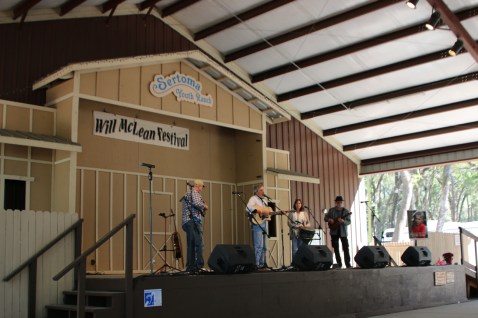
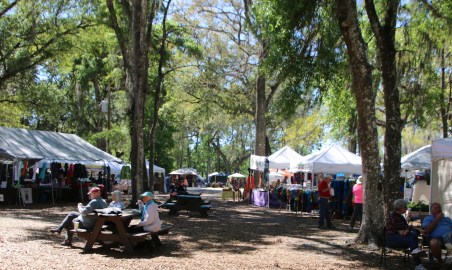 volunteer from another part of the state who I had last seen about 20 years ago.
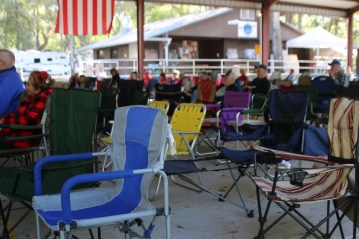 sizes and shapes, and a handful of standard metal folding chairs. There were several hundred chairs there, with maybe 20 people occupying them, early that Friday afternoon.


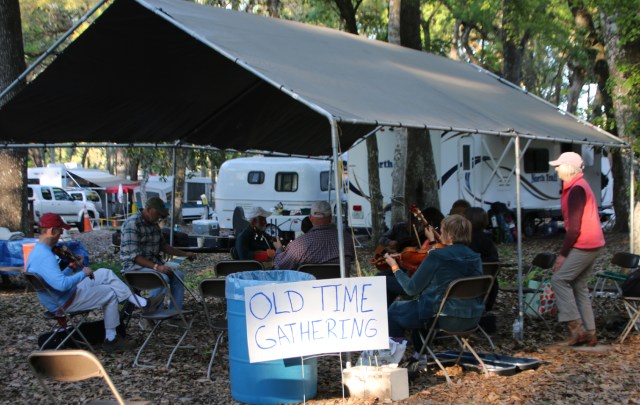





 The Urge to be Someplace Else