Thankful Arnold

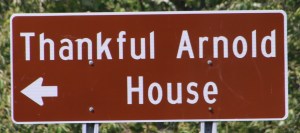
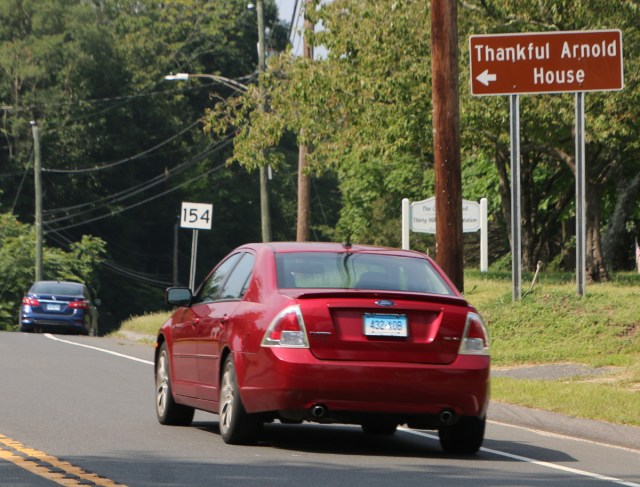
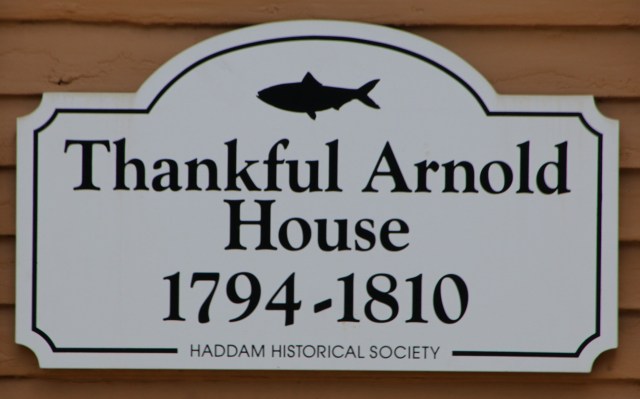
This sign along the road stopped me the other day as I drove through Haddam, CT.  I wasIMG_5709c on State Road 154, also known as the Middlesex Turnpike or Saybrook Road.

That’s what I like about Connecticut; if you don’t like the name of a thoroughfare, just consult another map and you’ll find a different moniker for it.

Anyway, “Thankful Arnold” was what made me slow down and make a U-turn back to Hayden Hill Road, the side street the arrow pointed to.

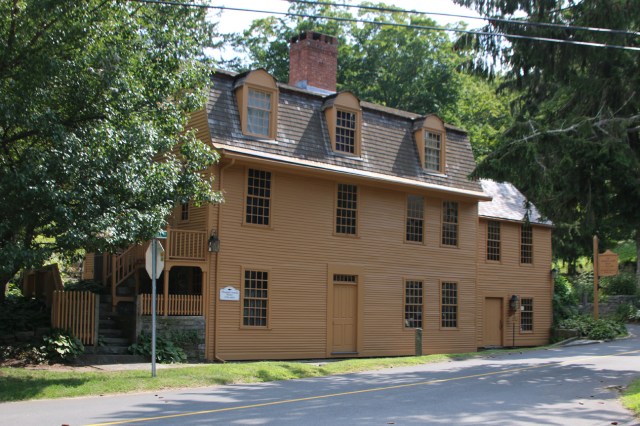
The house is a museum, but wasn’t open at the time.  As I continued the drive home I wondered about the story behind Thankful Arnold.

I figured the tale went something like this: A simple-minded itinerant named Arnold wandered into Haddam decades ago and decided to stay.  He survived on handouts and odd jobs, and eventually was given a room in the basement of this house to live in by its owner in exchange for doing a few chores.  Arnold earned his nickname Thankful because he bellowed out a huge THANKS in his incredibly deep voice whenever anybody helped him out or even just smiled at him.  Too frugal to spend much on himself, Arnold saved nearly everything he earned from his odd jobs.  He lived to a ripe old age and when he died townsfolk found a small fortune in cash stashed in his room and a note explaining how kindly the citizenry had treated him and saying he wanted the town to have his money.

Not even close!

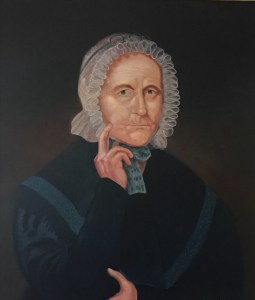
It all has to do with a woman named Thankful.  Yes, that was her name.  The colonialists, as it happens, liked to give their female offspring the names of the major virtues, or desireable character traits.  Have you ever met a Prudence?  I know a couple of them.

That’s another of the colonial names, along with Charity, Grace, and Constance, which

Thankful

Thankful Arnold

one encounters still today.  Others though, have pretty much faded:  Piety, Prosperity, Remember, Temperance, Prosperity, Deliverance, Mercy, and, tellingly, Truth.

Thankful, a descendant of John Alden and Priscilla Mullins of the Plymouth Colony, married a man named Joseph Arnold and became Thankful Arnold.  The couple were among the newest citizens of a new nation, having been born at the beginning of the War for Independence, Joseph in 1774 and Thankful in 1776.   Joseph was a direct descendant and namesake of one of the original founders of Haddam in the mid-1600s.

The Arnolds and their daughter moved into the house in 1798.  The dwelling remained in the Arnold family and occupied by descendents of Joseph and Thankful until 1962, when the last family occupant died and it was put up for sale.

Fortuitously, Haddam was just then turning 300 years old and the Haddam Historical Society had sought out descendants of the town’s early settlers as part of its fund-raising efforts for the celebration. Many ancestors responded generously, including Isaac Arnold of Houston, Texas, a great-great grandson of Thankful and Joseph.

Isaac Arnold purchased the house in March of 1963, promised funding for the restoration of the structure to its early nineteenth century appearance and said he wanted it to become the new home for the historical society, which became the owner when he died in 1973.

And, thankfully I suppose, that’s about all I have to say about my drive through Haddam.

IMG_5693cIMG_5715cIMG_5699c


Posted in Uncategorized | 4 Comments

Henry Hanger

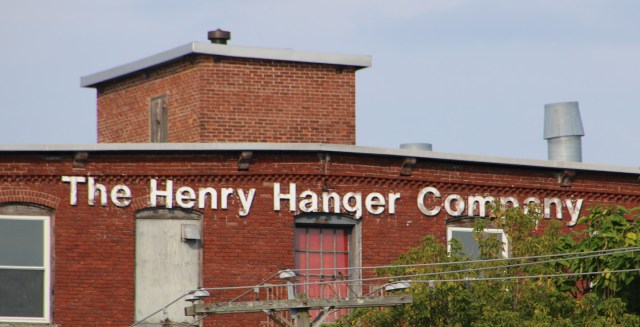
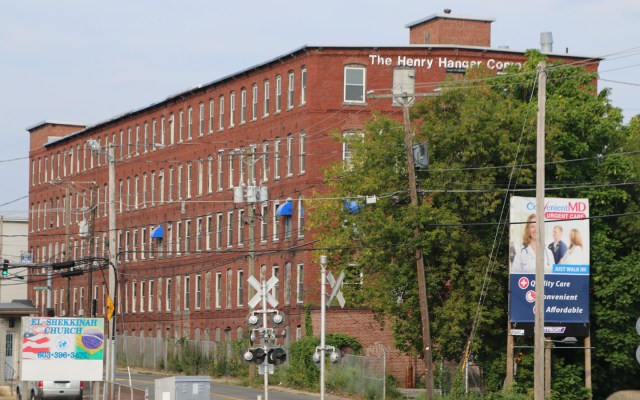
Well, his first name WAS Henry.  His last name, however,  wasn’t Hanger.  It was Spitz.  But in 1929 Henry Spitz had the alliterative good sense to name his Nashua New HampshireIMG_5567c enterprise the Henry Hanger Company.

And today it remains there, along gritty Hollis Street, headed up by his son, Bernard, who has crowned himself The Hanger King.  As the company website recounts, the senior Spitz had a simple premise; why hang personal or expensive garments on wire hangers that can cause wrinkling or damage clothing?   He also realized, when visiting retail stores, that the right hanger could actually make garments look better and even improve sales.

Bernard Spitz

The Hanger King

Today the company supplies clothiers large and small, hotels, resorts, and “A-List celebrities” with a wide assortment of hangers, with or without custom logos.

The line includes simple wire, wood, acrylic, padded, bamboo, and plastic hangers along with just about any hanger accessory one could think of.

Henry didn’t invent the hanger.  Some historians say President Thomas Jefferson came up with a forerunner of the wooden hanger.  Credit for today’s most-used hanger, the shoulder-shaped wire hanger, is spread among several people.  One account is that it was inspired by a coat hook that was invented in 1869 by O. A. North of New Britain, CT.  Another story says Albert J. Parkhouse arrived to work in 1903 at the Timberlake Wire and Novelty Company in Jackson, Michigan, to find that all the coat hooks were taken. Annoyed, he took a piece of wire, bent it into the shape we would recognize today, and hung up his coat.  Also credited is Christopher Cann, an engineering student at Boston University in 1876.  And in 1906 Meyer May, a men’s clothier in Grand Rapids, Michigan,  became the first retailer to display his wares on his wishbone-inspired hangers.

Some Henry Hanger Company products

For hangers in popular culture, who can forget the “No wire hangers, ever!” line from 1981’s Mommie Dearest,  when Faye Dunaway, portraying Joan Crawford, discovered her daughter using wire hangers for her expensive clothing instead of the fancy padded ones provided?  If you don’t remember the line I am sure the image of Ms. Dunaway’s cold-cream-slathered face as she screamed out the words is stuck in your brain.

As for me, I’m a pretty simple hanger soul.  For clothing I’ve moved from wire hangers to sturdy plastic over the years.

But for fixing something, nothing can replace the good old fashioned wire hanger.  I once had a badley rusted axel on my boat trailer.  I hit a small bump, and all of a sudden it bent an alarming 45 degrees about a foot inside the wheel.  Fortunately I was at the ramp so was able continue backing down to the water and get the boat off of it.  My neighbor and I used a steel bar and a half dozen or so wire coat hangers to splint and hold the axle straight enough to drive the trailer the four miles to the repair shop.

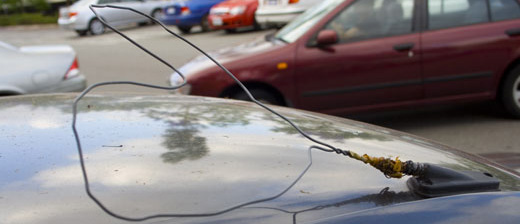
aerial1cAnd I suppose it’s a thing of the past, but I can never forget the wire hangers I have seen functioning quite well as car radio antennas.

For giggles someday, google How To Use A Coat Hanger To…    There’s a whole other universe out there.

IMG_5558c

IMG_5562c

The company also has facilities in two other states and abroad.

Posted in Uncategorized | 5 Comments

Did I just see what I think I saw?

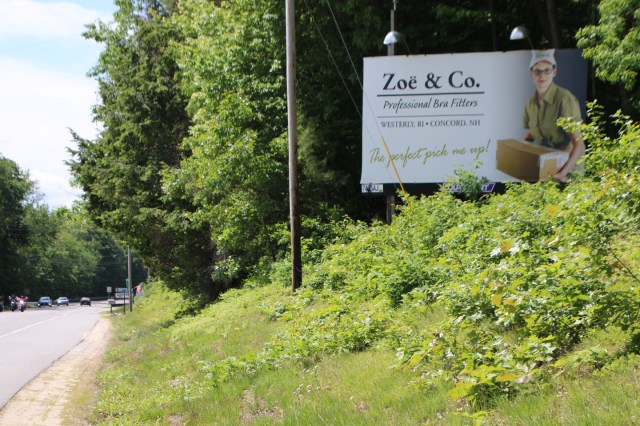
This billboard caught my eye as I flew past it on a busy two lane highway somewhere in New Hampshire.

IMG_3190c

For the next half mile my mind replayed the scene, trying to figure out what that sign was all about.  I’ve probably seen nearly every billboard there is in my travels, but this one wasn’t ringing any bells.  Maybe a UPS advertisement, with the brown shirt and package?   A plumbing company perhaps, thinking it said pipe fitters?  But that word “Bra” stuck in my mind…wow, if it’s what I am thinking it is I want a photo of it!

So of course I turned around to go back for another look.IMG_3187c

And there it was plain as day:  My first time seeing a billboard for a professional  bra fitter.

There’s a whole world out there of bra fitters, certified and otherwise; foundation professionals, and undergarment gurus.

It’s a world, quite frankly, that I want to know nothing more about than what I had to learn to get this far along in this post.  And I don’t even want to imagine the discussions that took place before they chose a model for this ad that looks like she hardly needs the product…or maybe they did so because she’s an odd size so would need custom fitting?  Don’t know, don’t want to know.

So this’ll have to be a do-it-yourself research project if you want to know anything more.  You can start with this article if you wish…and please consider making a donation to the Guardian.

Posted in Uncategorized | 2 Comments

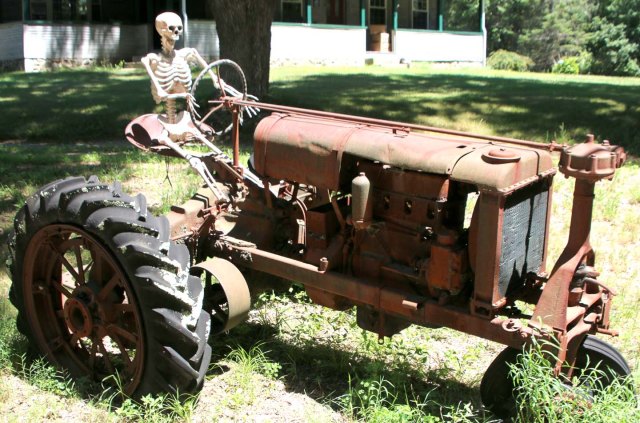
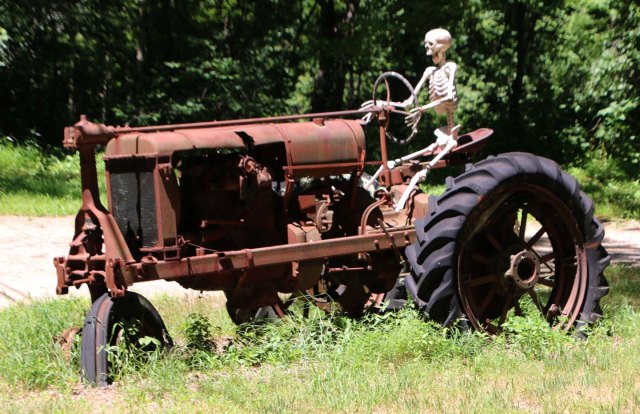
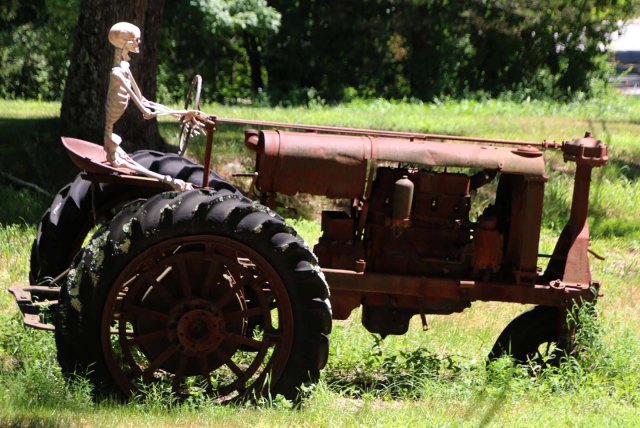
Farming’s tough on the equipment

Farming’s tough on the equipment.  Spotted on Farm Town Road in rural Coventry, Rhode Island.  (Photos by Ron Haines)

IMG_4635c

IMG_4624c

IMG_4634c


Posted in Uncategorized | 1 Comment

Nope, not my hill

Nope, not my hill.

IMG_3186c

If it were, I’d be king of it.

But what in the Sam Hill am I saying?   I wasn’t worth a hill of beans at that game back when I was a kid.  In fact I hated it.   That’s what hill’s all about, after all, that and growing old, and getting away from it all.

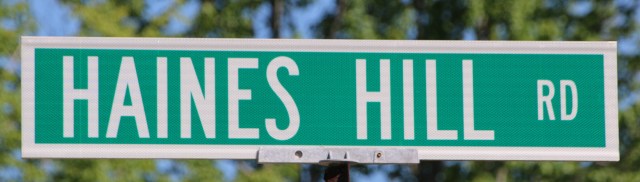
But let’s go briefly back to Haines Hill in Wolfeboro, New Hampshire.  According to local historians it was home to seven generations of Haines for about 200 years.

Unfortunately, none of them related to me, that I know of anyway.

There go the dreams of being king of the hill.

Remember that game?  Just find a spot, yes, it could be a hill, and dare anyone to knock you off of it.  That old school yard game has made it into the current video game world and also into the title of an animated TV show (never did understand the popularity of that one).  And the same meaning is found in warfare (‘taking the hill’) and dominant architecture (the castle on the hill, the house on the hill).

This is a political-free zone so we will not discuss The Hill in Washington.

“Over the hill” has some pretty negative connotations of course, especially when related to age, but it can also mean get out of jail.  And the simple  “it’s all downhill from here” can go either way too.  Things will either continue to get worse, or, on the bright side, things will be easier.  Take your pick.

Speaking of take your pick: the origin of Sam Hill, as in what the Sam Hill was that, using the phrase as a euphemism for Hell, has several possible beginnings:  H.L. Mencken suggested it came from the name of the devil in a German opera performed in 1825; another source says it came from the name of a store owner in Arizona with a diverse inventory;  New England Magazine speculated in 1889 that it came from a politician of that name in Connecticut; another report says it came from a Michigan surveyor  Samual W. Hill because of his legendary use of foul language,  and a final possible origin is attributed to a general by the name of Samuel Ewing Hill sent by the governor of Kentucky in 1887 to find out what was going on with the Hatfield and McCoy feuding.

Competing quoters:  “It is easier to go down a hill than up, but the view is from the top”—Arnold Bennet (English writer, died 1931) and “It’s easier to go down a hill than up it but the view is much better at the top”–Henry Ward Beecher (American clergyman who died in 1887).

And then there’s that depressing Nelson Mandella fellow:  “After climbing a great hill, one only finds that there are many more hills to climb.”

And I suppose you will find, as I did, that none of this is worth a hill of beans  (Beans aren’t worth much.  A hill of them is just the way they used to be planted, several seeds in a small mound of earth.)

Posted in Uncategorized | 1 Comment

Contoocook for the Fourth

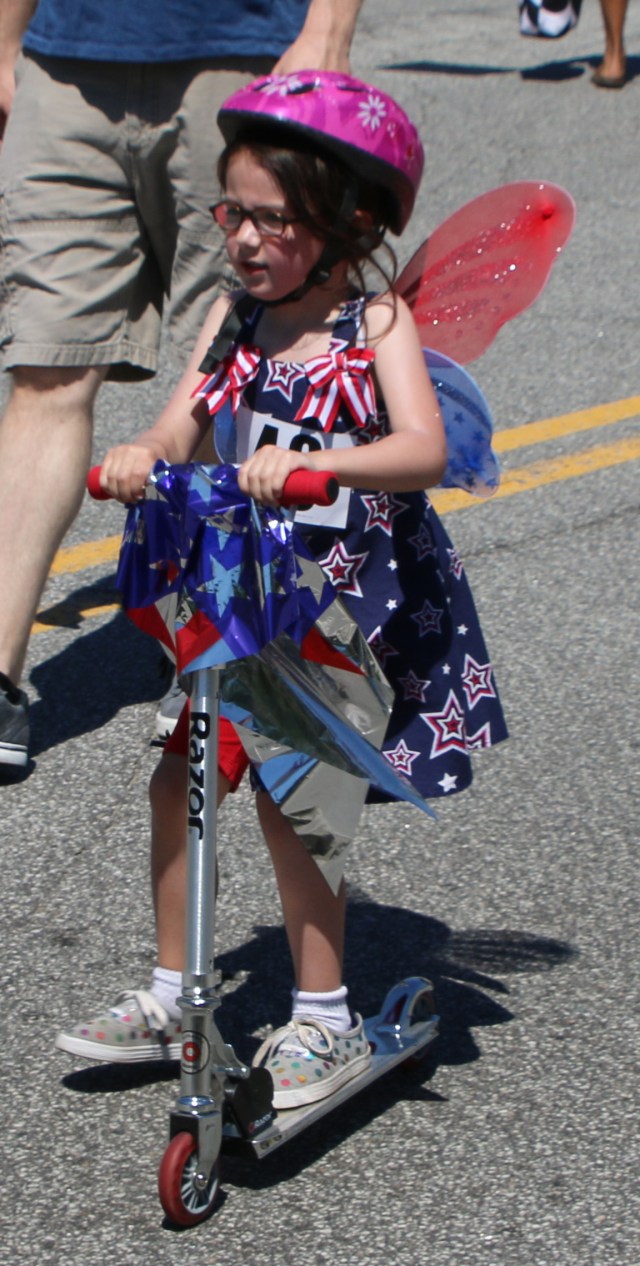
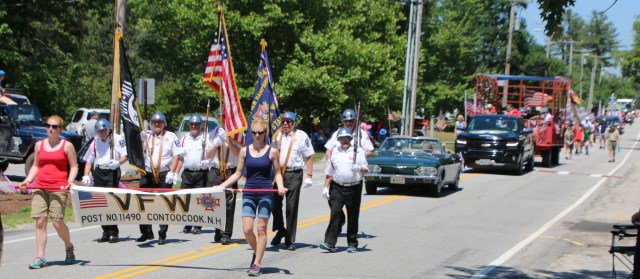
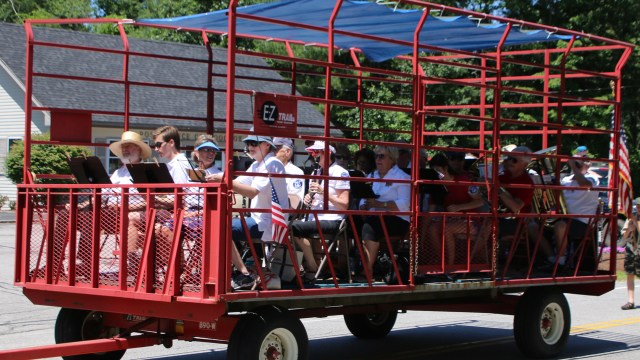
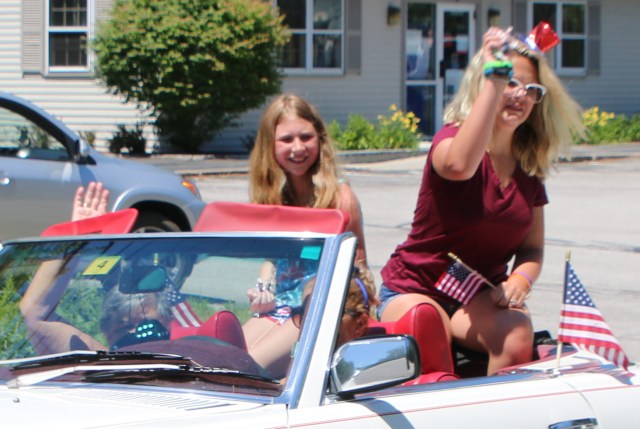
The 4th of July wouldn’t be complete without the parade in Contoocook, NH, home of brother Rick and his wife Ginni.

We all made it there this year and the kids’ parade was as always a big hit. Both M and S brought home a nice stash of candy, tossed out by the handful from parade vehicles as they passed by us.

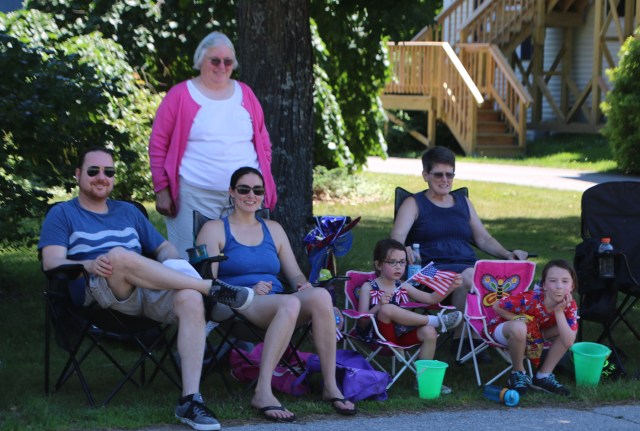
We’re in the middle of a hot spell, so a nice patch of shade along the parade route made a nice viewing stand for us.  Within walking distance of the house too.

Photos from today are below.  Go here and here for photos from other years.  About the only thing that’s changed is the grandchildren are bigger.

IMG_3752c

IMG_3747cIMG_3757cIMG_3756cIMG_3776cIMG_3781cIMG_3788cIMG_3762c

Posted in Uncategorized | 4 Comments

Things don’t change much…

Five years ago I was meandering around Maine in January and stepped back in time.

It was damn cold, as Maine in January can be. I had wound my way up from Florida, hugging the Atlantic coastline. The occasion was my second granddaughter’s upcoming birth in Connecticut and I was to be on hand to look after the first granddaughter, Margeaux, because her parents would be understandably distracted.

I had made it all the way up to Bar Harbor (which is a fine place without all its summer visitors) and had turned inland to make a big circle to the north and west and head back to brother Rick’s house in New Hampshire on my way down to Hartford for the birth.

My route north from Bar Harbor took me up to the area in Maine where one runs out of major roads so I turned west at Dover-Foxcroft and followed a nice highway parallel to the Piscataquis River.

I needed gas when I got to Guilford and I was not looking forward to it. The car’s thermometer showed minus 3. Self-service gas is not fun in the winter.

This was my first cold-weather road trip since I was about 30 and I had quickly learned that a heavy winter coat was too bulky for lengthy driving. So I used just a hooded sweatshirt. I had a long scarf and stocking cap ready for when I had to get out.

When I pulled up to the pumps at the Shell Station at the intersection of Water Street and Blaine Avenue in Guilford, I zipped up the sweatshirt and started wrapping the scarf around my neck, getting prepared to face the cold.

Just then a middle-aged man appeared next to my car and looked at me expectantly.

I rolled the window down a bit.

“Fill ‘er up?” he asked.

“Sure,” I replied, fully expecting the Candid Camera folks to appear any minute.

I offered him my credit card, figuring he’d need it to get the pump going, like they do inuntitled copy New Jersey, the only other place I’d experienced full-service in decades. Then I noticed that there were no credit card slots on these pumps.

“Later,” he said, and proceeded to fill up the tank. He came back to my window and I handed over the card.  I half expected him to disappear with it down some dark alley, never to be seen again.

Nope.

BN-EI168_KNUCKL_G_20140829165653He headed to the office. Soon he came back with a plastic clipboard and a pen. The clipboard had a slot that held my credit card and clipped to the board was one of those multi-page, carbon paper things from the good old days. The kind you put into a machine on top of the card and pulled a roller over to imprint the card info on the forms.

I signed it. He handed me my card and one of the copies.

As I drove away the Twilight Zone thoughts began. Tiny Guilford is, after all, an important setting for prolific science fiction writer Harry Turtledove’s Supervolcano Trilogy.

Had I driven into another dimension to get the tank filled up? I looked into the rear view mirror. Yes, the station was still there. If I come back tomorrow will I have the same experience?

I never did go back there on that trip. I was a hundred miles away from the place by evening and needed to keep heading toward Connecticut so I’d be there in time for the baby’s arrival. (As it turned out it was good that I kept moving. I stopped in Guilford on January 23 and granddaughter Simone made her appearance just two days later.)

But I did go back to Guilford last weekend, after a meeting in St. George with my colleagues on the Sierra Club Awards Committee.

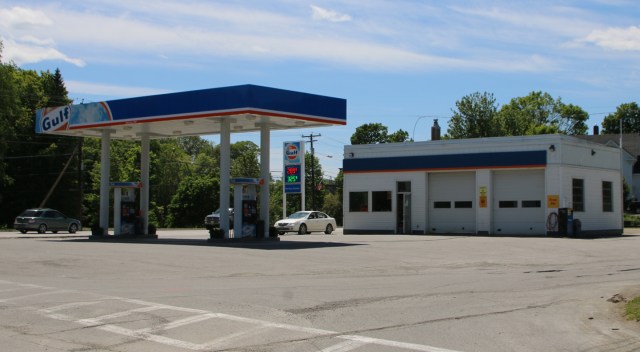
And I found that gas station.  It’s now a Gulf station.

When I pulled up to the pump a young man came out of the office.

“Fill ‘er up, please,” I asked, and he did so. When he was done, I handed him my card and off he went to the office.  Wow, I thought, things are still the same.

But I was wrong. When the young man came back with my credit card he had one of those modern, cash-register-like receipts on the clipboard for me to sign, not one of the old fashioned carbon paper ones.

Now that’s progress!

Shell Station in 2013:Guilford, Maine

Gulf Station in 2018:IMG_3155c

Posted in Uncategorized | 5 Comments

Saved by the moat

As a castle, it’s not all that much.

Hardly big for one thing, a mere 1,962 square feet, with two bedrooms and two and a half baths. IMG_2926c

Up on a remote hill, with a commanding view of surrounding forests?  Nope.  Just plunked down on a cleared, two-acre lot at a busy intersection within a stone’s throw of more conventional suburban ‘castles’ in Milton, Georgia, 30-some miles from downtown Atlanta.

But the moat!  That saves it.  The waterway connects to the swimming pool in the back yard and provides an excuse for a couple of nifty drawbridges connecting to garages.  Add a pool house that’s a small replica of the main castle and what’s not to like about that setup?

The granite and white marble castle was built in 1950 by Rudy and Ruth McLaughlin. Local lore has it that Rudy was a long-haul truck driver who told his wife he would build her a castle—and did!

Current information about Rudy and Ruth is sparse indeed, but I figure that if they’re still around they’re well into their 80s today.  The Ruth Elizabeth McLaughlin Revocable Trust owns the place, according to Fulton County, which appraises the structure and land at some $440,000.

Some accounts state that it’s not as small as it looks and that there’s lots of subterranean living space, but according to the county records the place doesn’t have a basement.

It’s always been a private residence and never opened for tours, but that doesn’t stop folks from stopping by and taking photos.  The sight of it along busy Arnold Mill Road sure slowed me down for a bit.

Here are a few more photos I took of it, and some aerial views, from Google and Bing:

castle 6google earth 3google earthIMG_2297cIMG_2922cIMG_2931cIMG_2933c

Posted in Uncategorized | 4 Comments

Generoso Pope would have loved this place

But Mr. Pope was long gone from this earth by the time Jim Bolen came up with the big ideas that have put Casey, Illinois, on the map.

Had they met I think they’d have gotten along really well.

Gene Pope turned a small, local New York publication into a massive supermarket tabloid called the National Enquirer.  In its heyday it sold more than 6 million copies a week.  He believed in doing things large.

In fact, he delighted every year in bringing to tiny Lantana, Florida, the World’s Largest5bcd3565ed16a075380cb3e810d39cc3 Decorated Christmas Tree (Guinness Book of World Records, 1979).

He started the tradition in 1971, the year the National Enquirer moved to Florida, and it continued until 1988.  The final tree was lit two months after his death. It was a 126-foot Douglas fir with 15,200 colored lights, 1,200 colored balls, 250 red bows, 180 candy canes and snowflakes, and was topped with a 6-foot lighted silver star.

Here’s a good read about the tree: https://ronhaines.org/wp-content/uploads/2021/12/the-last-christmas-tree-ne.pdf

The tree, a huge model train set, hundreds of thousands of decorative lights and numerous animated displays around the grounds of the Enquirer office drew up to a million visitors every year.

About the time Mr. Pope’s life was coming to an end, Jim Bolin’s father, Ed, was establishing Bolin Enterprises Inc., in Casey (pronounced KAY-zee).  The company today is a major pipeline and tank maintenance firm with projects across nearly half the US.

Jim, co-owner of his family’s firm, had for years watched business after business close down and his hometown wither.  He decided to build something big, to attract visitors to the town and perhaps give it a boost. He decided on a huge wind chime, and modeled it after one hanging on his porch.IMG_4465c

Aided by the engineering and fabrication resources of his company, Bolin’s dream of the world’s biggest wind chime became reality two years later, in 2011.  It stands 55 feet high. The largest of its five 8-inch-wide chime pipes is 42 feet long.  A flat, 75-pound disc-shaped granite hammer can be swung by visitors to produce the sound.

Other certified World’s Largest projects followed quickly: rocking chair, knitting needles and crochet hook, mailbox, wooden shoes, golf tee, and pitchfork, all displayed in and around Casey.

Also scattered around town are numerous other big things, including an ear of corn, a bird cage, a pencil, a yard stick, a wooden coin, and a balsa wood plane.

Casey calls itself The Small Town with a Big Heart.  Small in a very nice way, as I found soon after I arrived.  Driving in I had noticed a sign that said “Camping,” so I checked it out. (I have found that many small towns run their own campgrounds, sometimes free, but always at a decent price.)

The signs took me to Fairview Park and a nice, shady grassy area with water and electric hookups.  I didn’t see an office so I went off sightseeing, figuring I’d see a policeman or someone eventually and find out how to book a campsite.

Right next to the wind chimes is a café called the Whitling Whimsy.  It turns out the place is run by Jim Bolin’s wife and daughter and uses his grandmother’s last name, Whitling.

I stopped in for lunch and asked the waitress about arranging for a campsite. Immediately, a fellow at the neighboring table spoke up:  “Just go pick a site and set up.  Larry lives across the street and he’ll see you and come over to collect the fee.”

And that’s precisely what happened.  That’s what small towns are all about. The campsite was $5.

IMG_4439c

One last note about the big things.  Bolin thoroughly enjoys seeing his creations draw folks to his hometown. “The stuff is cool,” he says. “But the thing is really the people, the visitors in town. That’s what makes my heart happy about what is going on.”

His attitude reminds me of watching Mr. Pope beaming at the crowds who flocked to his annual Christmas display.

Pope, from Paul book

Generoso Pope Jr. and the National Enquirer Christmas Tree (Photo from Deeds of My Fathers, by Paul David Pope)

IMG_4414c

IMG_4429c

IMG_4482cIMG_4473cIMG_4436cIMG_4434c

Posted in Uncategorized | 1 Comment

Little League Baseball and Grit

On a drive through Williamsport, Pennyslvania, I happened upon this statuary.

IMG_3699c

What’s that for?  It took a few seconds for the synapses to work and then the light came on.  Duh!  Williamsport is the home of Little League Baseball.  That connection’s been buried in my brain for decades and I hadn’t exercised it in a very long time.

Williamsport (town motto, “The will is in us”)  was founded around 1800 and has a population just under 30,000, down from a peak of 45,000 in 1950 .

In 1939, native son Carl Stotz was looking for a way to inject some adult supervision into IMG_3700cthe sandlot baseball games played by his nephews and their friends.  He wanted to eliminate the on-field bickering.   So he and the boys started experimenting with various playing field dimensions, the mother of his nephews sewed the bases and Carl himself carved home plate and the pitcher’s mound.

He also attracted sponsors and other parents and soon had three teams set up, the Lycoming Dairy, Lundy Lumber, and Jumbo Pretzel.  The first League game took place on June 6, 1939, with the Lumber defeating the Dairy  23-8.

Today, Little League is huge. Its umpteen divisions in various age groups for girls and boys, encompassing baseball, softball, and even T-ball, include nearly 2.6 million players divided geographically into eight regions in the U.S. alone and another eight covering over 80 countries around the world.

The main stadium for Little League Baseball’s World Series is named after Howard J. Lamade, which leads me nicely into the other interesting thing I found about Williamsport.

It’s the birthplace of Grit, which was a national weekly newspaper popular in rural areas for more than 100 years.  It carried the claim, “America’s Greatest Family Newspaper.”

It was founded in 1882 as the Saturday edition of the Williamsport Daily Sun and Banner, and its typesetter was a young German immigrant by the name of Dietrick Lamade.  He left that job in 1884 to work for the newly launched Times newspaper, but that venture soon failed.  At age 25 with two children and no job he teamed up with a couple of partners, bought the Times’ equipment and the Grit name and became a publisher.

Grit1892

With rapid expansion, a wagon of Remington typewriters was delivered to the Grit offices in 1892 (Wikimedia Commons)


By 1887 he had a weekly circulation of 20,000.  He targeted small towns and rural families with a thick package of general news, features, comic strips and serials.  By 1900 circulation was at 100,000 a week.


His editorial policy was clear: “Always keep Grit from being pessimistic. Avoid printing those things which distort the minds of readers or make them feel at odds with the world. Avoid showing the wrong side of things, or making people feel discontented. Do nothing that will encourage fear, worry, or temptation… Wherever possible, suggest peace and good will toward men. Give our readers courage and strength for their daily tasks. Put happy thoughts, cheer, and contentment into their hearts.”  (Huh?  Not too dissimilar from the philosophy of a certain tabloid titan I began work for in the late 1970s)

Sales were propelled by direct mail delivery and a national newsboy sales force (Those ads in the comic books about how you could make extra money delivering Grit were still running well into my childhood).  By 1932, it had a circulation of 425,000 in 48 states, and 83% of its circulation was in towns of fewer than 10,000 population.

At its peak in 1969, Grit sold 1.5 million copies a week.  It stayed in the family until 1981 and, after changing hands several times, it survives today as a small circulation bi-monthly magazine, part of the stable at Ogden Publications in Topeka, which also publishes American Life & Traditions, Farm Collector, Mother Earth News and Utne Reader.

Founder Dietrick Lamade died in 1938.  It was one of his sons, Howard J., who as a vice-president was the Grit tie to Little League Baseball, serving the fledgling organization as an executive.  The main stadium used for the league’s world series was built on land donated by the Lamade family, and it is named after Howard J.

MillionairesI will leave you with this one last bit about Williamsport.   It once had more millionaires per capita than anywhere else in the world.    This is why the sports teams at Williamsport Area High School are known as the “Millionaires.”

Posted in Uncategorized | 3 Comments