Smallest?

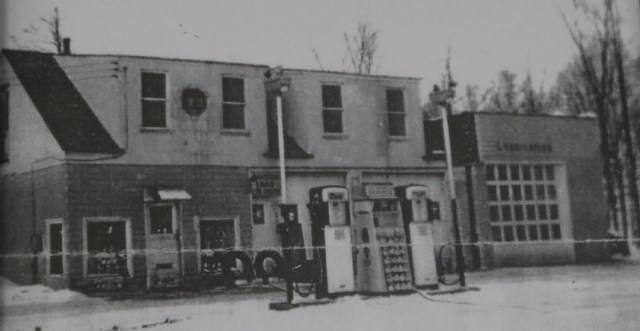
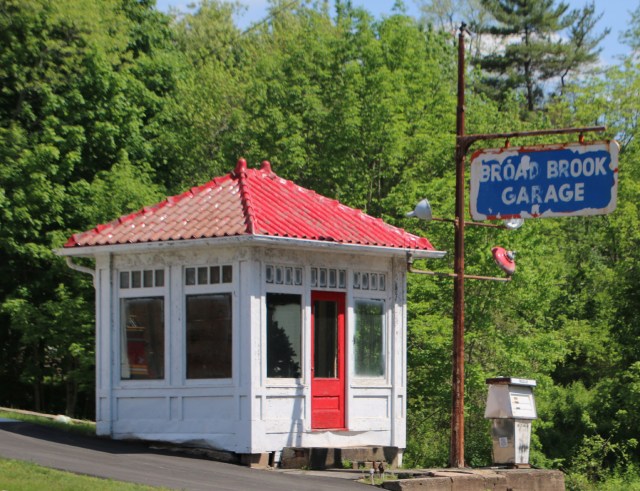
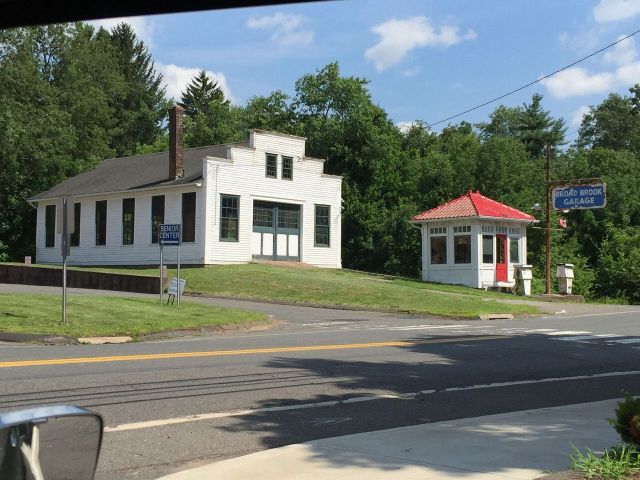
This might be the smallest old gas station I’ve come across.  It’s in Broad Brook, a tiny community in north central Connecticut.  To see my whole collection of old gas stations in the U.S., go here.

IMG_3566c

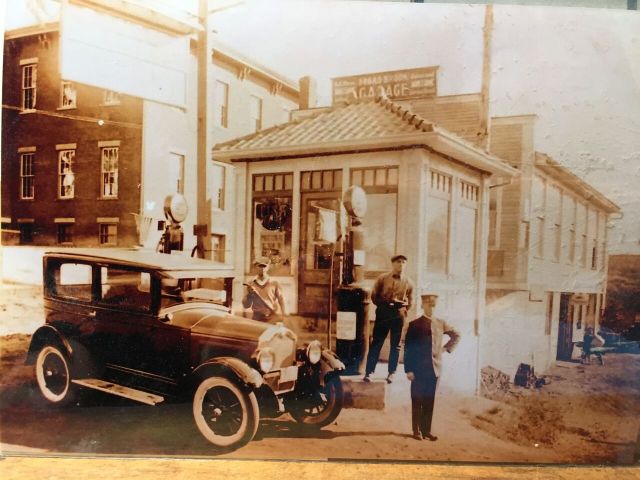
PS:   I got a comment from reader Chris in January 2019 explaining what this building is all about (see below).  He sent along a couple photos too, one from the really early days and another more recent one.  I had seen the larger building when I took this photo but didn’t realize that it was part of the original set up.  A large repair building and a smaller building for the pump attendant.  The photos he sent did not display properly in the comments section, so I am putting them below:hsgt4gfe.jpegemflmrei.jpeg


Posted in Gas stations | 4 Comments

What’s a Willfest?

It’s pretty hard to write this without embarrassing myself, but here goes:

I’ve lived in Florida since 1976.  I’m not a native, of course, but it’s been long enough that I should know a fair bit about the state.

I thought I did.

But I had never heard of Will McLean.

Maybe it’s because I’ve lived down on the southeast coast, where things are more urban and filled with people from somewhere else than the rest of the state. One is way less likely to rub shoulders with native Floridians down here than up in the central and northern areas.

Will McLean and his legacy are way more popular in the ‘real’ Florida parts of the state than the ‘full of transplants’ portions, where he is likely an unknown.

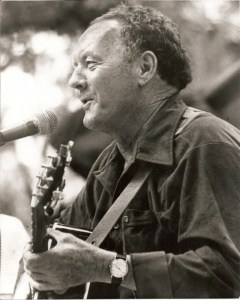
Turns out that  McLean (1919-1990) was an influential Florida folk singer-songwriter.  He was prolific, credited with authoring more than 3,700 songs and stories, and he was inducted into the Florida Artists Hall of Fame in 1996.

Called the “Father of Florida Folk” and  the “Black Hat Troubadour,” McLean chronicled

Will-McLean-performing-624x781

Photo of Will McLean from festival website

the folk stories of Florida and lived the folk life as well.

“We know about Cebe Tate and his week in the swamp. We know about Acre-Foot Johnson and his mail. We know about the hog-hunting burro of Wewahitchka, geese on the wing and the terrifying wild hog of Gulf Hammock.

“We know the fear as hurricane winds whipped Lake Okeechobee in 1928 to kill thousands in graves of mud. We know this thanks to Will McLean,” one newspaper reported.

“McLean was a troubadour in the traditional sense: a musician/storyteller traveling town to town with evenings of song and stories in exchange for food and shelter. Sometimes, friends said, he would wear out his welcome. So when he couldn’t find a couch, he’d camp; Gore’s Landing along the Ocklawaha River south of Fort McCoy was a favorite place to park his VW mini-bus and stay a week or two.

“‘As long as he had a hook for fishing, a bag of potatoes, he was happy,’ one friend said.”

Born in Chipley, he spent his life finding slivers of Florida lore and preserving them in song and story, voicing them in his resonant, barrel-deep baritone.

“My grandfather must have told me 10,000 stories about Florida, all of them true,” McLean said in 1985.

McLean photos, records, songbooks, harmonicas and videos of his performances at the annual Florida Folk Festival are archived at the College of Central Florida in Ocala.

“He’s one of the informal historians who’s preserved much of Florida heritage,” said Dr. Ron Cooper, a professor of humanities there.

So how did yours truly finally find out about him, you might be wondering.  Like most of the things I discover, I was driving along a rural road.  It was this past March, on my way home after some paddling with a few New York acquaintances over on the west coast of Florida.

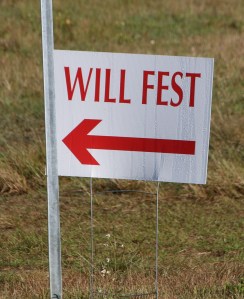
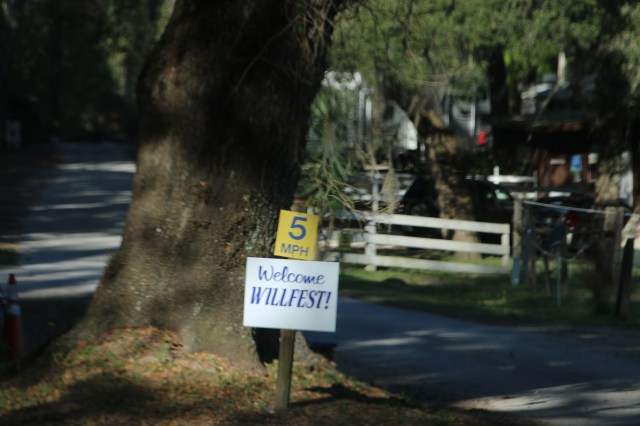
I saw this unassuming sign along the road.  What’s a Willfest?IMG_2556c  From the quality of the sign I guessed it might be an upscale garage sale.

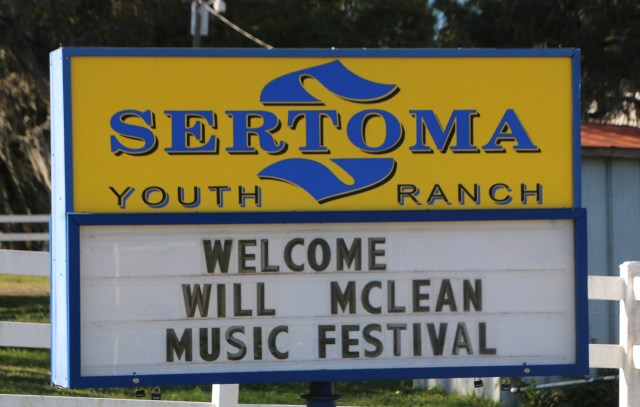
So I followed the arrows.  I ended up at the  Sertoma Youth Ranch in rural Brooksville, the site of the annual Will McLean Music Festival, a three-day affair for young folk singers and songwriters and other folks who want to enjoy a fun weekend camping out and listening to great folk music.  It features music workshops, jam sessions, craft and food vendors, continuous live performances on four different stages, and a Best New Florida Song contest.  Sponsored by the Will McLean Foundation, it draws about 3,000 devotees.

I didn’t know all that as I drove down a narrow dirt road that Saturday afternoon and pulled up to a gentleman standing outside a small building that looked like a cross between a guard shack, ticket booth and concession stand.

I was ready with the stupidest question he’d probably heard all weekend:

“What’s a Willfest?” I asked.

It’s about Will McLean the musician, he said through a big grin.

The festival’s facebook page says the 2018 event will be March 9-11.  It’s already on my calendar.  (UPDATE:  I did attend in 2018.  Read about it here.)

And no, Will McLean is not related to Don McLean of ‘American Pie’ fame.

IMG_2552cIMG_2548c


Posted in Uncategorized | 4 Comments

Another one right under my nose

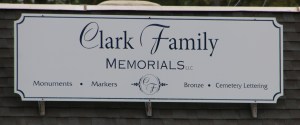
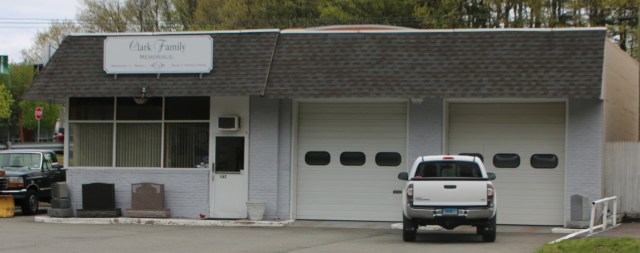
In all my years of taking photos of recycled gas stations IMG_3013caround the country I am always amazed when I find one that’s been right under my nose the whole time.  This one, now home to a monument company, is right here in Manchester, CT, a town I’ve been visiting yearly since even before this gas station project began.


IMG_3015cGo here to see the rest of my gas station collection.

Posted in Uncategorized | Leave a comment

That’s a new one on me

It’s not often I happen upon a religion I haven’t heard of before, but I did yesterday, in rural Royalston, Massachusetts, of all places.

I was on my way back from my second paddle of the Northeast season.  I went out a week ago in sunny 80-degree weather, but yesterday’s paddle was bit harsher, lower 50’s and cloudy.

But with only a slight breeze and no rain it was a nice time to explore the nooks and crannies of Tully Lake, a Corps of Engineers impoundment in the north central part of the state.  You can see from the photo below that we were bundled up a bit.

On to the religion.  “Vale Do Amanhecher” proclaimed the sign in front of a churchy looking building along  two-lane (no line in the middle) South Royalston Road.  ThereIMG_2875c was no one there on that Saturday afternoon, just the building, which probably started life as another, more mainstream denomination, and a parking lot.
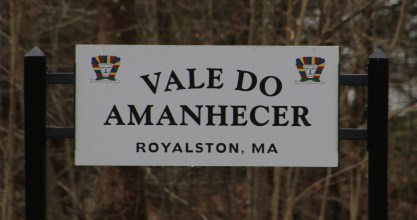
Not the typical Baptist or Methodist establishment, I suspected, so I snapped a few photos and planned to do so some internet research later on, figuring there might be a tale to tell.

There is a tale, that’s for sure.  Lots of it in Portugese.  I rely heavily on a Wikipedia page, which carried this cautionary note:
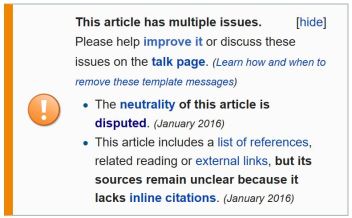
Capture

Vale do Amanhecer or in English, Valley of Dawn, is indeed a religious community.  It was conceived in Brazil by a female ex-truck driver and medium, Tia Neiva, born Neiva Chaves Zelaya, who died in 1985.  In 1969 it was established in its present location, called The Valley, in the city of Planaltina, about 31 miles from Brazilia.  Its official language is Portuguese.  Tia Neiva was the first female truck driver in the country, by the way.

There are approximately 500 residents, many of whom, according to the official web site, are abandoned children taken in by Tia Neiva.  Followers number in the tens of thousands.

The focal point of the community is the Temple of Dawn, built of stone. At the back of the elliptical-shaped temple there is an enormous statue of Pai Seta Branca (“Father White Arrow”), the pre-Columbian spirit who allegedly began to talk to Tia Neiva in 1957 and to guide and aid her and her followers in the creation of the doctrine, the Temple and, eventually, the Valley. He is always depicted as a nice-looking, young, strong, South American native man, wearing a blue tunic, a long, feathered headdress and leather sandals and holding a white arrow.

Here’s where it gets fun:  The church doctrine appears to be a mashup of christianity, spiritism, mysticism, afro-brazilian religions, ancient egyptian beliefs and flying saucers.  All bases seem covered, that’s for sure.

Two kinds of people are found in the Valley of Dawn: Mediums and Visitants (also called patients).  Between three and four thousand people visit the Valley every day seeking help for their spiritual or personal problems.

The Mediums wear special robes with bright colours. Most of them are considered the reincarnation of an extraterrestrial giant people, “the Equitumans,” who supposedly landed on the Earth 32,000 years ago, and later returned in successive reincarnations in various civilizations.  In establishing The Valley on Earth, Tia Neiva was following theIMG_2877c orders of the supreme commander, none other than Pai Seta Branca, the statuary fellow in the Temple, who seems to be an amalgam of several indigenous figures, Incan and American-Indian, and is also known to be the reincarnation of Francis of Assisi.
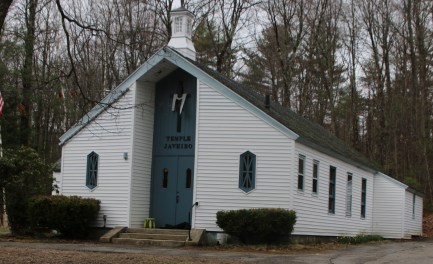
How all of this tentacled itself into a small church building along a two-lane road in rural Royalston, Massachusetts, I have no idea.  There’s another in Marietta, Georgia, for a total of two in the U.S.  There are single outposts in England, Trinidad, Bolivia and Guyana, along with four in Portugal, a more understandable place to colonize, given the language.

For way more information about this than you probably want,  there are numerous You Tube videos, a website, a facebook page this scholarly treatise from 2011 and this history from the World Religions and Spirituality website.  Your Portuguese will come in handy for all but the latter two.

And while I’m onto religion, check out the Church of the Double Bladed Paddle.
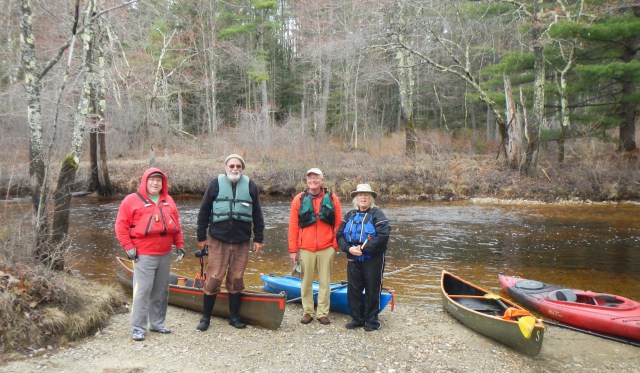
highres_460278949c

On Tully Lake in north central Massachusetts (Photo by David Hannam)


.
Posted in Uncategorized | 4 Comments

When you’ve got at itch…it’s nice to have Mom handy

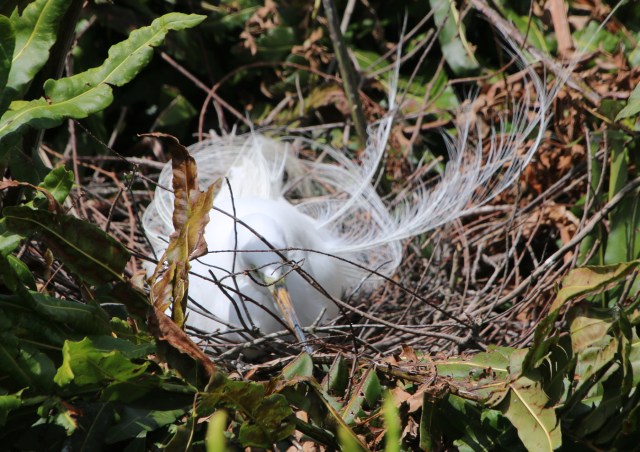
A young wood stork gets an itch scratched by an attending parent out at the Wakodahatchee Wetlands.  The place is overrun with wood storks, their nests and their babies right now.IMG_2671c

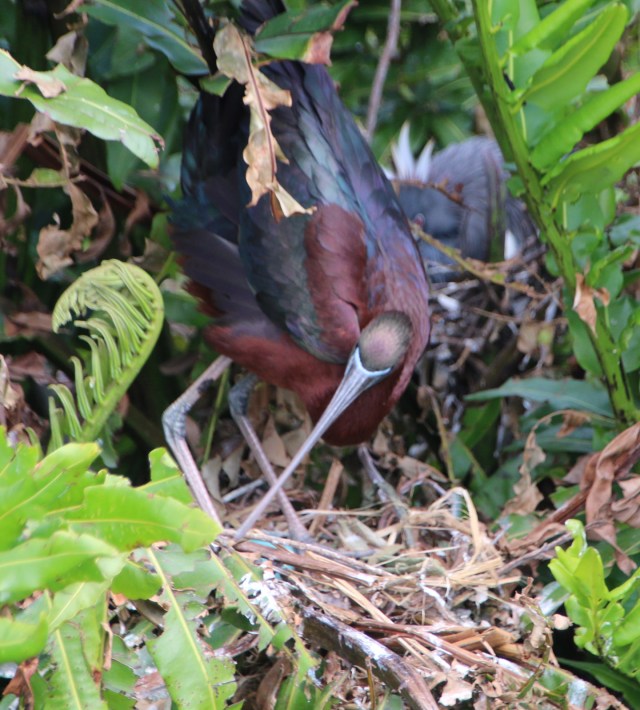
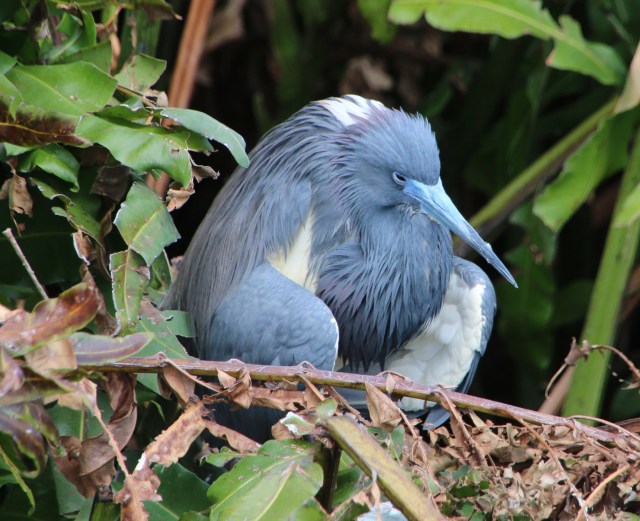
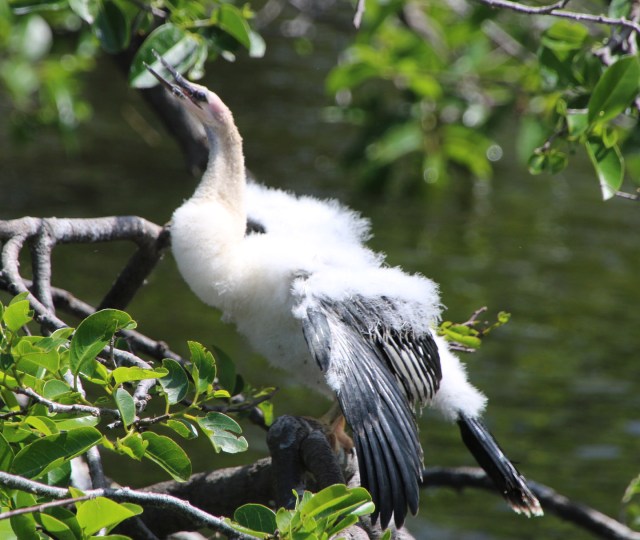
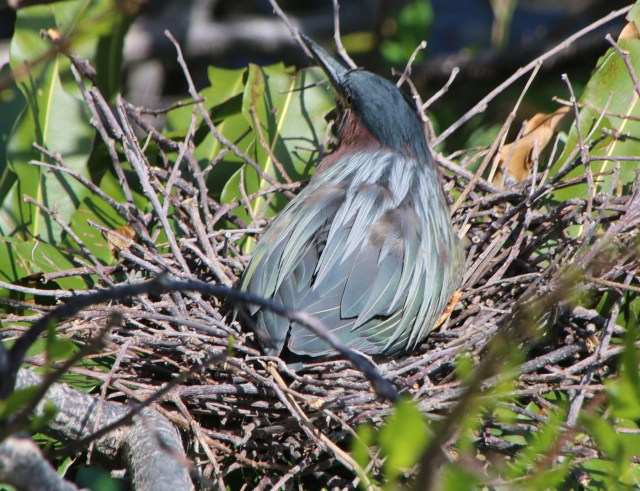
The anhingas come in a far second in nesting space occupied, with the blue herons, green herons, tri-colored herons, glossy ibis and egrets lodged in whatever nooks and crannies they can find.

It’s a popular place this winter, so be prepared to wait for a parking spot.  More photos below:

IMG_2704cIMG_2694cIMG_2693cIMG_2648cIMG_2623c

If you want to see all my other ‘itch’ photos, just put the word ‘itch’ in the search box, upper right.

Posted in Nature, Photos mostly | 1 Comment

Kumquat Festival here I come

I stopped in Dade City the other day.  It’s small, about 7,000 population, and is located in west central Florida.

It was a Saturday and it seemed to be antique day, because all the stores were open downtown and there were also tables out on the sidewalk and vendor booths in the alleys.

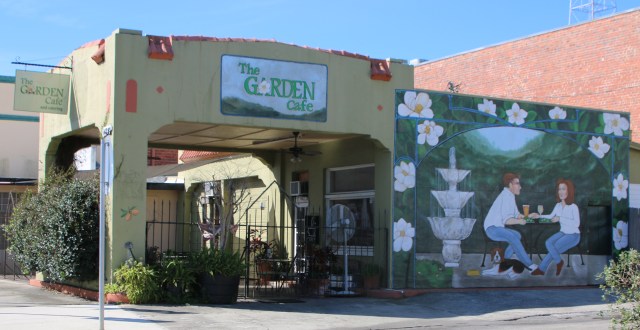
What drew my eye first though was this old gas station, now recycled into the Garden Café.  The unmistakable shape and the huge mural on the side attracted my attention immediately.  It wasn’t open unfortunately, so I had my breakfast in another café around the corner.

IMG_2567c

Dade City began in the 1870’s as Fort Dade, a few miles from its present location.  When the railroad came through in 1884 a few miles to the east it was relocated there and given its present name.   It is the seat of Pasco County.

Its most recent claim to fame is that it was mentioned as the home of Dexter’s recently deceased biological father in the Father Knows Best episode of the Showtime TV series Dexter. By the way, in the course of checking out that factoid I actually read the plot of that particular episode and was reminded once again why I stopped watching much TV long ago…I think it was about the time they stopped doing Seinfeld reruns at 7 p.m.

I missed the town’s annual Kumquat Festival.  It’s in late January and has been going on for about 20 years.  I don’t think I have knowingly eaten a kumquat, but I have maligned them and joked about them enough through the years that I really should go to the festival, at least once.

I’ll put that on the 2018 calendar for sure.

(If you’d like to see my entire collection of old gas stations that have been recycled for other uses, go here.)

Posted in Gas stations, Offbeat, Road trip | 1 Comment

Crater Lake…just what it says it is

On my road trip last year from San Francisco to southern Oregon and back I noticed a sign proclaiming that Crater Lake National Park  was nearby.

After a short detour off of U.S. 97  I was at the entrance, my senior citizen national parks pass in hand.

I came in the northern end and took the eastern loop around the lake down to the southern entrance.  There was road work causing tieups on the western loop, the guy at the gate told me.

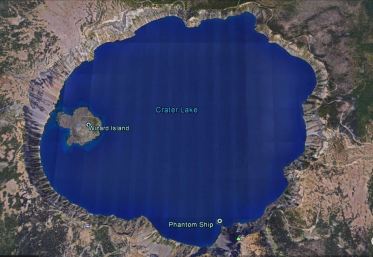
It was indeed all that it was cracked up to be; a lake in a crater.    The name itself has

crater lake google earth snip

Google Earth image of Crater Lake

always described it in my mind’s eye and I was happy it lived up to its billing.  Truth be told, it was much larger and way more defined that I thought it would be.

And the real truth to be told…somewhere in my mind has always been the notion that it was actually formed when a meteor fell out of the sky and left a crater that filled with water.  I have never claimed geological literacy.

Au contraire.  Crater Lake used to be a volcano, Mount Mazama.  Eruptions for approximately 400,000 years had built the mountain up to about 12,000 feet.  A massive eruption about 7,700 years ago caused so much material to be thrown up out of the center that the remaining mountain collapsed, creating a deep hole, or caldera, that is today about half filled with water.  Subsequent eruptions were within the caldera and resulted in two islands in the lake.

It took about 700 years for rain and snowmelt to fill the crater to where it is now.  At just over 1,900 feet at maximum depth, it is the deepest lake in the U.S. and it is about 5 miles by 6 miles.  Its average depth is 1,100 feet.

The lake has no inflow or outflow.  Loss is from evaporation and gain is from rain and snowmelt.  The Pacific Ocean weather systems bring an average of 44 feet of snow a year to the crater.  And the snow can hang around.   It was September when I visited, and there were still couple of small snowdrifts visible along the shoreline.

The systems that bring all that snowfall generally bring moderate winter temperatures, so there is rarely a surface freeze of the lake. The last complete one was in 1949.

And in case you’re wondering, with the evaporation and the precipitation the lake replenishes itself every 250 years.

How about the swimming?  Pretty cold.  The water temperature is 55 to 60 degrees in the summer.  And to take the plunge one has to take a 1.1 mile hike, descending 700 feet, and then hike back up again.

Not for me, thanks.

IMG_8376c

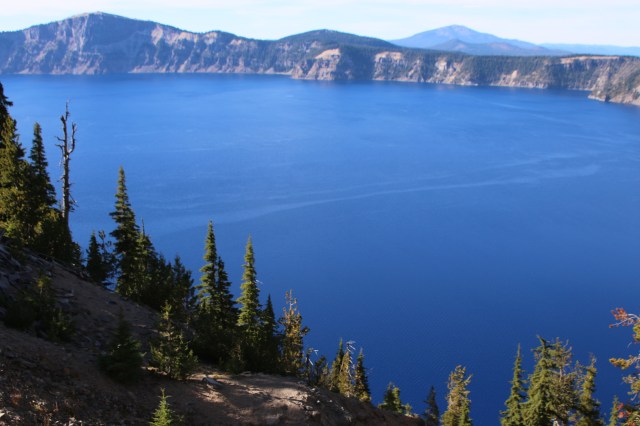
This is Wizard Island, one of two formed from volcanic activity within the crater after the massive collapse of Mount Mazama.  The other, a small rocky outcrop with a handful of trees on it, is called Phantom Ship because of its profile.  All photos by Ron Haines.


IMG_8359c

IMG_8353c

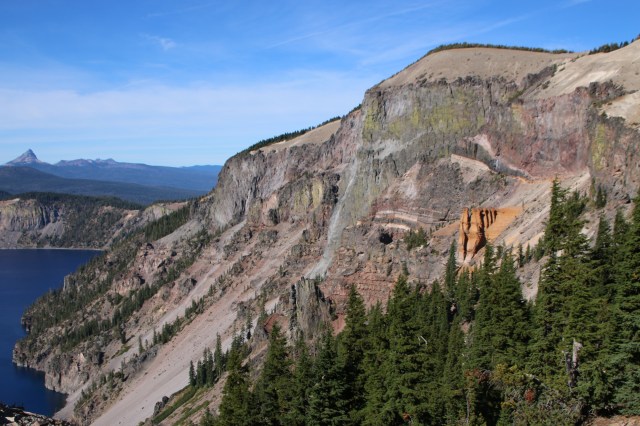
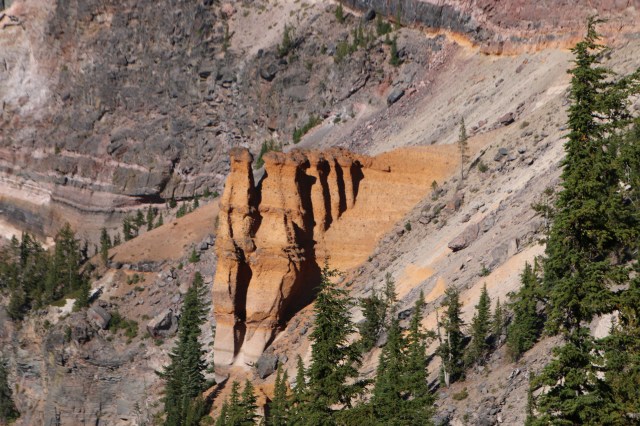
The tan outcrop in this photo (and the closeup below) is pumice, which is created when super-heated, highly pressurized rock is violently ejected from a volcano.  This formation was buried under the years of volcanic activity before the mountain collapsed.  Subsequent erosion of the sides of the crater have exposed it.

IMG_8354c


Posted in Nature, Offbeat, Road trip, Snow | 2 Comments

Swamp cabbage and Arbuckle Creek

I combined two of my sweet spots on Saturday:  A paddle in a nice place and a visit to an offbeat festival.  And because this was all in rural south-central Florida I was even on some roads I’d never traveled before, a bonus sweet spot.

I carpooled up there with Leslie, the paddling friend who accompanied my on my moose search in New Hampshire last summer.

The paddle was at Arbuckle Creek, a picturesque, 25-mile-long water trail connecting Lake

highres_458661454c

Yes, that’s me amongst the cypress trees. (Photo by Kim)

Arbuckle to the much larger Lake Istokpoga  near the town of Avon Park.

Much of it borders the vast Avon Park Air Force Bombing Range (don’t go ashore on the east side of the creek and you’ll be fine).  There’s also a state prison complex at the bombing range, so don’t pick up any human hitchhikers along the creek.

We drifted leisurely downstream about 3.5 miles to a boat ramp/picnic stop at East Arbuckle Road and then paddled north back to our start, where Lake Arbuckle feeds into the creek.  My only do-over would be to start at the downstream end next time so the leisurely drifting part is on the home stretch.

Part of the Kissimmee River watershed, the lake and the creek probably get their names img_2001cfrom Fort Arbuckle, one of several forts built across central Florida by the U.S. Army in the middle 1800s.  The fort was named after General Matthew Arbuckle.  Oddly enough, there is no town called Arbuckle in Florida.  There is one in California though.

We encountered no bombs or hitchhikers on the paddle, but saw lots of wildlife and a guy doing pistol target practice behind the one house we saw along the way.  It was a pleasant, shady and lazy way to spend a few Saturday hours.

After that it was off to the 51st Annual Swamp Cabbage Festival in LaBelle, FL.  It was a bitimg_2143c of a detour from a more direct ride home, but what’s a route without a meander?

If this event were to be held on ultra-ritzy island of Palm Beach it would likely be called the Hearts of Palm Parade and Gala.  But it’s in very rural LaBelle, a town of 4,500 folks in the southwestern part of the state.  The settlement was named for Laura June Hendry and Carrie Belle Hendry, daughters of pioneer cattleman Francis Asbury Hendry, for whom the county it is the seat of is named.

img_2150cSo it’s called Swamp Cabbage, a cracker name for the Florida state tree, the sabal palm. It is also known as the palmetto, sabal palmetto and the cabbage palm.

The edible part being celebrated is the couple of feet in the core of the trunk just below where the leaves sprout out.  It was most visible at the festival in the form of fritters and stews or simply fried up with a bit of bacon.  The photo below on the left shows the piece of the trunk cut off below where the leaves start and the photo on the right shows the core of the trunk, which is the heart.

For me swamp cabbage falls into a category of food ingredients I call filler, some almost tasteless stuff included to provide some tactile substance or bulk to whatever there is in the way of ingredients that actually taste like something, like bacon or fried dough or even seasoning.  Sorry to insult all the foodies out there, but I have to let my inner chef speak up.

But I didn’t go to the Swamp Festival for the culinary delights.  I went because I’d never been there, about the same reason for my attendance at the Fellsmere Frog Leg Festival in 2016.

Situated in a nice park right along the Caloosahatchee River and well shaded by huge live oak trees dripping with Spanish moss, the festival grounds included lots of food vendors, a big bandstand, and a ‘craft’ section.  Disappointingly, my appetite for local crafts wasn’t sated a bit.  I didn’t look at all the labels of course, but most of it probably originated in China.

img_2148c

The bandstand was right in the heart of the park with all the food and craft tents, so the music was a pleasant background for the whole event.  (Photo by Ron Haines)

The  Festival is more than one day, of course.  We missed the parade, the car show, the fishing tournament and a bunch of other stuff that marked the long weekend.

We also missed the armadillo racing. We got there late in the afternoon and they were done for the day.   That would have been a first for me.  We did see the empty racetrack though.  It was identical to the one in this video of an actual race.  For the youngsters, armadillo racing means something entirely different in the video gaming world apparently.

And while we’re on alternatives, please note that Swamp Cabbage is also the name of a blues band founded in 2003 by  Jacksonville, Florida, native Walter Parks,  who recorded and toured for 10 years as lead guitarist for Richie Havens.  He was also half of the folk-pop duo The Nudes.

Here’s some of the wildlife we saw on Arbuckle Creek (All photos by Ron Haines).

img_2125cimg_2123cimg_2112cimg_2089cimg_2119cimg_2079cimg_2057cimg_2014cimg_2006cimg_1997cimg_1967cimg_1937cimg_1941c

Posted in Offbeat, Paddling, Photos mostly, Road trip | 1 Comment

When you’ve got an itch…Part 8

When you’ve got an itch…it’s nice to have someone around to scratch it for you.

img_1731c

This is a pair of wood storks I photographed last week at Wakodahatchee Wetlands in Florida.  For my Florida friends, it is west of Boynton Beach on Jog Road.  It is a great place to see birds, and babies, but beware, it is popular.  We had to wait in line to park the car, on a Friday morning!

This is a 50-acre, man-made wetland, designed for recycling waste water (the name is derived from a Seminole Indian phrase meaning “created waters”).  It was full of nesting wood storks the day we were there, and we also saw some very young anhinga and blue heron babies in nests.  So it will be a good baby spotting destination for the next few weeks.

The wood stork is the only stork that breeds in North America and is limited to Florida, Georgia, and parts of the Carolinas.  It was removed from the endangered list and upgraded to threatened in 2014.

For my younger readers:  Do storks bring babies?  Yes, but only their own.

The stork as baby deliverer myth has been around a long time.  Even back in Roman timesdelivery-stork-and-baby-outline-clipart-cliparthut-free-clipart-plpiwm-clipart a stork on one’s roof was seen as a blessing.  All that good fortune eventually included claims of fertility and babies.  Hans Christian Anderson pushed the lore into greater popularity with his 1938 fairy tale, “The Storks.”

But from what I have read, the stork of the baby myths was always one of the nice white-headed kind found in Europe, not the ugly-headed wood storks that we have in the US.  That would be a very hard myth to swallow, even for a desperate parent wanting to avoid the birds and bees talk with the children.  They aren’t pretty.

Below are more photos from my Wakodahatchee visit.  If you want to see the other ‘itches,’ start here.

img_1850c

Roosting birds.  I see anhinga, wood storks and blue herons in here.  The upper part of the tree is white because of the bird poop.


A slide show of anhingas and babies:

This slideshow requires JavaScript.


And a few blue herons and babies:

This slideshow requires JavaScript.


Below are a tri-colored heron, a grebe, a gallinule, an egret and an alligator:


Posted in Uncategorized | Leave a comment

Back to school

I took my Mississippi River canoe trip road show to a school class here in south Florida recently.

image1c

Here I am showing the class one of the maps I used in Minnesota (Photo by John Stone)

The teacher is a high school friend of my daughter and her husband (Somehow all those people grew up and now have jobs and families!  When did that happen?).

As part of a section about adventures, teacher John Stone had given them my website with the trip description and photos and had them do some reading.

It was interesting to see, up there on the blackboard, that my blog had been turned into aimage1inset homework assignment!

He followed up with an invitation for me to come along and do a presentation. Fortunately I still had a power point program that I had put together years ago.  I also took along the life jacket, a dry bag, some maps, a paddle, and the canoe itself so I’d have some show and tell.

I managed to fill up an hour and no one fell asleep.

Kidding aside, it worked out very well. They were attentive and interested. And obviously well prepared.

I particularly enjoyed the questions.

They ran the gamut:
What kind of animals did you see? Any snakes?
What about the waves from the boats?
Did you lock up the canoe at night?
Didn’t you get tired of eating the same thing all the time?

And the best one of all, What about number one and number two?

Number two involved digging a hole and depositing, usually before I shoved off in the morning, I explained.  For number one I just pulled ashore when necessary.  And yes, I had toilet paper with me.

The questioner persevered with a followup though. Couldn’t you just stand up in the boat for number one?

Nope, I replied, it’s a balance problem. Didn’t want to fall in the water.

Posted in Grumman canoe, Mississippi River Canoe Trip | 4 Comments