Seeing pink elephants

I’ve been drunk in my life.  Many times.  But I had never seen a pink elephant.
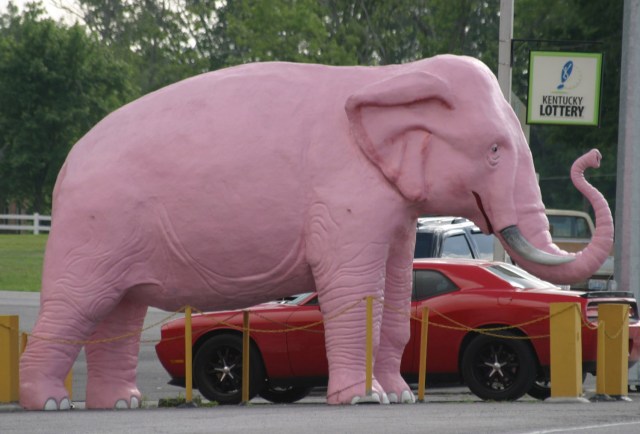
Guthrie, KY

Until one day, stone sober, I came across this one in Guthrie, Kentucky.

It appears to be the mascot for a gas station.  And my guess is that it’s also a great landmark for the 1,500-some folks living in Guthrie when they give directions.

Situated at the site of an 1840s-era stagecoach stop, Guthrie also has a huge cow with glasses, located just down the road from the pink elephant.

Guthrie, KY

And that little burg is also the birthplace of All the King’s Men author Robert Penn Warren.

Other than that, this line from the town’s website seems to sum it up:  “Nestled outside of Clarksville, TN, in the state of Kentucky, the City of Guthrie is waiting to be discovered.”

So what’s a pink elephant doing in a nice little town like Guthrie?  I haven’t the foggiest idea, but I have discovered that large plastic pink elephants aren’t all that rare in the US.  This website lists about 20 of them.

And how did they end up being what a drunk sees?    For a long time those who chose to imbibe to excess reported seeing snakes during their alcoholic hallucinogenic state.  Why did pink elephants replace them?

There was even a physiological explanation offered for the snakes.  In 1902 a doctor in London treating sufferers of delirium tremens from too much alcohol examined the eyes of patients with an ophthalmoscope and found that the minute retinal blood vessels were congested.  The vessels appear black and are projected into the field of vision, where their movements resemble squirming snakes, he reported.

But the seeing of snakes eventually become a pretty hackneyed alcoholic description, and writers started making increasingly elaborate modifications to the standard drunken scenarios. They changed the snakes to rats, monkeys, giraffes, hippopotamuses or elephants – or combinations thereof; and added color – blue, red, green, pink – and many combinations thereof.

An early known example was one of Henry Wallace Phillips’ “Fables of our Times” which referred to a drunken man seeing a “pink and green elephant and the feathered hippopotamus.”

In 1913, Jack London, in the autobiographical John Barleycorn, describes an alcoholic “…who sees, in the extremity of his ecstasy, blue mice and pink elephants.”

Eventually, according to the thinking of those who spend time thinking of the origins of things in our language, pink elephants emerged as the popular favorite.  They became the animal of choice in drunken hallucination descriptions.

But all that still doesn’t answer the question of why pink elephants, does it?  How did we come to know about pink elephants.  It turns out that the color comes from white elephants, which weren’t really white.

We can thank showman extraordinare P.T. Barnum and his hankering for a white elephant for introducing America  to the concept of a pink elephant.  The existence of albino, or ‘white’ elephants had been known for hundreds of years in Asia.  They were rare, sacred and much prized in the Southeast Asian monarchies of Burma, Laos, Thailand and Cambodia.

Here’s the rub:  Although described as white, and depicted in drawings as white, they were actually a soft reddish-brown, turning a light pink when wet.

As P.T. Barnum found out.  After much effort and a lot of money he convinced the King of Siam to send over a white elephant and he found out it was really a dirty grey in color with a few pink spots.

As one reporter at the time put it: “He has got a pink patch across his face and trunk, little pink dots on the outside of his ears, yellow toe-nails and a handsome pair of tusks. Standing in front of him, a person would believe that he was a pink elephant dotted with slate-colored spots . . . .”

As with everything that P.T. Barnum did, the arrival and display of what he had billed as the “Sacred White Elephant of Burma” and the subsequent realization that it was sort of pink in actuality, received massive publicity, and, the theory of word origins goes, introduced the ‘pink elephant’ concept to the American populace in the mid-1800s.  And it became a handy euphemism for an alcoholic hallucination in subsequent years.

And why does the term ‘white elephant’ mean something useless and hard to get rid of, a meaning that’s been around since the 1600’s, way before P.T. Barnum?  It all goes back to those Asian monarchs and the rare albino elephants.  They were sacred and prized, remember.  And elephants were then and still are very expensive to maintain.  A crafty monarch would often gift someone with a white elephant, especially someone he didn’t like very well and someone for whom he knew the maintenance of the beast would be a huge financial burden.

Now you understand the true meaning of those white elephant gift party games, right?

But back to the pink elephants for a moment, to wrap this up.

Does anyone remember good old Sarah Palin?  Well, she introduced a whole new meaning for pink elephant during her vice presidential campaign.  She, quite seriously, used the phrase “pink elephants” to refer to conservative women.  Playing on the elephant being the Republican Party symbol and pink being the stereotypical feminine color, she warned Washington of a “whole stampede of pink elephants.”  Now there’s a vision to stir the soul and rally the troops!

I’ll bet there are a lot of Republican women who are happy that that concept didn’t stick, about as happy as are all those Democrats that Sarah Palin didn’t stick.

Posted in Offbeat, Road trip | 1 Comment

Can you cut the mustard?

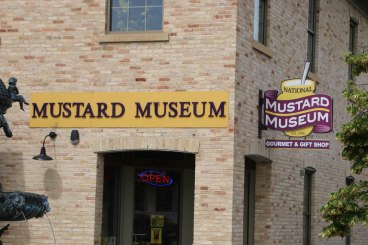
The National Mustard Museum was a must visit during my recent whirlwind tour of IMG_5090coffbeat places in the Midwest.

Why?

For the simple reason that mustard has become a standing joke with me and granddaughters Margeaux and Simone.  It started a year or so ago when I said I didn’t like mustard.  We were probably having hot dogs or something.

It’s been a running gag ever since, popping up now and then.  It’s usually in the context of “We know what to get you for your birthday, Grandpa,” or somesuch.  It’s one of those pleasant jokey things we have in common and use to amuse each other with once in a while. The utterance ‘mustard’ never fails to get the three of us laughing.  They have a similar thing going with Sue and her dislike of marshmallows.

So that’s why I couldn’t resist a visit to the National Mustard Museum in Middleton a suburb of Madison, the capital of Wisconsin. The small town calls itself ‘The Good Neighbor City,’ has a population just under 20,000, and is supposedly named after a town in Vermont, though I couldn’t find one with that spelling in the Green Mountain State.

The museum, located in the heart of historic Middleton, turned out to be a great place.

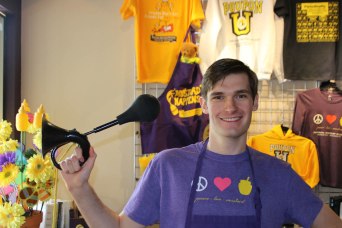
It’s a very serious place, with its thousands of brands and flavors and mustard pots from all over IMG_5192cthe world. But it’s downright delightfully hilarious at times with its several tongue-in-cheek exhibits.  And there’s the totally unexpected.  When I bought a sampler box in the gift shop I got to squeeze the store’s large ooga horn (see it in photo at right).
What a sweet sound!

My sampler box had eight flavors and we made good use of them at a mustard tasting session with family in New Hampshire, complete with homemade soft pretzels.

The museum was the brainchild of Barry Levenson, who started collecting mustard while he was an assistant attorney general for Wisconsin.  One night in 1986, despondent because his Boston Red Sox had just lost the World Series, he was wandering the condiment aisle of an all-night grocery store.    As he passed the mustards, he heard a deep voice say, “If you collect us, they will come.”

The final straw came later when he was in Washington, D.C, to argue a case before the Supreme Court.  At the hotel he spied a mustard jar on a discarded tray and pocketed it.  “I argued a case before the Supreme Court with a mustard jar in my left pocket,” he says. “We won.”  In 1992 he left the law and opened the museum

Today it boasts about 6,000 mustards, from all 50 states and 70 countries, hundreds of

IMG_5108c

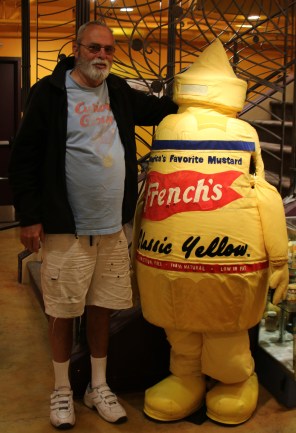
Me and a buddy at the museum

mustard pots and other mustard memorabilia, a well-stocked gift shop, and the ever popular Poupon University: “Lowering the bar in higher education.”

And a modest online store: “If you can’t find it here you won’t find it anywhere.”

And a newsletter, The Proper Mustard, “Yellow Journalism at its Best.”

You see what I mean about the place.  It’s serious, but fun.  It’s in that vein that I now omit all the boring stuff about the history of mustard (it’s been around since before 1800 BC) and all that, and go right to the point of all this:  Why does the term “cut the mustard” mean to succeed or of high quality?  Amazingly, the most probable explanation makes literal sense, in several ways.

Mustard stalks are thick and stringy, hard to chop.  Mustard seeds are small and shiny, tough to cut with a knife.  And finally, this:  Back in the day, mustard was made in large oak barrels, and as the barrel matured a thick leathery crust formed at the top.  This had to be very carefully removed before the contents could be tested, for if a piece of crust fell into the mustard it would lose some of its distinctive flavor.   Over the years a specialized tool was developed, with a blade that had a very thin and extremely sharp leading edge, widening in the middle and tapering but not sharp at the back edge, allowing it to skim most of the crust off, leaving a only a very thin slice.

And the mustard maker, the Mustardeer, could tell by a look at the blade if his assistant hadn’t sharpened it properly, and on such an occasion would hand it back with the comment, “this doesn’t cut the mustard.”

I will leave you with this:  Remember Grey Poupon mustard from the ads with the friendly folks in the neighboring Rolls-Royces?  Developed in the 1860s, the name comes from two men, Maurice Grey, who had come up with a machine that dramatically increased the speed of Dijon mustard production, but who needed financing, and Auguste Poupon, another Dijon producer, who supplied the money.  They lived, of course, in Dijon, France.

Mark your calendar:  National Mustard Day in 2018 falls on August 4.

Some random museum photos:

This slideshow requires JavaScript.

Here are some of the mustard pots on display:

This slideshow requires JavaScript.

And a bit more of the always present humor of the place:

This slideshow requires JavaScript.

A comic strip from the place, from back at the beginning of it when the museum was in Horeb, WI:

This slideshow requires JavaScript.

And finally, a slide show of the sampler box I bought and all of us up at Rick Haines’ house in New Hampshire for the homemade soft pretzels and mustard tasting party:

This slideshow requires JavaScript.

Posted in Offbeat, Road trip | 5 Comments

Look out below!

Believe it or not, this is actually the second two-story outhouse I have encountered in my life.  I discovered the first one, which I actually used,  nearly 50 years ago and in another country.

But more about that later.

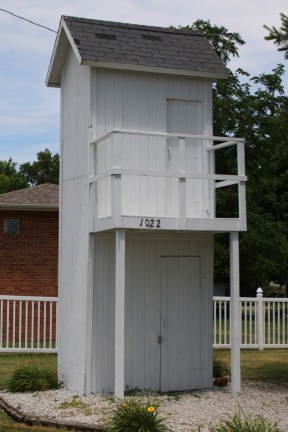
This one’s right here in the US of A.  It’s in tiny Gays, Illinois (it’s growing though, havingIMG_4520c jumped from 260 souls in 2000 to a whopping 657 in 2010).
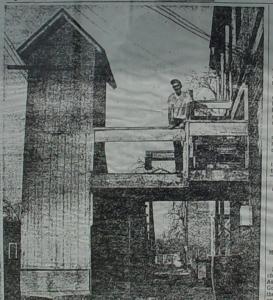
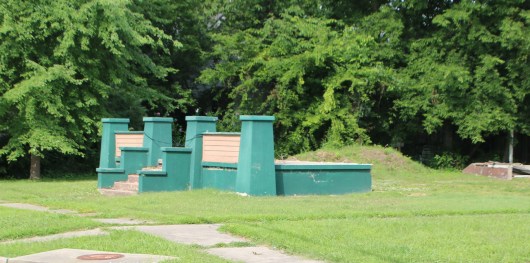
Now standing alone in a small park at the corner of North Pine and Front streets, the outhouse  was attached to a two-story building when it was built in the late 1800s.  Downstairs was a general store and upstairs were apartments.  The upstairs portion of the outhouse was for the apartment dwellers and the downstairs part for store patrons.

As you can see in the old photo below, a walkway on the second floor outhouse3connected it to the building, which was torn down in 1984.

So, how did that work, you may wonder.  This was a four-holer, two upstairs and two downstairs.  No, one didn’t have to worry about something dropping from above.  The upstairs and downstairs holes were offset, with the upper ones closest to the back of the tower. The waste from the top floor dropped behind a false wall into a pit at the bottom, out of sight, if not sound, of folks using the lower level.

Below is an overall view of the park, and photos of all the newspaper clippings posted in the kiosk and the stone honoring Gene Goodwin, a town official who made it his mission to preserve the outhouse.  (All photos by Ron Haines)

Once there were two-story skyscrappers all over the place, built usually for the convenience of folks who lived or had bedrooms on the second floors.  There are still a handful of these around. And I did run across some stories of a second story being built on outhouses in regions where deep snow was a constant problem in the winter.

With the advent of piped plumbing, of course, facilities on upper stories became architecturally much simpler.

And now to my personal experience with a two-story outhouse.  It was in Sheno, Ethiopia, of all places, back in 1967.

Sheno was at that time a very small town about 55 miles northeast of Addis Ababa on the then-gravel Highway One, which linked Addis with Asmara in Eritrea, in the north.   The bus ride to Sheno took half a day or more as I recall.  Today, with the roads paved, I am sure it is quicker.

My Peace Corps volunteer friend and colleague, Bob Hazlett, was stationed there.  I couldn’t find any figures online, but I would guess that in 1967 there were not more than a couple hundred residents, and way more than that on market day.  The population there in 2005 was 10,000, double the figure from 1994.

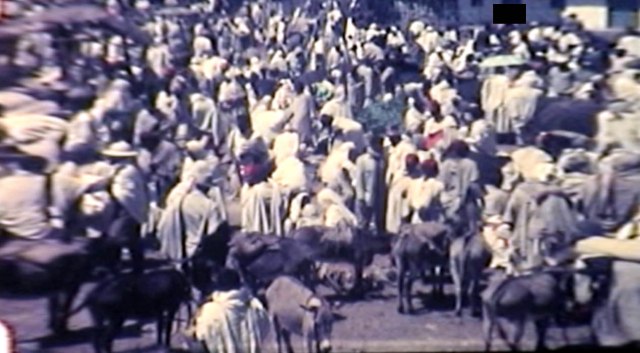
Bob rented the upper floor (two rooms) of a two-story, mud-walled building.  His place overlooked a huge dirt field that on Saturdays was the site of a massive market that drew thousands of sellers and buyers.  He had a terrific view of the action.

Screen Shot 2013-04-20 at 11.49.59 AMc

A screen grab from movie film that I shot from the window at Bob’s place of the packed weekly market in Sheno in 1967.

His landlord, trying hard to please the new foreigner in town, built a slender, two-story addition to the structure when Bob moved in.  It was Bob’s very own two-story outhouse, with a hole on the top floor and a pit way down at the bottom of the first floor.

No, Bob does not have a photo of that.   I asked him just the other day.

And no, we never asked the first floor residents what they thought of the arrangement.

Posted in Offbeat, Road trip | 3 Comments

Can you ear me now?

The Midwest means corn to most folks, just no getting around it.  This past June when I was there, the stalks weren’t yet high enough to block the view of the wide plains and vast sky of the region.  As an Illinois native, my recollection of those two-lane roads in late summer is that it was like traveling through tunnels of corn, with not much else to be seen.  Makes for pretty boring driving.

Also as an Illinois native, before driving age and probably somewhere well under the age of ten, I used to sell sweet corn from my Grandpa Haines’ fields next to the Calumet River to folks in my neighborhood—for a whopping 50 cents a dozen.  I’d hit my likely customers one day and take orders and the next day I was back on the sidewalk with my red wagon full of freshly picked corn, delivering the goods.

And I also remember helping out at the small farm stand my aunt and uncle organized under a billboard on busy Halsted Street a block from the cornfield in Harvey, about 20 miles south of downtown Chicago, and traveling nearby neighborhoods with my uncle with a trailer of corn behind grandpa’s tractor selling door to door.

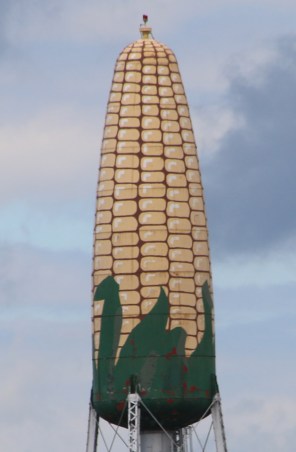
Enough with the fond memories.  This year there was this one ear of corn that stuck IMG_4721cright up at me.  It’s actually a 50,000-gallon water tank at the Seneca Foods Plant in Rochester, MN.  I knew it was there but didn’t know the precise address and figured I would just drive into town and find it.  And that’s what happened.  I spotted it pretty quickly as I hit the outskirts of town and just kept aiming for it.
It’s not just a water tank painted to look like an ear of corn.  It was actually built in the shape of an ear of corn back in 1931, when the industrial complex was the Libby Food Plant.  It is now an historical relic and, well-lit at night, serves as the same kind of tourist attraction and town landmark that the Libby Food executives planned it to be back in the Depression.

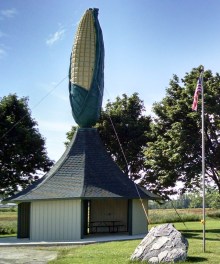
About 180 miles west and a bit north of this Memorial-Park-Web-PicCtower is a 25-foot fiberglass ear of corn atop a gazebo.  It’s at Memorial Park in Olivia, MN, which built the structure in 1973, the same year it declared itself the Corn Capital of the World, a designation affirmed by the Minnesota State Senate in 2004.

The birthplace of modern hybrid corn seed production, Olivia is home to nine seed research facilities and annually celebrates Corn Capital Days in late July with a parade, corn cobb toss and other activities.  I missed it this year.

Ever had a nagging question about corn?  I’ve had one for a long time:  How did the phrase corny joke get started?

So I waded through reams of internet words about the history of corn (first domesticated 10,000 years ago, yada yada yada) and the hybridization of corn and even the use of corn-related terms to mean rural, hick, backwards.

But how it got used to mean a very simplistic, adolescent, funny-but-at-the-same-time-not-funny, joke eluded me for a while.  Until I came upon this explanation:  In the early 1900’s seed companies started sending printed catalogues to farmers to advertise their goods.  Sprinkled among the ads were jokes and cartoons, usually pretty low quality ones.  They became known as ‘corn catalogue’ jokes and that was soon changed to ‘corny.’

Makes sense to me.

IMG_4718c

The ear of corn water tower in Rochester, MN, was pretty easy to spot.  (Two photos by Ron Haines. Third is courtesy of Olivia, MN)

Posted in Uncategorized | 4 Comments

This is not a Motel 6

A sign that you’re not at a Motel 6 is when this pops up when you turn the TV on:

IMG_8515c

Yes, a huge cut above my normal on the road accommodations, courtesy of the Sierra Club.  I was there last week in my role as a member of the Awards Committee, helping out at our annual Awards Ceremony.  For more about all that, take a look at the committee’s Facebook page.

Other signs of course are the fluffy towels, assortment of soaps and conditioners and the cheery ‘How can I help you, Mr. Haines,” when I ring the front desk.  And the multiple pillows.

As much as I do enjoy lapping it up when someone else is paying, I just cannot justify that cost for a night’s sleep when I am footing the bill.

My four-by-eight-foot camping trailer works just fine, thanks.    And there’s always a Motel 6 around if it’s raining–or below 60 degrees overnight.


Posted in Road trip, Sierra Club | Leave a comment

Is it still a porch if there is no house?

I like front porches.  I’ve mentioned that a few times, most notably in this entry.  I like the looks of a porch, the philosophy behind them, and the need for my mind to have one at my disposal.

So what’s a porch without a house?  Not quite the same thing.  No front door to wander out of to pass some time on the porch.  No roof to keep the rain off.  No inside, presumably heated, shelter in the winter.  And no bathroom handy.

I ran across this porch without a home this summer driving through Metropolis, Illinois.IMG_5418c  Would love to know why it’s still there.  The house is obviously long gone, maybe in a fire?  Perhaps the plan was to one day build a new house and use the old porch?  I don’t know.
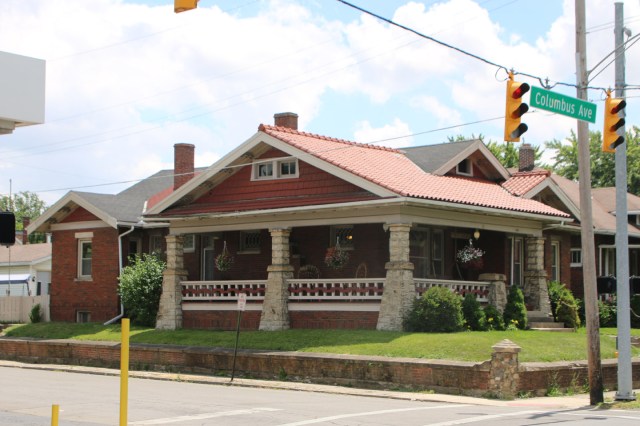
But I do know, now that I have seen one, that sitting on a porch without a house would be no where near as nice as sitting on a porch that has a house.

Speaking of porches.  I found this great corner specimen in Washington, Ohio, on that same road trip this summer.IMG_3848c

And porches reminds me of another favorite structure of mine; recycled gas stations.  The one below, found in Easton, Illinois, is of classic design, with a garage added onto the side.  It now serves as someone’s very nice man cave.  This is one of about 40 old and repurposed stations I photographed on that same road trip.  I have added all those photos to my collection, with the new ones on top, in case you want to see them all.

This slideshow requires JavaScript.

Posted in Uncategorized | Leave a comment

Fork. In. The. Road.

I have seen and will see a lot of forks in the roads in my travels.  But I had never seen an actual fork. In the road.

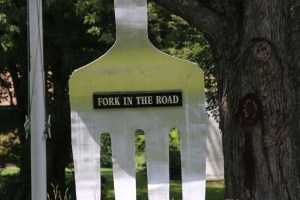
Until the day I passed through Rock City, New York.  There, where the combined IMG_6620cwestbound routes 308 and 199 split and take their separate pathways, is a triangular patch of trees and grass and standing on it is a FORK, a pretty large one.
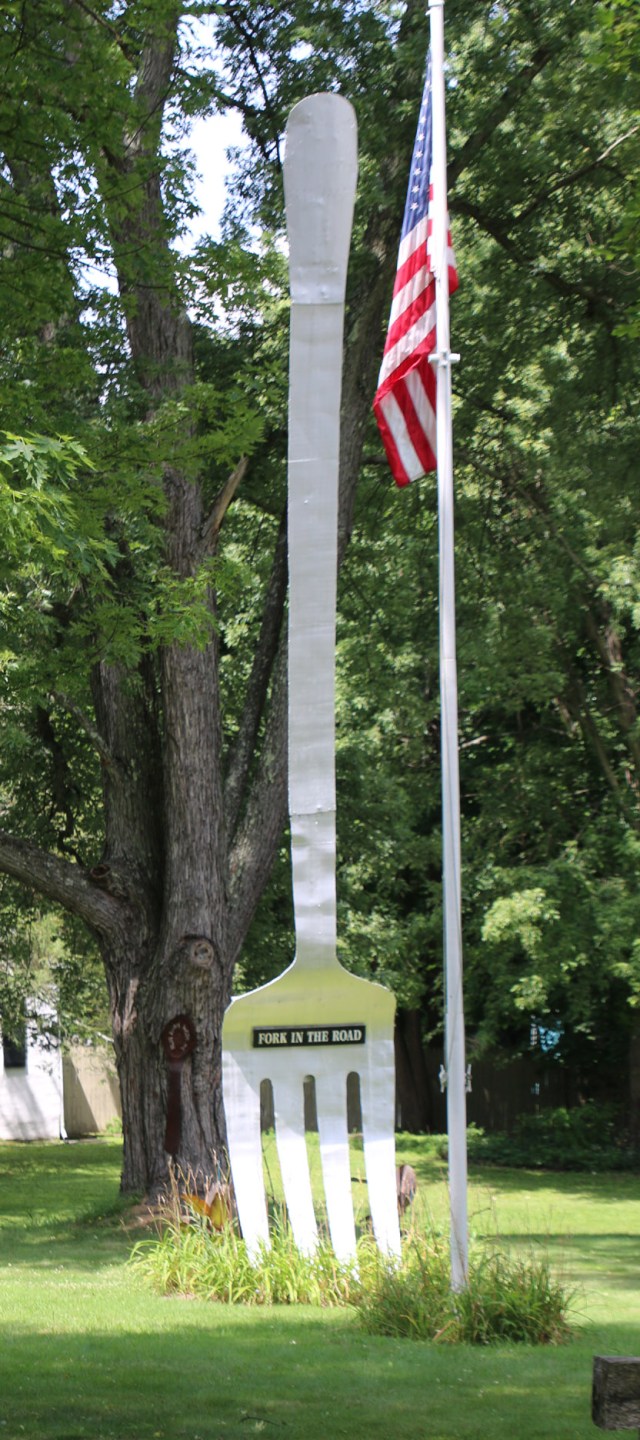
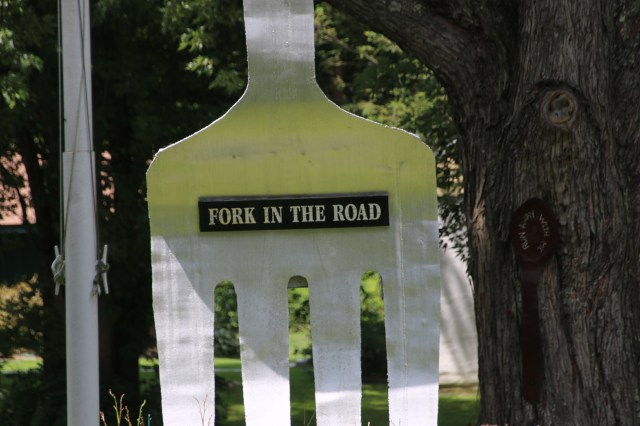
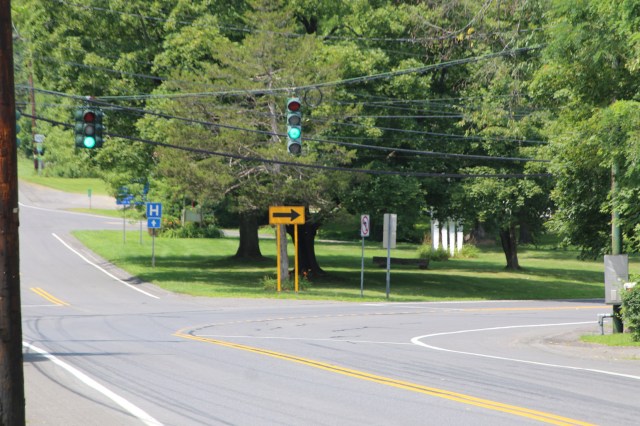
Local resident Stephen Schreiber put it there in 2000 as a fun art project and to bring attention to the town.

“My fork in the road is 31 feet tall. I made it from a 13ft. piece of scrap plate steel and the top 5-ft was aluminum from my dumpster diving — complete with a taper (sent by the fork gods).  I did it as a goof. I didn’t think they would let me leave it there.” he says.

It has stayed, obviously, and continues to bring a bit of notoriety to the place, in the form of occasional mentions in travel blogs and even appearing in a cartoon panel of Ripley’s Believe It Or Not!

In you’re of a philosophical bent, of course, the term fork in the road sets you to thinking.  I think of decisions, though I cannot remember making any really momentous ones in my life.  Sure, I’ve taken one path or the other at times, but I tend to think it all would have worked out about the same no matter what.

Not so in the mind of Mike DeWine, an American politician and current Ohio Attorney General: “One of the most important things that I have learned in my 57 years is that life is all about choices. On every journey you take, you face choices. At every fork in the road, you make a choice. And it is those decisions that shape our lives.”

Sheesh!  I’d have given up on living a long time ago if I thought every fork was that important.

So I guess I prefer the thinking of economist Paul Samuelson “You’re not making a decision if you come to a fork in the road. There is no ‘it’ to take. It’s one or the other.”

And to confuse things immensely, there is this from social philosopher William Irwin Thompson, who manages to mix the literal and the figurative and end up saying not much: “One way to find food for thought is to use the fork in the road, the bifurcation that marks the place of emergence in which a new line of development begins to branch off.”

But let’s get back to the simple: “If you come to a fork in the road, take it,” said Yogi Berra.

Enjoy the photos…

IMG_6615c

IMG_6620c


IMG_6630c

Trees hide the top of the fork, but the tines are visible as you approach the fork.  I spotted them right away.  (All photos by Ron Haines)


Posted in Uncategorized | 2 Comments

Bear Den Landing

I made it a point when I was in the Midwest recently to revisit a desolate campsite in the swamps of northern Minnesota.  It was the site of the first of several amazing kindness-from-strangers incidents I had experienced during my solo canoe trip down the Mississippi River in 2003.

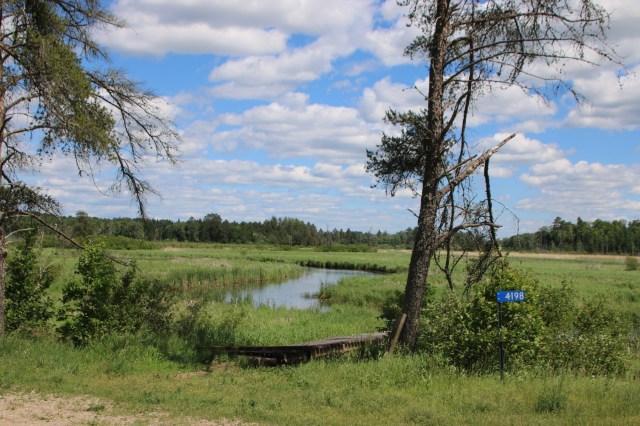
Bear Den Landing it’s called and it is at the end of a 2.5-mile dirt trail called Bear Den IMG_4815cForest Road, off of County Highway 5 in rural Solway.  Some maps call it Bear Den Canoe Road, which I like better.
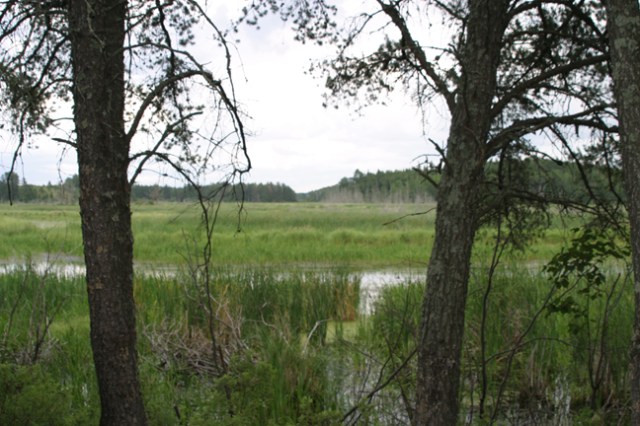
It is 30 river miles from the headwaters at Lake Itasca and I reached it in the late afternoon of  Day 3 of my paddle.  By road it is 22 miles from the start, a mere 25-minute car ride.

I camped there that night and at first light on Day 4 I set off.  By that evening I was right back at Bear Den Landing, after a frustrating,  tiring and unsuccessful day trying to find my way downstream through the thick rice swamp and weed bogs in low water.  As I was getting ready to set up the tent for the night, fully prepared to walk out that dirt road in the morning and find some help getting me, my canoe and all my gear to Bemidji, a couple of fishermen pulled up.

I hadn’t needed, or even really thought about needing, the kindness of strangers on my trip and here I was, only four days into it and I needed a hand.  And serendipity brought me George Weidig and Dean Jones, two nice fellows more than willing to help out.  After I explained the situation, they quickly offered to go get Dean’s pickup truck and carry me and all my stuff to Bemidji, some 28 river miles and 18 road miles away.

So I had this pleasant bit of  history with Bear Den Landing and I wanted to check back there, now 14 years later, to see if it was still the nice camping spot that I remembered.  It certainly was, with the addition of a couple homemade teeter-totters and minus some of the shade trees.   It seems to have acquired an address as well.

bear den landing view

This is the view looking downriver from Bear Den Landing in 2003 and, below, my campsite there in the morning fog of Day 4. (Photos by Ron Haines)

foggy morning

IMG_4804c.jpg

Here’s the 2017 view looking downriver–note the address sign.  Below are the teeter-totters I found there in my recent visit.  (Photos by Ron Haines)

While in northern Minnesota this summer I also swung around for a return visit to the town of Little Falls.  I went through there on Day 22 of my trip.  I had paddled 346 miles by then, but by road I was a mere 115 miles from where I had started, two hours by car.

This was where I enjoyed my second major stranger kindness incident.  It happened when a pack of boys on bicycles approached as I was unloading the canoe for the portage around the dam.

Mentally I was prepared to be hassled, but all I heard when they pulled up was Can We Help You?  and boy they sure did.  With all that assistance I got the boat and gear to the put-in spot in good time and one of them even refilled my water jug for me at the park bathroom.  I got all their names and addresses and sent them all postcards when I arrived in New Orleans.

102_0244

In this 2003 photo at Little Falls, MN, you can see my canoe and gear at the take-out point and off in the distance the boys on bikes approaching.  Below is the same area in 2017. (Photos by Ron Haines)

IMG_4767c

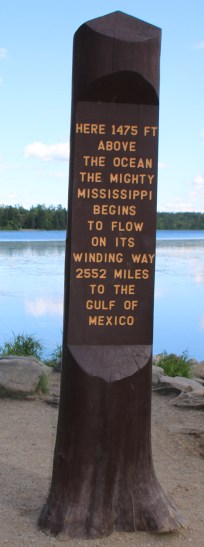
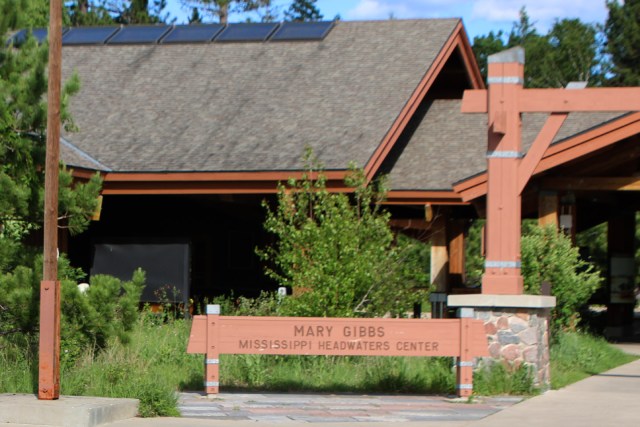
I also stopped at the headwaters in Lake Itasca State Park.  I finally now have a decent photo of the sign marking the beginning of the Mississippi River (the one on my site is pretty badly backlit and about impossible to read).  That area’s changed a lot since 2003.  There is a headwaters center building and new parking area across the river from where the parking area used to be.

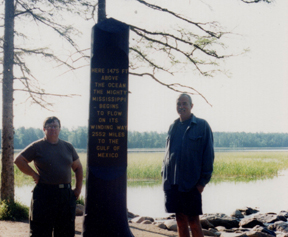
Below is a photo of friend Jim Bogden and I at the signpost in 2003 and a clear, 2017 photo of the signpost so you can see what it says.   IMG_4829c

Signpost

at dam 5c

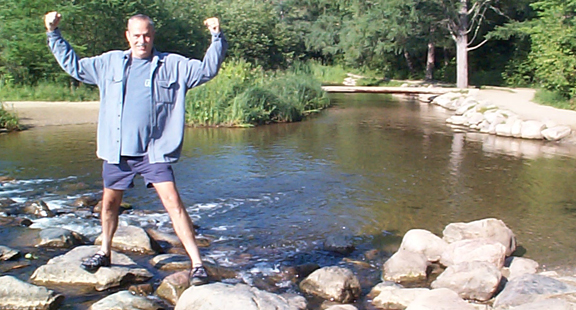
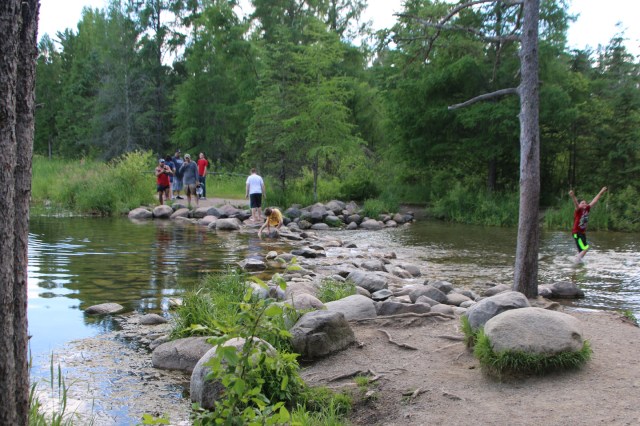
And here I am in 2003 clowning around on the rocks that mark the beginning of the Mississippi River.  A 2017 view of the same area is below.

IMG_4825c

IMG_4833c

A new-to-me headwaters center features a nice interpretive display, a cafeteria and a gift shop.  (Photos by Ron Haines)

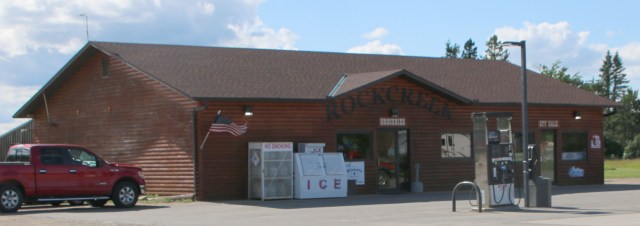
And finally I want to give a hearty shout out to the Rock Creek gas station and store just outside the northern entrance to Itasca State Park.  I am sure it’s one of only a very few gas stations left in the country where you just pull up to the pump, fill your tank and then go inside and pay up.  When’s the last time you were able to do that?

IMG_4819c

Posted in Uncategorized | 4 Comments

Shoddy

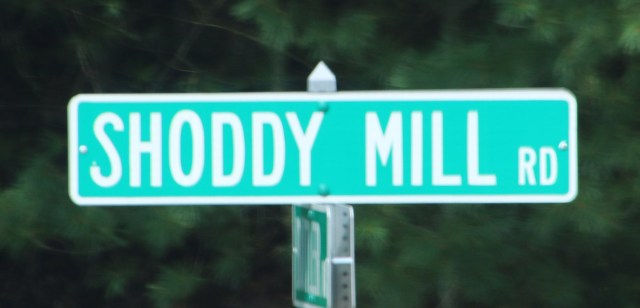
Shoddy Mill Road, the sign says.  This one’s in Glastonbury, CT., but I have seen them elsewhere in my travels around the northeast.

These are not new roads in newly developed areas, so the name obviously originated a century or more ago.

IMG_7131c

But why celebrate a shoddy mill?  And what explains the proliferation of shoddy mills?  Or maybe it isn’t the mill that was shoddy so long ago, perhaps it was the Mill Road that was shoddy?  If that’s the case, how did so many Mill Roads in the northeast get so shoddy?  Why are there no Shoddy Main Streets?  There are way more Main Streets than there are Mill Roads.   Or maybe there was a Mr. Shoddy, who owned a string of textile mills in the Northeast?

Or maybe, just maybe, shoddy didn’t mean shoddy back in the day?  Turns out that’s the answer.

The word shoddy was a noun in the early 1800s in England and was simply recycled wool; fabric made from cutting or tearing apart existing wool cloth and re-spinning the fibers.  It was cheaper than using virgin wool.

And the mills that made it? Yes, shoddy mills.

The use of shoddy grew and spread to the U.S.  Originally used as padding, the recycled fabric soon grew to be favored in clothing, because when new it looked just like the high-grade stuff.  At one point, a U.S. Government report noted that shoddy was used widely for clothing and blankets for the Army and Navy.

The use of shoddy for clothing eventually evolved the word to its modern-day meaning, however, because although the cloth looked good initially it was nowhere near as durable and lasting as virgin wool.  “Shoddy” soon became equated to inferior or poor quality in general.

By 1862 in fact, the word, by now an adjective, came to be defined as “having a delusive appearance of high quality,” in reference to the quality of governmental supplies for the armies in the Civil War.

Things do come full circle though.  At the end of Shoddy Mill Road in Glastonbury  is the 77-acre Shoddy Mill Open Space, a spectacular reuse of the ruins and land of the Crosby Manufacturing Company,  where wool waste was once recycled into dark blue woolen yarn.


Posted in Uncategorized | 1 Comment

Oquawka revisited

I was roaming around the Midwest recently and decided to stop at a small, Mississippi River town in Illinois called Oquawka, a place I had been once before.

Its name makes it memorable enough, but for me it was a return to a spot that will always stick in my mind because of what happened there before daybreak on September 20, 2003.

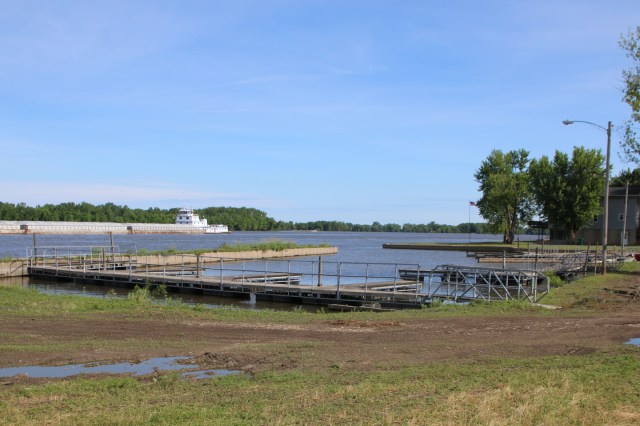
I had arrived the previous day by canoe, on my way from Minnesota to New Orleans.  I paddled into the town’s small marina.  It was very welcoming, several public docks and a boat ramp protected from the wind and waves by small breakwaters.  The perfect spot to leave the canoe for the night.  And I was happy to find a small grassy area nearby to set up my tent.

It was my 54th day on the river and I was in that really sweet stretch through the Midwest where there’s another nice friendly river town around nearly every bend.  After tying up at the dock, I quickly and easily settled into what had become a comfortable routine for me:  Set up the tent and scout out the town for a nice place, or places, to stop for a few beers and new friends and a huge dinner.  And keep an eye out for someplace to have breakfast in the morning.  In Oquawka everything I needed was within easy walking distance of the river.

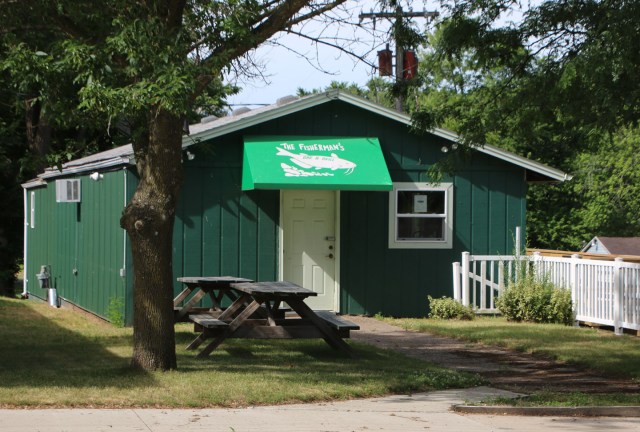
My first stop was at The Fisherman’s Bar and Grill, a nice unpretentious place on Schuyler Street a couple blocks from my tent.  It was a Friday night so the place was busy. The owner let me use his electricity to charge up my cell phone and he gave me a beer cosy with the bar’s name on it as a souvenir of my visit.

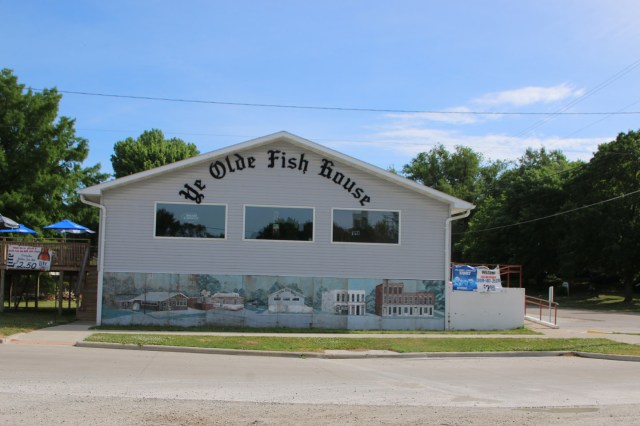
After that I walked a block or so for dinner at what is today called Ye Old Fish House, at the foot of Schuyler right by the river.  When I stopped there in 2003 it was called the Oquawka Diner.

Full and content I ambled back to the tent for a good night’s sleep.

A few hours later the memorable happened.  In the pre-dawn darkness I woke up to a huge racket.  It sounded like every guy for miles around with a pickup truck and a boat and a dog had descended on the town boat ramp, a mere couple hundred feet from me, intent upon making as much noise as possible.  I peered out of the tent.  The place was mobbed with folks launching their boats.  Boat engines raced, dogs barked, and doors slammed.

In a half hour or so the hubbub ended.  Everyone had sped off by boat and I got back to sleep.  Then, at the crack of six am all hell broke loose again.  This time in the form of continuous loud gun volleys out on the river.  I finally gave up on sleep and dragged myself out of the tent.  I packed everything back into the canoe and headed down the street to the diner for breakfast.

And I asked the waiter what all the early morning activity was.  First day of duck hunting season, he replied, started at six.  And it was the opening of the season over in Iowa, way across the river, not on the Illinois side, where I was.  I was glad I hadn’t camped in Iowa for the night!

I’m happy to report that Oquawka, at least the small bit that I am familiar with,  is much the same as it was when I first visited it 14 years ago.  The restaurant is still there, the bar and grill is still there, and the waterfront remains the same quiet laid back place I found it to be years ago.

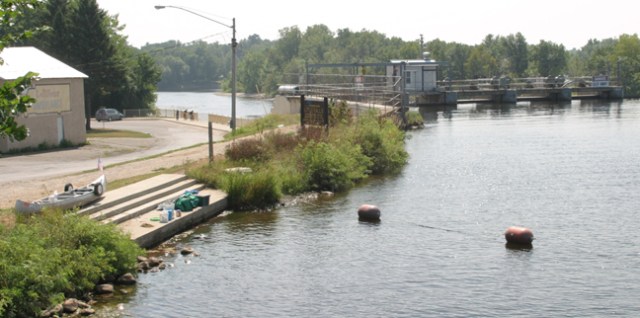
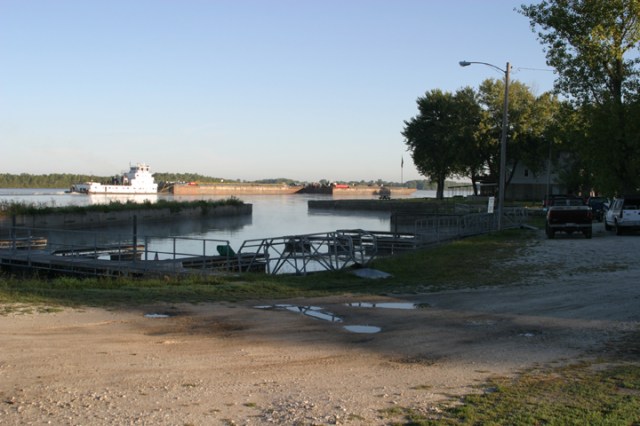
Here’s the view from my tent of the town marina back in 2003:103_0362

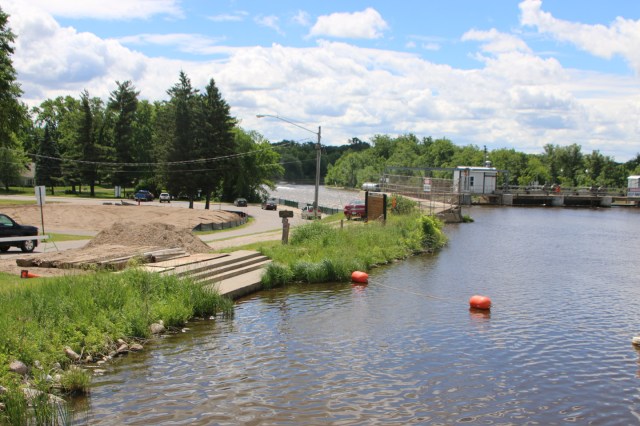
And the same view in 2017:IMG_4549c

And below are 2017 shots of The Fisherman’s Bar and Grill and Ye Old Fish House:IMG_4555cIMG_4553c

Posted in Uncategorized | 12 Comments