Two florists and some Florida rambling

I had a handful of productive days meandering around Florida this past week.  It included some nice recycled gas stations, a wildlife-filled paddle on the Hillsborough River, a couple days with relatives, and an afternoon visiting with former high school classmates.

It was all accompanied by some very nice tunes from the playlist I’ve uploaded to my new music toy.  Yes, I am moving from CDs to an electronic music library.

First the florists.  There were two of them, Sara’s Flowers in Bartow and the Bonita Flower Shop in Dade City, both in well-kept classic designs.  A third recycled station rounded out the trip.  It was the Fashion Shop in Webster.  From the looks of the add-on drive through bank window on the right side, this is at least the second reuse for this nice former gas station.  You can see all my photos of recycled gas stations here.


My paddle on the Hillsborough was a bit spur of the moment and well worth it.  A friend down here from Connecticut went along.  We put in at the Morris Road Bridge in Thonotosassa and paddled upstream 4.5 miles to Sargeant Park.  It took us three hours for the upstream paddle and two for the return. It was a nice, leisurely paddle. We saw tons of alligators and so many birds that I was at the end of my bird-recognition knowledge.  The scenery was great; huge cypress trees with their magnificent knees and live oaks with their Spanish moss and air plants.

A note for the future:  It’s nine miles from Sargeant Park to the Trout Creek launch and doing a shuttle for the whole run would make a nice morning or afternoon paddle.

I also intended to paddle a small section of the Withlacoochie River up in Dade City on this trip, but the conditions at the launch I picked, on Route 575, were pretty lousy so I passed on it.  I need to research that one a bit more.

Photos are below.  Click on one for the slide show.  I’ve included some of John’s as well.

This trip also included a stop in North Fort Myers.  My cousin Peggy and husband winter there and they were being visited by son Brad and his family from Boston.  My brother Roger and wife filled out the crowd.  It was a nice, relaxed visit with folks I don’t get to see very often.

On the last day I stopped for an afternoon in The Villages for a mini high school reunion.  My high school class (1962) has been holding reunions back in Illinois regularly since graduation, thanks to the fine work of a core group of classmates.  I made it to the fifth and the fiftieth.  In recent years there have also been smaller gatherings in Florida amongst those of us who live/visit here.  I’ve enjoyed renewing those contacts.  We all grew up to be pretty decent folks!

And finally, my new music toy.  I’ve had to change my music formats because a lot of new cars these days don’t have CD players.  I’m getting to the point of wanting/needing a new one, having put my normal ten years and 250,000 miles on the present one.

My daughter recently bought a new car and it didn’t come with a CD player.  Oops.  I wouldn’t have road trip music without a CD player.  What to do for the future?

My decades-old and largely unused ipod couldn’t be resuscitated and I don’t want to use my phone for music.  So I started poking around and found that ipod-like devices are cheap and plentiful, so for $35 I got a nice one that’s Bluetooth capable.

Then came the fun part:  Poking around for all the music I wanted on my playlist.  I have about 24 hours’ worth  loaded up.  It includes the best from all the CDs of course and way more.  I made the list public on Spotify if you’re interested.  It’s called Road Music.   There are several with that name so look for the one By Ron.

Happy listening!

Posted in Uncategorized | 2 Comments

The Desert Inn: Going… Going…

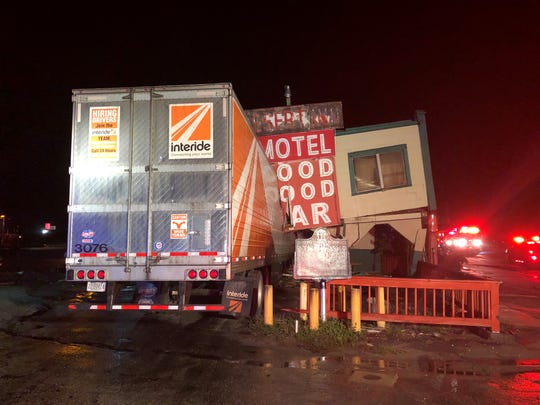
…Gone, I’m afraid.  It’ll be very hard for the venerable place to recover from this blow.

60153785-2cdc-4605-a6d0-17519c73c1a0-desert_inn_crash_3

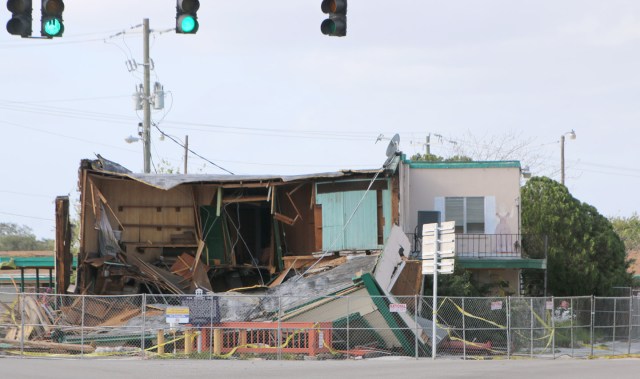
A trucker, apparently thinking it was a drive-in, did just that a few days before Christmas last year and embedded his rig in the building.  The truck went so deep into the first floor that when they pulled it out most of the building collapsed.

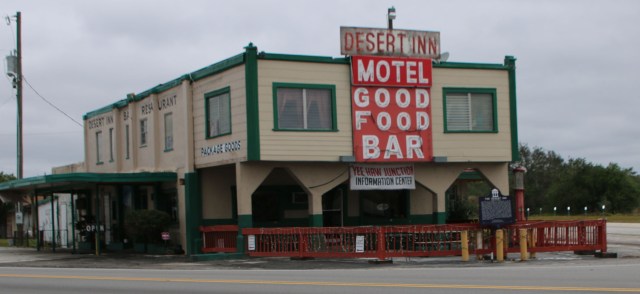
Here’s what it looked like before the truck hit it:IMG_2729c

And here it is a week ago:IMG_2001c

On shaky ground for a long while—the restaurant has been closed for about a year—the building had recently been donated to the local historical society, which was in the process of figuring out what to do with it.

I suspect that truck driver has now made their decision for them.  It doesn’t make me happy.  I am sure it’ll be replaced by a far less interesting eatery, probably a huge truck stop.

As a funky and mellow stopping place at the nicely rural crossroads of well-traveled routes in east-central Florida, it has always figured into most of my travels around the state.  For some previous blog posts about the place, go here and here.

Built in the 1920s, it ended up on the National Register of Historic Places not because of anything particularly unique about the building as a structure but because its presence spanned two key historical periods in Florida history.

Its location, now called Yeehaw Junction, was the juncture of two dirt tracks far back in the 1880s and the area became a hub of sorts for the wild cattle industry later in the century.  Moving into the 1900s, it became the site of a cattle depot, trading post, and, later, gas station/motel/restaurant called the Desert Inn.

This is from the paperwork that lead to the historical designation in 1994:  “The evolution of the Desert Inn coincides with the transition of the Florida cattle industry from a traditionally transient open range occupation to modern ranching operations, and with the early development of the state’s modern, transient tourist industry based on automotive transportation.  It reflects, in other words, the final stage of Florida’s long frontier history and the short twentieth century prelude to the space age.”

It’s a bit sad for me because it is another of those nice country places that are disappearing all over the place.  If you’re looking for someplace to stop up that way, however, there is still Griffis Café, a few miles up 441 in Kenansville.

Some more photos:

Posted in Uncategorized | 1 Comment

I almost missed that corner in Winslow Arizona

That’s true.  It was a couple years ago and I was meandering east through Arizona, sticking as closely as I could to the cracked pavement of the original path of classic Route IMG_7571c66.  Much of it has been paved over by Interstate 40 through that state, but there are still bits and pieces remaining.

This drive meant going through several small downtowns with a handful of businesses still eking out a living by catering to tourist traffic.  One looks much like the other and all are worth stopping in, but stop in them all and you’re not going to get anywhere.

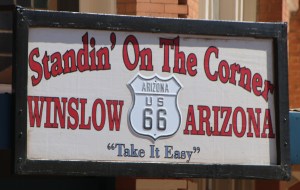
I ended up in Winslow by following the Old Historic Route 66 signs that took me off I-40IMG_7579c west of town.  The downtown was small but looked healthy. I wasn’t in a stopping mode though, and I was nearly through it and back to I-40 when the phrase hit my brain: “Standin’ on a corner in Winslow Arizona.”

Well, Damn!  Here I am!  I circled back and started looking for the corner.  It wasn’t hard to spot, as you can see from the photos.

Winslow, a town of some 10,000 folks (0.09 per cent Pacific Islander, in case you want to know) was a pretty important shipping and trade hub in the steam locomotive era, but began declining  when the Atchison, Topeka and Santa Fe Railroad moved its maintenance base to Barstow, CA, when diesels came along.  Today the BNSF Railway uses it as a crew change point and there is twice-daily Amtrack service.

Route 66 kept it going OK for a while, but the final blow to a bustling downtown came in the 1970s, when it became the second to the last town in the state to be bypassed by I-40.

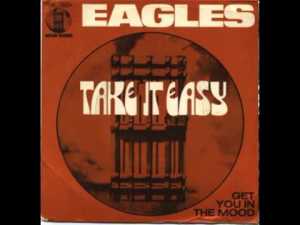
It rose to national fame of course in 1972, with “Take It Easy,” written by Jackson Browne take-it-easy-singleand Glenn Fry.  It was The Eagles’ first single and became the band’s signature song.

As Browne later recalled it:  “I knew Glenn Frey from playing these clubs – we kept showing up at the same clubs and singing on the open-mic nights. Glenn happened to come by to say ‘hi,’ and to hang around when I was in the studio, and I showed him the beginnings of that song, and he asked if I was going to put it on my record and I said it wouldn’t be ready in time.

“He said ‘well, we’ll put it on, we’ll do it,’ ’cause he liked it.  But it wasn’t finished, and he kept after me to finish it, and finally offered to finish it himself. And after a couple of times when I declined to have him finish my song, I said, ‘all right.’ I finally thought, ‘This is ridiculous. Go ahead and finish it. Do it.’ And he finished it in spectacular fashion. And, what’s more, arranged it in a way that was far superior to what I had written.”

According to Frey, the second verse of “Take It Easy” refers to a time when Jackson Browne’s automobile malfunctioned in Winslow on the way to Sedona, requiring him to spend a long day there. The city erected a life-size bronze statue and mural commemorating the song at the Standin’ on the Corner Park in 1999.

There is one Winslow favorite son worth mentioning:  Richard Kleindienst, US Attorney General under Richard Nixon.  He grew up fluent in Navajo.

He was largely untainted by Watergate, and in fact helped get the investigation started, but pled guilty to a misdemeanor relating to Senate testimony in which he attempted to hide White House efforts to get him to drop a Justice Department antitrust action against the International Telephone and Telegraph Corporation.

The judge who handed him a suspended sentence called him a man of ”highest integrity” but one who had ”a heart that is too loyal.”

Posted in Uncategorized | 1 Comment

Walden Pond: Thoreau and the Ice King

Walden Pond is nicely nestled in Concord, Massachusetts, about 20 miles west of Boston.  It’s a kettle pond, left behind by retreating glaciers ten or twelve thousand years ago.  (Don’t ask me how we know that please)

It’s not a normal pond, of course.  This post is intended to give you a Thoreau explanation why.

THAT’S A LOUSY PUN, you’re screaming.  Let me point out that 19th century New Englanders put the accent on the first syllable, not the second one, as we now do.

So just calm down.

It’s not an ideal paddling pond for me, a bit small at 64 acres, very few nooks and crannies, and no fowl-filled wetland areas.

Also, getting to the launch area is a bit of a chore because you have to pay the park entrance fee at the main parking lot on the east side of Route 126 and then turn around and drive to the launch area on the west side of Route 126.  The place is very busy on summer weekends so all that maneuvering with a canoe on a trailer through congested auto and foot traffic takes a while.

But how can one NOT go to a place so embedded in the culture?

I’ve been there twice.  The first time was on a summer Saturday while driving home to Connecticut from New Hampshire.  When I realized that the sign I saw that said “Walden Pond” was THE Walden Pond I had to stop.

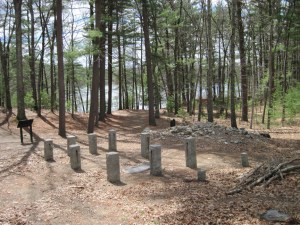
It was a busy day.  Lots of folks come to swim at the small beach, but the main attraction is the pleasant path along the shoreline to the site of Henry David Thoreau’s cabin.  The building’s location is marked by granite posts and there is a replica of it on the park grounds.

IMG_0367c

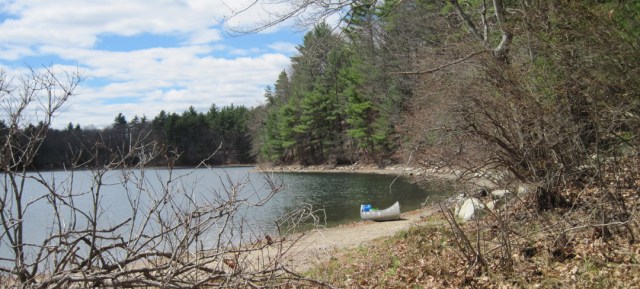
The pond is visible from the Thoreau cabin through the sparse leaves of early spring.

I returned early the following spring because I wanted to see the place without so many leaves on the trees and because I didn’t have my canoe with me on that first visit.

The trees mattered because I wanted to see if Thoreau had had a water view from his cabin.  He certainly did not have one when the trees were fully leafed out, assuming the trees were there during the two years he lived in the cabin in the mid-1840s.

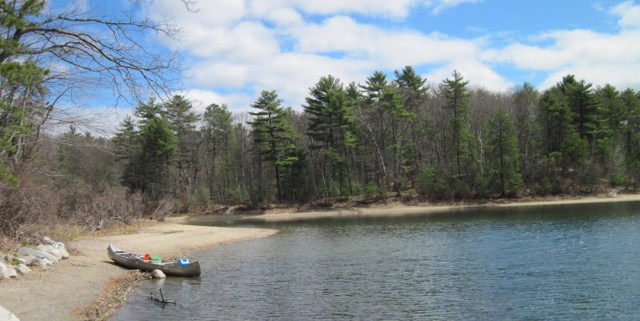
And I wanted to paddle the pond.  Paddling is allowed, but no motors and no sails. I think Thoreau would have agreed with banning the former, but the latter would seem to be right up his alley. Among his dying words, it is reported, is the phrase: “Now comes good sailing.”    And here’s another quote: “The sail, the play of its pulse so like our own lives: so thin and yet so full of life, so noiseless when it labors hardest, so noisy and impatient when least effective.” But those are the rules.IMG_3949c

I hit the gift shop too, of course.  Found the perfect T-shirt for myself.

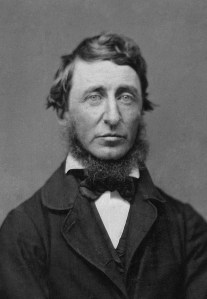
Henry David Thoreau was born David Henry Thoreau in 1817.  He decided after college to go by Henry David.   His maternal grandfather led the first recorded student rebellion in the colonies, at Harvard, which the younger Thoreau attended from 1833 to 1837.

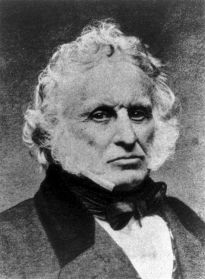
His life appears to have been shaped by the steadiness of work at the family’s pencil Benjamin_D._Maxham_-_Henry_David_Thoreau_-_Restored_-_greyscale_-_straightened (1)factory and the influences that came his way through a friendship with Ralph Waldo Emerson, who he met after college graduation.  Emerson became a mentor of sorts, inviting the younger man to live at his home and tutor his children and introducing him to folks like poet Ellery Channing, journalist Margaret Fuller, educator and philosopher Bronson Alcott, and novelist Nathanial Hawthorne.

It was Channing, in 1845, who told him “Go out upon that, build yourself a hut, & there begin the grand process of devouring yourself alive. I see no other alternative, no other hope for you.”

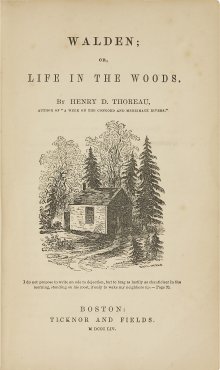
Just two months later Thoreau moved to a small house he had built on land owned by Emerson at Walden Pond and began his two-year experiment with minimalist living.  More precisely, it was two years, two months and two days.Walden_Thoreau

His cabin was a whopping 1.5 miles from the Emerson home, to which he returned to live at Emerson’s request to help his wife manage the household while he was traveling in Europe.

The book, Walden, or Life in the Woods, was published in 1854 and Thoreau continued to write until his death in 1862 at age 44 from tuberculosis, a disease he had first contracted in 1835.

He was asked by his aunt Louisa on his deathbed if he had made peace with God.

“I did not know we had ever quarreled,” he replied.

And now let’s get to the Ice King:

Thoreau’s years at Walden Pond overlapped with another figure of the time, Frederic Tudor, dubbed Boston’s “Ice King.”  Older than Walden by some 40 years, Tudor was hitting his entrepreneurial stride at about the time Walden moved into his cabin.

Walden was one of several ponds from which Tudor cut huge blocks of ice in the winter and shipped and sold all over the world and became a very wealthy man.800px-Frederic_Tudor-facingright_pre1864

The ice was free, sawdust for packing and insulation was free and shipping was cheap because many vessels leaving Boston were empty.  Sure, there is loss on the way: 180 tons of ice at the start would become 100 tons by the time it arrived in India four months later.  But it was profitable.

Thoreau philosophized upon it all in his journal while watching Tudor’s ice harvesters one winter:  “The sweltering inhabitants of Charleston and New Orleans, of Madras and Bombay and Calcutta, drink at my well … The pure Walden water is mingled with the sacred water of the Ganges.”

There, consider yourself Thoreaully informed.

IMG_3909c

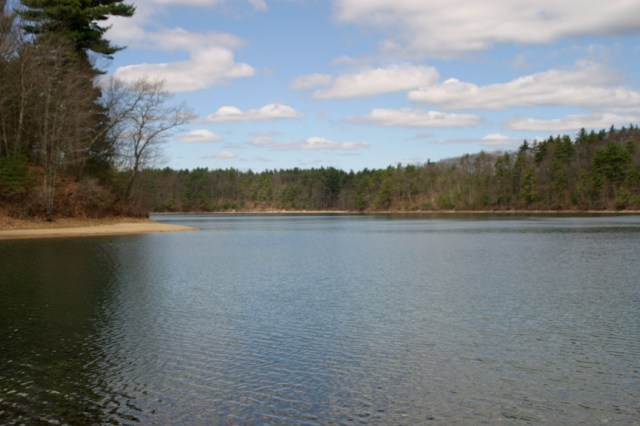
This shot is from the boat ramp, in the southeast corner, to the cabin site in the northwest corner, about dead center in this photo.  (All Photos by Ron Haines)

IMG_0377cIMG_0373c

Posted in Uncategorized | 2 Comments

The midnight watchman

I hadn’t heard the song in months.  It’s on one of those CD’s I keep in the car and play only when I am on a serious road trip.  It’s been a good while since I’ve enjoyed one of those.IMG_1347c

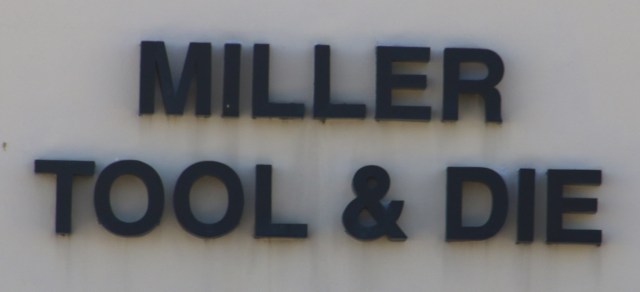
But that didn’t keep this sign on a building in Lake Park, FL, from hitting me right between the eyes this afternoon as I meandered my way back home from a short paddle on the Loxahatchee River up in Jupiter.

The song?  “A Better Place to Be,” of course.  One of those great poems set to music by a songwriter I have long enjoyed.  My music tastes were set in stone decades ago, in case you hadn’t noticed.

Seeing the sign today pushed any other thoughts out of my brain and I was left with this:  “I am the midnight watchman down at Miller’s Tool and Die. And I watch the metal rusting, and I watch the time go by.”

Harry Chapin was born in 1942 and died in a car accident in 1981.  If you’re of a certain age, just say out loud, “It was rainin’ hard in Frisco……”  and it will all come screaming back.

And for a look at some of what Harry Forster Chapin left behind go here.

IMG_1349c

Posted in Uncategorized | 3 Comments

End of my 2019 northern paddling season

I almost forgot to post a note about the end-of-season paddle this year with my friends at Paddle Killingly, an eastern Connecticut paddling group I belong to.

To mark the final paddle of the season we always have a pizza party.

This year was a special one because Granddaughter Margeaux came along in her kayak.

It was a chilly day, and I was glad I’d thrown a jacket in for her to wear and that I had my

IMG_0612hat

Margeaux in the hat she gave me.  She sewed the moose design on it.

backup stocking cap along.  The hat actually was a gift from her that she had hand sewed the outline of a moose into.  One of my paddling friends had an extra pair of gloves that came in handy too.

She did quite well.  The use of a tow rope to augment her paddling works nicely when we’re against the wind but otherwise she can keep up by herself.  We headed back to the launch a bit before everyone else and had such a nice time just moseying along by ourselves that the rest of the group caught up to us about when we were ready to come ashore at the boat ramp.

Here are some photos.


Posted in Uncategorized | 2 Comments

Bubbles

I’ve never done a whole lot to direct the trajectory of my life. Things just seem to have happened of their own accord as I’ve moved from one phase to another.

That’s why, to this day, I am amazed that I had a hand in affecting the trajectory of someone else’s life in a very substantial way.

To explain this means going way back to around 1980, give or take a year or so. I was a photo assignment editor for The National Enquirer, one of four persons on the photo desk responsible for not only illustrating the various stories brought in by reporters but also scouring the world and our own imaginations to come up with photos that were so good they could by themselves catch the attention of the reader.

It was a fun time. We had no limits on our ideas and no limits on money, as long as the ‘boss,’ Generoso Pope, approved of whatever ideas we came up with. GP, as he was referred to, owned the paper. It was selling millions of copies a week with a very popular, reader-friendly mix of celebrity and real-life stories, displayed with gee-whiz headlines and illustrated with eye-stopping photos.

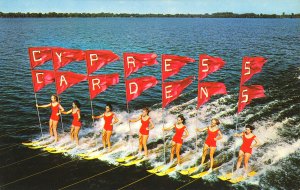
A lot of the fun for me was coming up with ideas for amazing photos. For example, Cypress Gardens (now the site of Legoland) was then a major Florida tourist attraction (pre-Disney), with its beautiful gardens, lovely ladies in southern-belle costumes, and the famed, Florida-shaped Esther Williams swimming pool.

It was also home to a highly professional, world-class water ski show, often featured in Enquirer photo displays.  It was, in fact, where barefoot water skiing was first performed, in 1947.

I got the hairbrained idea one day of doing photos of someone water skiing on their head. So I called up the publicity person at Cypress Gardens: Do you think one of yourcypress gardens skiiers folks can figure out how to do that? I asked. Sure, was the reply. GP approved the idea.

Weeks went by. I checked in every few days. “We’re working on it,” was the constant refrain. Finally, the word came back from Cypress Gardens: “We can do it using a helmet with a disc attached to the top, but not the bare head.”

I had a quick conference with GP. It’ll sort of look like he’s skiing on his bare head, but he won’t be, I said. Not good enough. Kill it, was the response.

You get the idea. The game was to come up with photos that would knock your socks off. If you couldn’t do that, the photo would not run.

So, to get back to the point of all this, on another day I was scrounging for ideas and found a small story from an Indiana newspaper about Eiffel Plasterer, a high school and college physics and chemistry teacher who for years had been working with bubbles, large and small soap bubbles.

Hmmm, I mused, I wonder if he can put a kid inside a bubble?   So I called him up and asked and he said sure, he could. So I got the necessary GP approval for the project and started arranging things.

I needed a photographer. Richard Faverty was a free-lancer in Chicago I had used often in the past. I knew from those previous assignments and my many chats on the phone with him that he was a great people person, had a good imagination, and would be interested and enthusiastic about this kind of off-beat assignment. He was indeed.

We set aside a weekend for it. Richard called me that Sunday night. Eiffel can’t do it, he reported. He couldn’t get a kid inside a bubble. I decided to pull the plug on the project. There was no sense keeping a photographer there if it just wasn’t going to happen.

Richard called me up the following week. “Ron, I can do it,” he said. This from a person who had no experience in blowing bubbles. OK, I replied, give it a go and let me know how it goes.

To cut to the chase, he did do it. And he photographed it. And the photos ran in The Enquirer.

richard_sandi_bubble[1235]c

richard_sandi_bubble[1235]text

That changed his life.

After the photos ran he started getting calls from around the world asking him to do bubble appearances. It started with a Japanese TV show, then a call from a Las Vegas promoter, a stint in Israel with the famed Fercos magic show and it snowballed from there. He was hooked. His career as Professor Bubble exploded and included shows in 37 countries; appearances on The David Letterman Show, the Mickey Mouse Club and Sesame Street; a book in 1987, Professor Bubble’s Official Bubble Hand-book, and the invention of many bubble toys and tools.

Where was I during all this? I kept track a bit, but Richard and I gradually lost contact. Our paths parted about the time his bubble career was really taking off, mainly because I left my job and spent a couple years at home with daughter Jennifer. I was no longer talking to photographers all over the world day in and day out.

When I returned to the business in 1984 it was as photo editor at Globe. The tabloid world had evolved to mostly a celebrity-driven publishing model and my days of enterprising photos and staying in constant contact with freelancers in places other than New York and Los Angeles were over. I remember calling him up in those early years at Globe to touch base and chat, but by then of course he was bubbling along full time. I remember us joking then about the role I’d played in the turn his life had taken.

Fast forwarding along, he moved on to corporate web design and digital photography and away from bubbles in the 1990s and in 2000 moved his photo studio from Chicago to Las Vegas  His exposure to the magic industry, computer skills and limitless imagination served him well and he carved out a nice niche helping acts from the Vegas strip and elsewhere come up with very effective promo shots.

So why dredge all this up now? Well, because I visited Richard last September. We had not stayed in close contact at all. I sort of kept up with him on Facebook. I didn’t think we’d ever met before, but he jogged my memory and I now vaguely recall him visiting the office in Florida one time.

Our relationship for me was like that I’ve had with a couple other photographers from the Enquirer era who I remain in contact with but rarely see. It is hard to explain why some of these relationships last: It’s a combination of a pretty good working telephone relationship, with enough leisurely chatting to know that we have some things in common and perhaps a mutual respect.

And the result of it is the feeling I have that yes, we will meet someday, and we will hit it off in person as well as we have on the phone.

It has worked that way for me with others and it was that way with Richard in Vegas.

We were together only a few hours, with lunch included, and what struck me about him today as it did years ago was the easy-going nature, ease of imagination and sense of humor. We hit it off as well as I had hoped. I was glad I stopped in.

Here’s the sequence of photos from the clipping above:

And here’s Richard in his office during our visit:

Posted in Offbeat, Road trip | 4 Comments

Burma-Shave

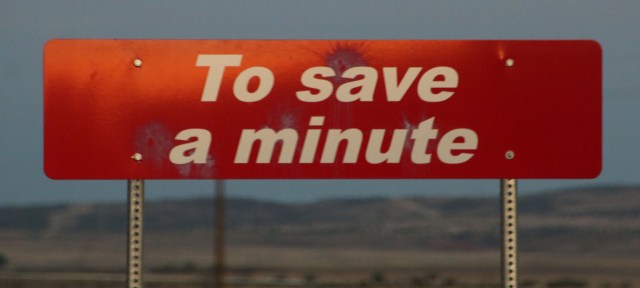
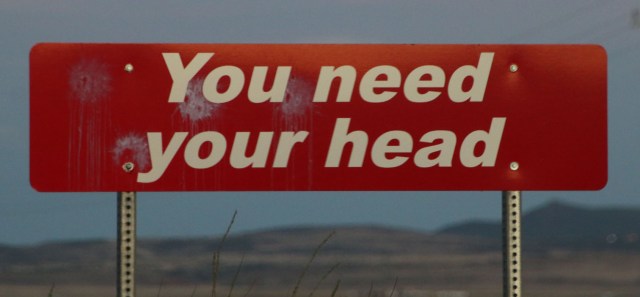
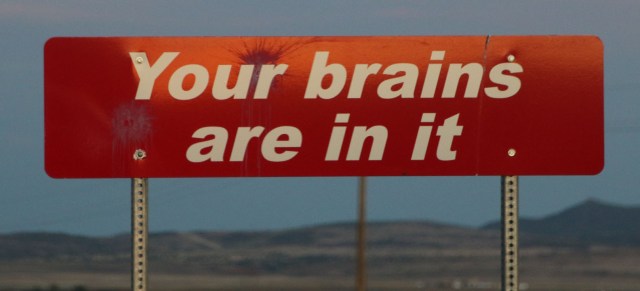
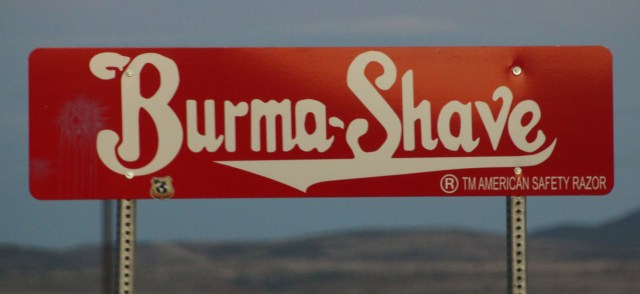
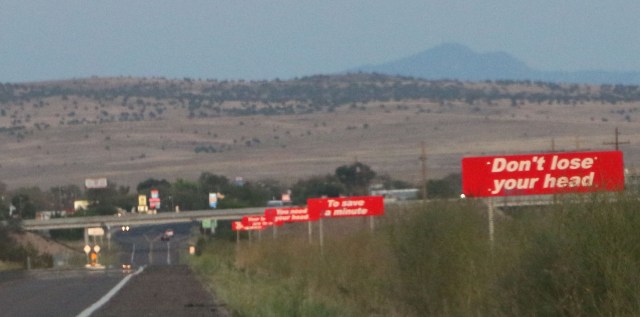
Those Burma-Shave signs, remember them?  I thought they were completely gone long ago, but I happened upon a string of them on a drive out West a couple months ago.

A relic of a time when driving a long distance was a bit of an adventure and roadside diversions a welcome thing, the Burma-Shave signs were once ubiquitous, but now, as far as I can find out, limited to a nostalgic collection of replicated icons along old Route 66 in Arizona. IMG_9104c

The Burma-Shave brand of brushless shaving cream was the creation of Clinton Odell and his sons Leonard and Allan.  Their Minneapolis company, Burma-Vita, was named after a liniment that wasn’t selling very well.  The ‘Burma’ came from the Malay Peninsula, the origin of one of the ingredients of the unprofitable product.

So they hired a chemist to come up with something people would use daily and voila! Burma-Shave was born in 1925.    Allan Odell is credited with coming up with the advertising idea.  He noticed a series of signs along the highway saying consecutively, Gas, Oil, Restrooms, with the final one pointing to a service station.  That sequence caught his eye better than a single billboard and he wanted to try it out for the shaving cream.  His father gave him $200 to try it out locally and sales soared.IMG_9105c

Soon the signs were nationwide and business was booming. Typically,  consecutive small signs would be posted along the edge of the highway, spaced for sequential reading by passing motorists. The last sign was almost always the name of the product.

The first set of slogans were written by the Odells; however, they soon started an annual contest for people to submit the rhymes. With winners receiving a $100 prize, some contests received over 50,000 entries.IMG_9106c

From 1925 into the 1960s the billboards were a highly successful advertising gimmick.  At the peak of the product’s popularity in the late 1940s some 7,000 signs dotted the country.   Postwar urban growth and higher speed limits started their demise, however, and sales fell with it.  The company changed hands in the late 1960s and corporate disinterest in the advertising campaign and apparently the product spelled the end.

Though it’s murky, the Burma-Shave trademark seems to be in the hands of the American Safety Razor Corporation these days, but they aren’t doing much with it. IMG_9107c

And just one of those little known facts:  We can thank the American Safety Razor Corp. for introducing and popularizing the phrase “Five O-Clock Shadow.”  That was back in 1942!

Thanks for that, folks.IMG_9108c

IMG_9102c

The signs above were along old Route 66 near Seligman, Arizona. Did you get through this whole post without skipping ahead to read the signs?  (Photos by Ron Haines)

Here are a few other Burma-Shave jingles.  The interwebs are full of them.

Within this vale
Of toil and sin
Your head grows bald
But not your chin – use
Burma-Shave

Around the curve
Lickety-split
It’s a beautiful car
Wasn’t it?
Burma-Shave

If Crusoe’d kept
His chin more tidy
He might have found
A lady Friday
Burma-Shave

Grandpa’s beard
Was stiff and coarse
And that’s what caused
His fifth divorce
Burma-Shave

Posted in Offbeat, Road trip, Signs | 1 Comment

Route 66. Where old gas stations thrive.

This post has been a long time gestating.

I’ve been crisscrossing the United States steadily for nearly a decade now (retirement somehow freed up a lot of time) and I have traveled old sections of Route 66 for miles in all of the states it crosses, sometimes on purpose, sometimes by accident.

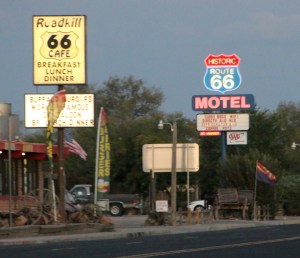
I have always appreciated the health and vitality of many of the small towns it runs through and I have photographed many of the recycled gas stations I have found along it.  In fact, the whole route is a treasure trove of classic stations that have been turned into other businesses.

One quick example…on a recent drive through Williams, Arizona, which in 1984 was the final section of the original route to be bypassed by an Interstate, I discovered these three former stations, one now a café, the other an Italian restaurant and the third a gas station museum:

By the way, the photos above have been added to my collection of recycled gas stations.

U.S. Route 66, also known as the Will Rogers Highway, the Main Street of America, and the Mother Road, was established in 1926.  By 1938 it had been completely paved.  By 1985, however, it had been replaced by the Interstate highway network and it was removed from the U.S. highway system.

Portions of the remaining roadway in some states have been designated scenic byways and given the name Historic Route 66.  With the nostalgia craze and resultant theft of

IMG_9111c

Route 66 scene in Seligman, Arizona.

many metal Historic Route 66 signs, however, the designation is now usually made by markings on the roadway itself.

I am sure many a modern-day road trip has been planned around following some of the existing sections of the old pavement.  If you’re contemplating that, here’s a good link for maps and tips.  For those inclined to a two-wheeler, there is also a USBR 66 these days, a bicycle route that runs along or parallel to former segments of the route for most of its length.

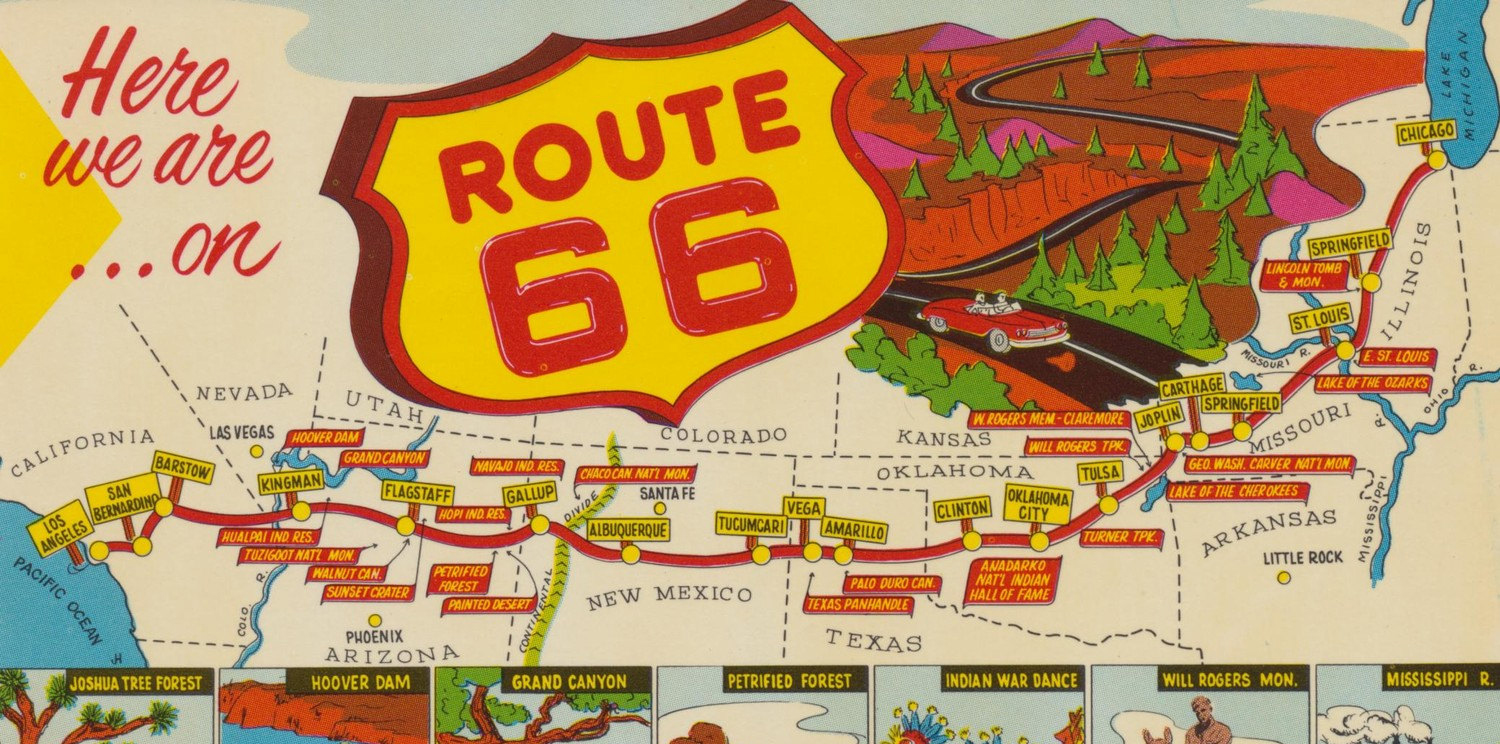
In its heyday, Route 66 stretched 2,448 miles from Chicago to Santa Monica, through Illinois, Missouri, Kansas, Oklahoma, Texas, New Mexico, Arizona and California.  It was designed to pass through a lot of towns that at the time were not connected by a major highway and it therefore spurred the growth of the communities it passed through.il_fullxfull.221896335c

In the 1930s it was the favored route for those heading west, many driven by the Dust Bowl that struck the plains in the latter part of the decade.   The route was mostly flat and thus favored by truckers and in the postwar era it became a popular automobile tourist route.  To serve and entertain all the travelers, motels, stores, restaurants, gas stations and roadside attractions sprang up, many with iconic architecture worthy of eventual historic preservation status.  The fast food industry was basically born along the route.

Firmly linked to the growth of the automobile, the route also became part of the culture.

“(Get Your Kicks on) Route 66,” composed in 1946 by songwriter Bobby Troup, was recorded that same year by Nat King Cole and it quickly became a hit.  Troup got the idea for the song on a cross-country drive from Pennsylvania to California with wife Cynthia. Julie_London_Bobby_Troup_Emergency_1971

They began on US 40 and continued along Route 66.  Troup considered a tune about US 40, but Cynthia fortunately saw the potential of the catchy phrase “Get Your Kicks on Route 66.” Of the eight states the route passes through, only Kansas is not mentioned in the song.

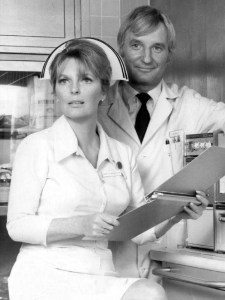
Troup, by the way, who yearned to become a Hollywood songwriter, also got some acting roles, most memorably perhaps as Dr. Joe Early in the 1970s TV show Emergency!  He is shown here with his second wife, actress Julie London, who played nurse Dixie McCall in the series.

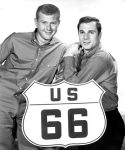
The route also lent its name to another TV show, Route 66.  The 1960s series was set and Martin_Milner_George_Maharis_Route_66_signfilmed in a different location every week, but ironically barely mentioned the real-life Route 66.  Series stars were Martin Milner and George Maharis, who had to quit because of hepatitis during the run. A character played by Glenn Corbett became Milner’s new traveling buddy.  Milner and Maharis are in the photo at left


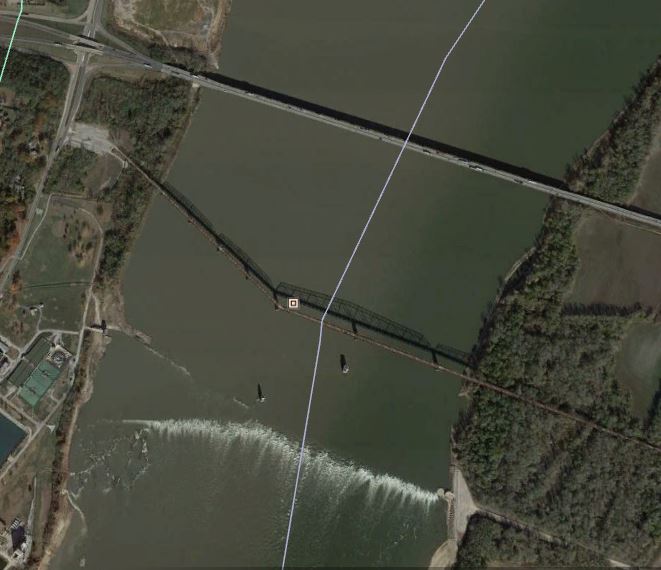
Finally, I must mention the Chain of Rocks Bridge, because it is at the intersection of two major US landmarks that have figured into my life:  Route 66 and the Mississippi River.

Historically, the Chain of Rocks Bridge carried Route 66 across the river on the north side of St. Louis. It was replaced by a new bridge just upstream in 1966 and the old one now carries only bicycle and foot traffic.

It must have been a white-knuckle ride across that 24-foot wide, two-lane span back in the day.  It’s a mile long and has a 22-degree bend in the middle.

Did I paddle under it on my Mississippi River trip?  No, I went around it.

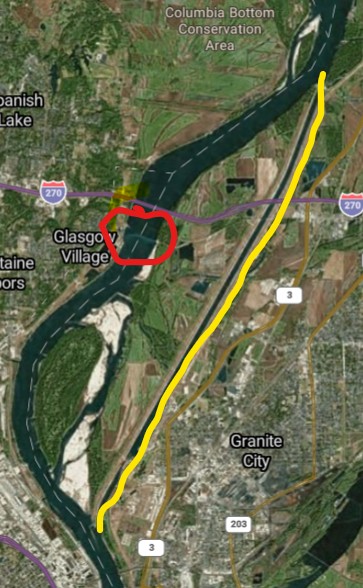
The Chain of Rocks stretch of the river is a series of rock ledges, resulting in shoals and rapids that rendered it unnavigable for commercial shipping.  In the 1940s and 1950s, the Corps of Engineers built an eight-mile canal to bypass that reach, with a lock and dam at the downstream end of it.  A small, low-water dam was built just downstream of the bridge to keep the water level up and force some flow into the canal.

It is possible to canoe under the bridge and over the rapids created by the low-water dam, or portage around.  But I have no experience with rapids and I’d done enough portaging up in Minnesota to last a lifetime.  So I chose to use the canal and the locks when I paddled through the area.

I did get to walk across a bit of it though.  A friend in nearby Alton, Illinois, who I stayed with on my way downstream, took me there for a look during my visit with him.

Here’s a Google Earth view of it.  The new bridge is at top, the old one below and the low-water dam below that:Chain of Rocks


Below, the Chain of Rocks area is circled in red and a yellow line shows where the bypass canal runs.

Posted in Gas stations, Road trip | 2 Comments

A sign of my time

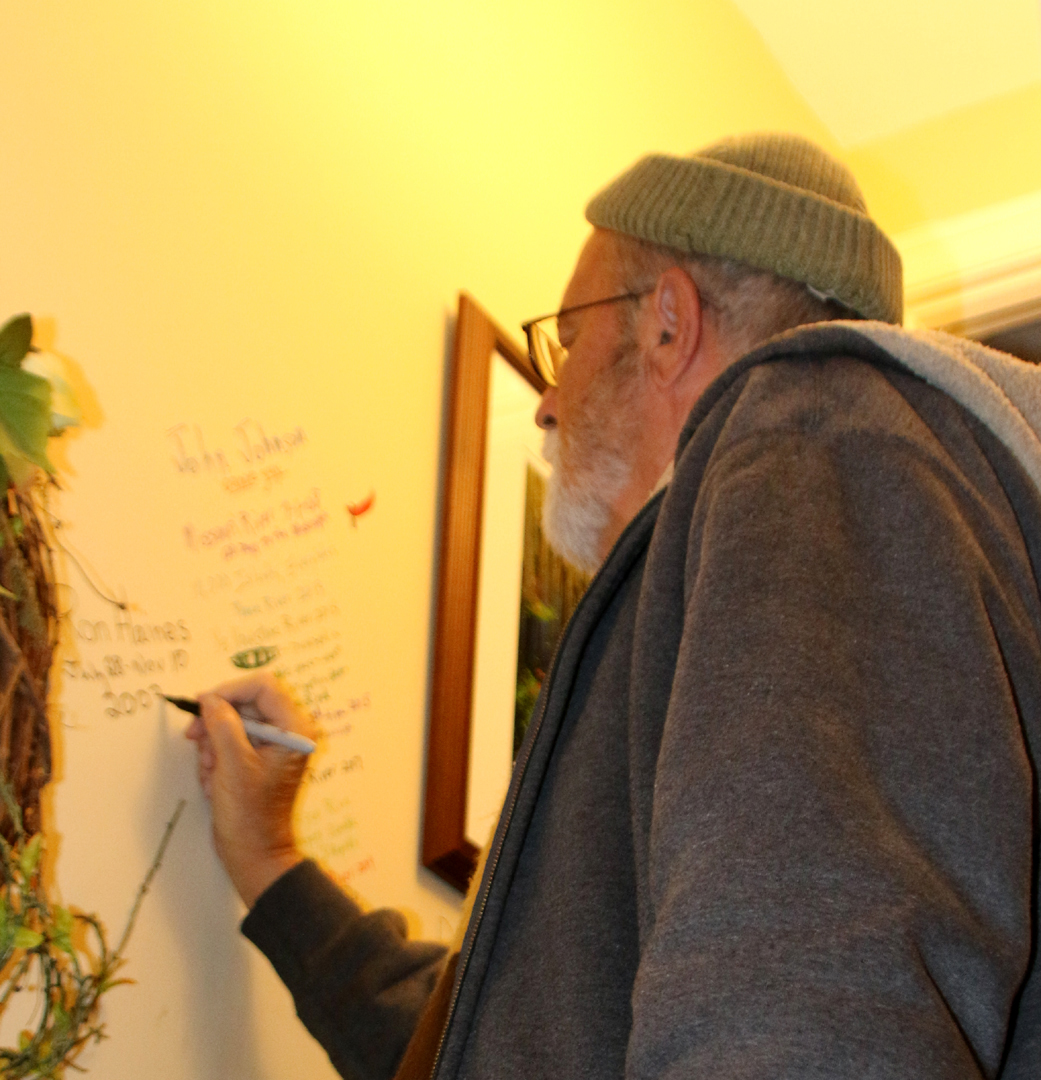
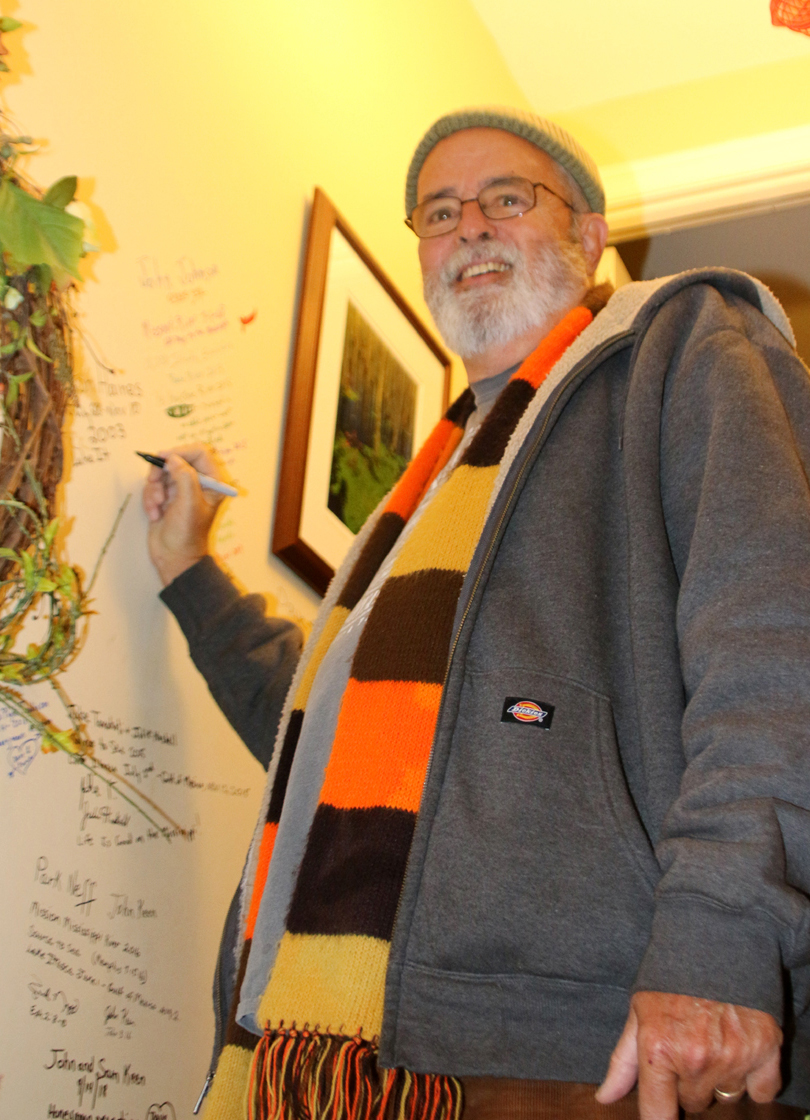
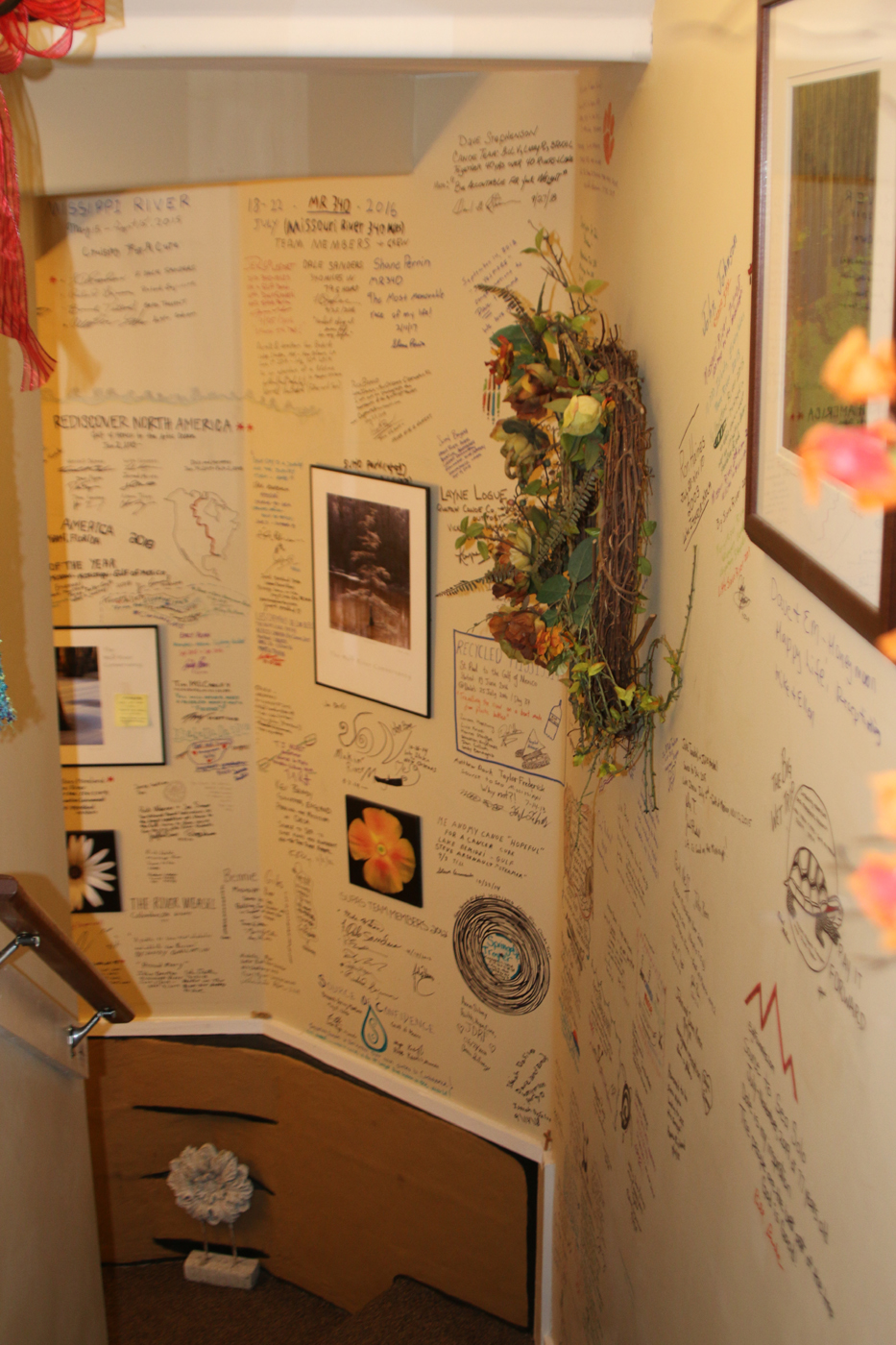
A week ago I was privileged to add my name to the wall of signatures of Mississippi River paddlers that Dale Sanders, the Grey Beard Adventurer, maintains at his home in Memphis for just that purpose.

For years Dale has been a ‘River Angel,’ one of those many kind folks up and down the Mississippi who aid thru-paddlers. Since 2012 he’s been collecting signatures on his wall.

A life-long adventurer, he himself paddled the river in 2015, becoming the oldest person, at age 80, to do so. He went on to hike the Appalachian Trail in 2017, becoming, at 82, the oldest person to do that in one calendar year.

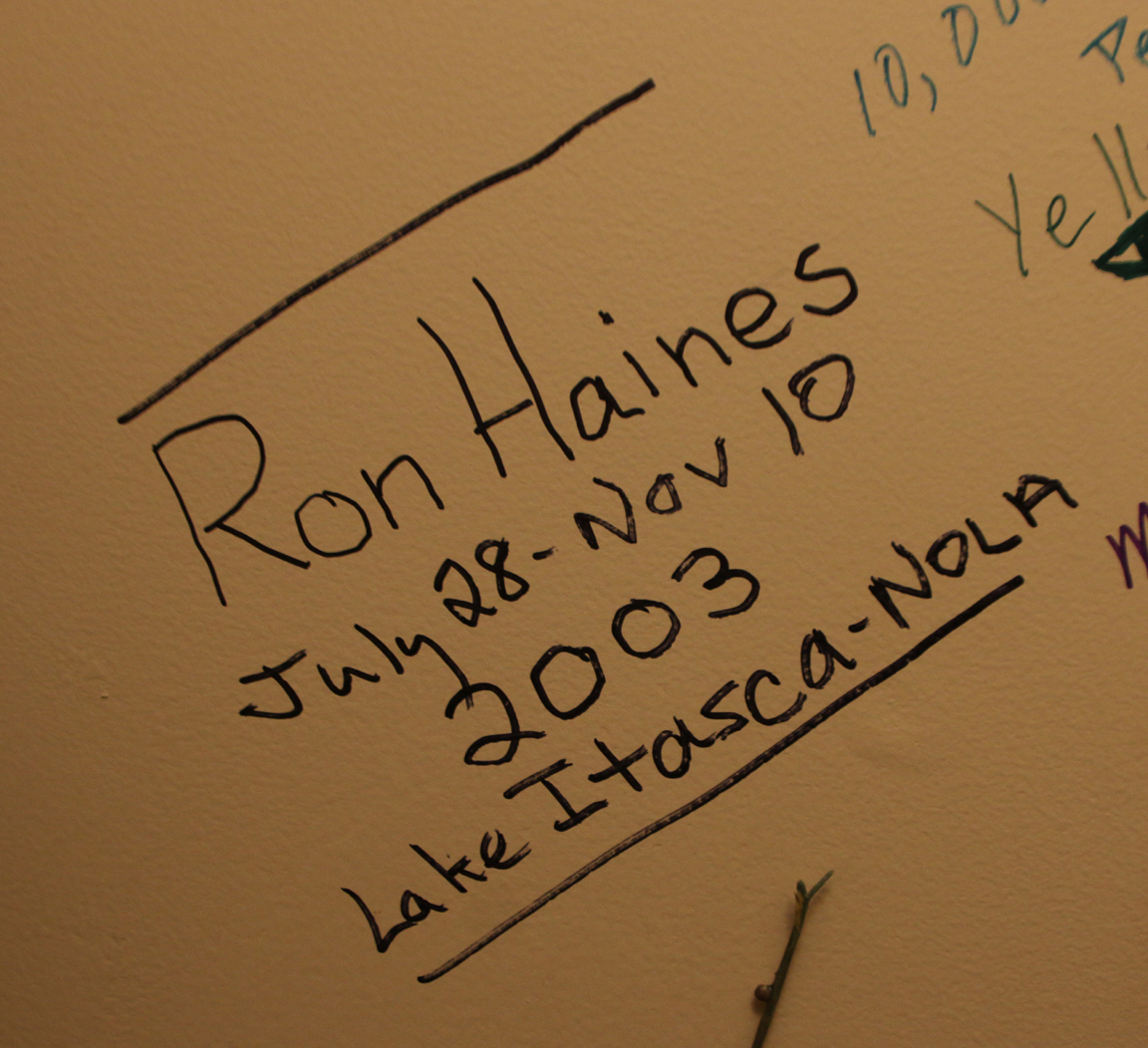
I’ve known of Dale for several years and had wanted to meet him and add my 2003 thru-paddle to his wall. Fortunately, our path from Connecticut to Arkansas for a Sue family meetup took us right through Memphis, so I messaged him that I was coming.

Unfortunately, Dale had a scheduled hiking trip on the day I would pass through, but his wife, Meriam, was a most gracious host. The two of them, by the way, hitchhiked around the world together back in 1983, passing through 26 countries.

Thanks Dale and Meriam.

Ron Haines signing wall at Dale Sanders house on 10/31/19.  Photo by Sue HainesRon Haines signing wall at Dale Sanders house on 10/31/19.  Photo by Sue HainesIMG_0706cA portion of the wall at Dale Sanders house on 10/31/19.  Photo by Ron Haines

Posted in Uncategorized | 3 Comments