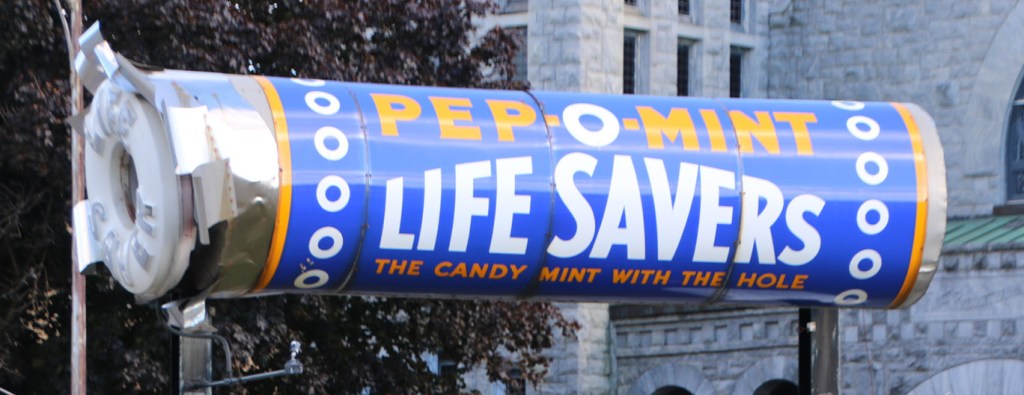
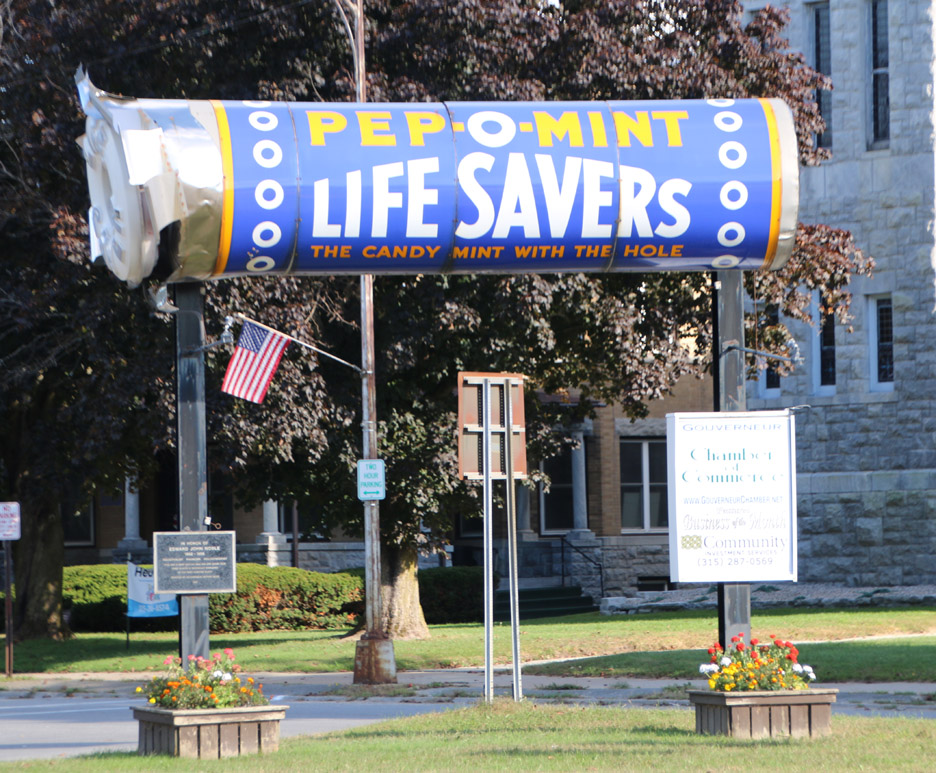
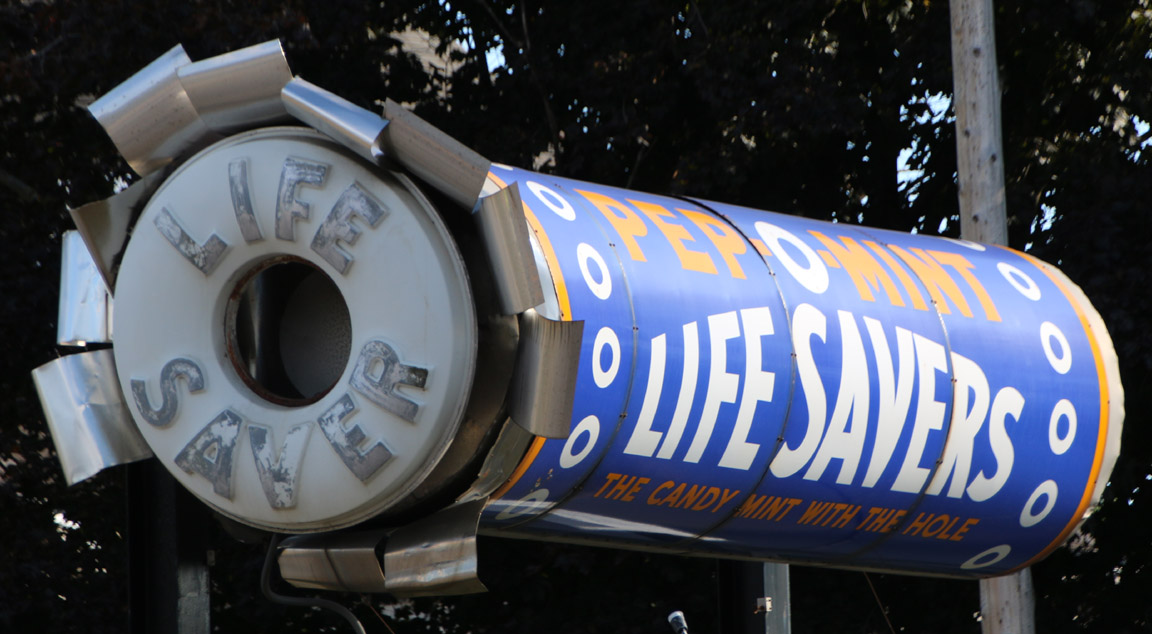
Wandering through Gouverneur, New York, a while ago I happened across this interesting monument along East Main Street in the center of town.
Gouverneur isn’t exactly a manufacturing hotspot. A tiny place of some 6,500 people, it’s on the western fringes of the Adirondacks, not very far from the St. Lawrence River in way, upstate New York.
So, what’s that monument on Main Street all about? Turns out it’s there because Gouverneur is the birthplace of Edward John Noble, the man credited with putting Life Savers on the map. It used to adorn the headquarters of the Life Savers Candy Corporation in Port Chester, on Long Island Sound, some 350 miles south.
The candy was actually invented by maple syrup producer turned chocolatier Clarence Crane of Garrettsville, Ohio. Crane, the father of American poet Hart Crane, was looking for a “summer candy” that would hold up in the heat better than chocolate.
To do that he used a machine that pharmacists used to manufacture round flat pills. He then punched a hole in the middle of the candy, making it resemble a life preserver and dubbed the result “Life Savers.”
They came only in mint flavor and were packaged in cardboard and marketed as breath mints. The product remained only locally distributed until businessman and industrialist Edward Noble came along in 1913.
Noble bought the Life Savers business and trademark from Crane for $2,900. He replaced the cardboard with tin foil to improve freshness.
He significantly expanded the market for the product by installing Life Savers displays next to the cash registers of restaurants and grocery stores. He also encouraged the owners of the establishments to always give customers a nickel in their change to encourage sales of the five-cent product.
Sounds a bit like the 1970s tabloid wars for rack space at the supermarkets to me.
The brand exploded nationally when Noble brought aboard his engineer-brother, Robert Peckham Noble, who moved Life Savers from a handmade product into a modern automated manufacturing facility in Port Chester that churned out a variety of flavors and offshoots. Robert remained chief executive until he sold the company in the late 1950s.
As with nearly all of the products that are still around from the early 1900s, Life Savors went through a dizzying array of corporate mergers and acquisitions through the mid-century. Today it is part of Mars, Incorporated.
One interesting note is that during World War II other candy manufacturers donated their sugar rations to keep Life Savers in production so that the little candies could be shared with Armed Forces as a tasty reminder of life at home. How quaint, and how foreign to the way we do things these days!
Edward Noble went on to become the first chairman of the Civil Aeronautics Authority and the nation’s first Under Secretary of Commerce. In 1943 he founded the American Broadcasting Company.
The Port Chester, New York, Life Savers headquarters building that his brother developed is now on the National Register of Historic Places. Manufacturing there was discontinued in 1984 and it is now an apartment building.
The oversized roll of Life Savers that I encountered on Main Street in Gouverneur was one of several that decorated the headquarters building in Port Chester.
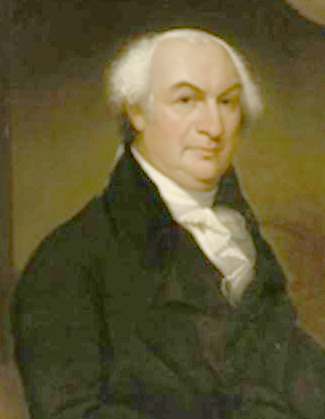
Gouverneur, by the way, was named after Gouverneur Morris, one of the signers of the Articles of Confederation and the United States Constitution, author of the preamble to the Constitution, one of the most outspoken opponents of slavery at the Constitutional Convention, and a United States Senator from New York from 1800 to 1803. Most sources call him a Founding Father.
His first name, from the French for “governor,” today does not even rank among the 1,000 most popular boys’ names. I have no idea where it ranked in 1872, when he was born. It was his mother’s last name.
The family kept the name alive though.
His son was Gouverneur Morris, Jr., and a great-grandson, also named Gouverneur Morris, was an author of pulp novels, one of which was turned into the famous Lon Chaney film, “The Penalty,” in 1920.
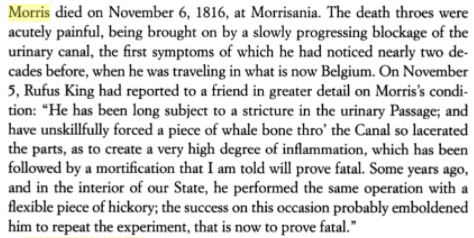
My sometimes dark sense of humor compels me to inform you of how he died, in 1816: He attempted self-surgery with a whalebone to clear a blockage in his urinary tract and died of internal injuries and infection.
Here’s a more complete account, from “Gouverneur Morris, author, statesman and man of the world,” by James J. Kirschke, 2005:
Aren’t you glad you read this all the way to the end?


 The Urge to be Someplace Else
I love that the sculpture has the open end with a Lifesaver popping out! So much more interesting than just a closed roll would have been.
Thanks for sharing all these bizarre details. Whalebone – shudder!
Vicky
LikeLike
You are so full of such useful information 😂. Thank you.
LikeLike
Ugh! But, yes, I AM glad that I read the piece all the way to the end!
LikeLike