Walden Pond is nicely nestled in Concord, Massachusetts, about 20 miles west of Boston. It’s a kettle pond, left behind by retreating glaciers ten or twelve thousand years ago. (Don’t ask me how we know that please)
It’s not a normal pond, of course. This post is intended to give you a Thoreau explanation why.
THAT’S A LOUSY PUN, you’re screaming. Let me point out that 19th century New Englanders put the accent on the first syllable, not the second one, as we now do.
So just calm down.
It’s not an ideal paddling pond for me, a bit small at 64 acres, very few nooks and crannies, and no fowl-filled wetland areas.
Also, getting to the launch area is a bit of a chore because you have to pay the park entrance fee at the main parking lot on the east side of Route 126 and then turn around and drive to the launch area on the west side of Route 126. The place is very busy on summer weekends so all that maneuvering with a canoe on a trailer through congested auto and foot traffic takes a while.
But how can one NOT go to a place so embedded in the culture?
I’ve been there twice. The first time was on a summer Saturday while driving home to Connecticut from New Hampshire. When I realized that the sign I saw that said “Walden Pond” was THE Walden Pond I had to stop.
It was a busy day. Lots of folks come to swim at the small beach, but the main attraction is the pleasant path along the shoreline to the site of Henry David Thoreau’s cabin. The building’s location is marked by granite posts and there is a replica of it on the park grounds.
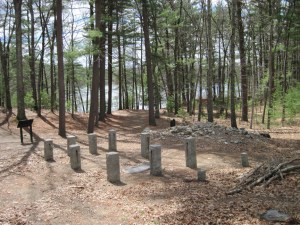
The pond is visible from the Thoreau cabin through the sparse leaves of early spring.
I returned early the following spring because I wanted to see the place without so many leaves on the trees and because I didn’t have my canoe with me on that first visit.
The trees mattered because I wanted to see if Thoreau had had a water view from his cabin. He certainly did not have one when the trees were fully leafed out, assuming the trees were there during the two years he lived in the cabin in the mid-1840s.
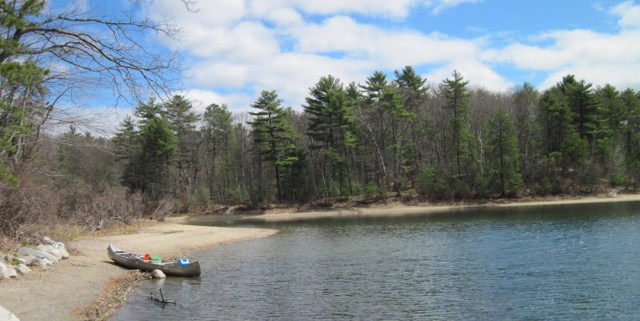
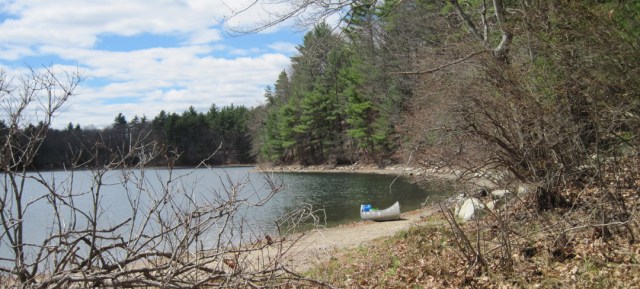
And I wanted to paddle the pond. Paddling is allowed, but no motors and no sails. I think Thoreau would have agreed with banning the former, but the latter would seem to be right up his alley. Among his dying words, it is reported, is the phrase: “Now comes good sailing.” And here’s another quote: “The sail, the play of its pulse so like our own lives: so thin and yet so full of life, so noiseless when it labors hardest, so noisy and impatient when least effective.” But those are the rules.
I hit the gift shop too, of course. Found the perfect T-shirt for myself.
Henry David Thoreau was born David Henry Thoreau in 1817. He decided after college to go by Henry David. His maternal grandfather led the first recorded student rebellion in the colonies, at Harvard, which the younger Thoreau attended from 1833 to 1837.
His life appears to have been shaped by the steadiness of work at the family’s pencil 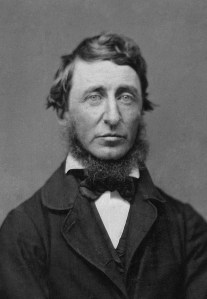 factory and the influences that came his way through a friendship with Ralph Waldo Emerson, who he met after college graduation. Emerson became a mentor of sorts, inviting the younger man to live at his home and tutor his children and introducing him to folks like poet Ellery Channing, journalist Margaret Fuller, educator and philosopher Bronson Alcott, and novelist Nathanial Hawthorne.
It was Channing, in 1845, who told him “Go out upon that, build yourself a hut, & there begin the grand process of devouring yourself alive. I see no other alternative, no other hope for you.”
Just two months later Thoreau moved to a small house he had built on land owned by Emerson at Walden Pond and began his two-year experiment with minimalist living. More precisely, it was two years, two months and two days.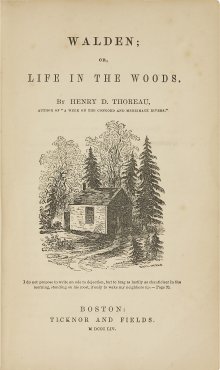
His cabin was a whopping 1.5 miles from the Emerson home, to which he returned to live at Emerson’s request to help his wife manage the household while he was traveling in Europe.
The book, Walden, or Life in the Woods, was published in 1854 and Thoreau continued to write until his death in 1862 at age 44 from tuberculosis, a disease he had first contracted in 1835.
He was asked by his aunt Louisa on his deathbed if he had made peace with God.
“I did not know we had ever quarreled,” he replied.
And now let’s get to the Ice King:
Thoreau’s years at Walden Pond overlapped with another figure of the time, Frederic Tudor, dubbed Boston’s “Ice King.” Older than Walden by some 40 years, Tudor was hitting his entrepreneurial stride at about the time Walden moved into his cabin.
Walden was one of several ponds from which Tudor cut huge blocks of ice in the winter and shipped and sold all over the world and became a very wealthy man.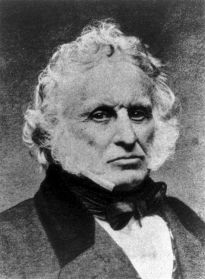
The ice was free, sawdust for packing and insulation was free and shipping was cheap because many vessels leaving Boston were empty. Sure, there is loss on the way: 180 tons of ice at the start would become 100 tons by the time it arrived in India four months later. But it was profitable.
Thoreau philosophized upon it all in his journal while watching Tudor’s ice harvesters one winter: “The sweltering inhabitants of Charleston and New Orleans, of Madras and Bombay and Calcutta, drink at my well … The pure Walden water is mingled with the sacred water of the Ganges.”
There, consider yourself Thoreaully informed.
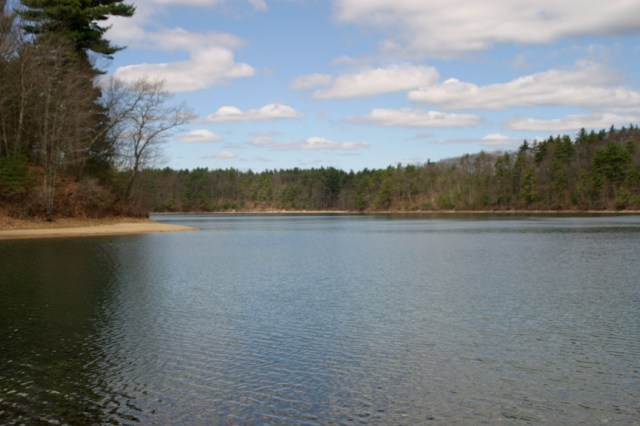
This shot is from the boat ramp, in the southeast corner, to the cabin site in the northwest corner, about dead center in this photo. (All Photos by Ron Haines)


The tea shirt reminded of of the origin of the word Saunter. Did we ever go over that?
Leslie
LikeLike
No we have not, but I can hardly wait. When are you back down here?
LikeLike