This post has been a long time gestating.
I’ve been crisscrossing the United States steadily for nearly a decade now (retirement somehow freed up a lot of time) and I have traveled old sections of Route 66 for miles in all of the states it crosses, sometimes on purpose, sometimes by accident.
I have always appreciated the health and vitality of many of the small towns it runs through and I have photographed many of the recycled gas stations I have found along it. In fact, the whole route is a treasure trove of classic stations that have been turned into other businesses.
One quick example…on a recent drive through Williams, Arizona, which in 1984 was the final section of the original route to be bypassed by an Interstate, I discovered these three former stations, one now a café, the other an Italian restaurant and the third a gas station museum:


By the way, the photos above have been added to my collection of recycled gas stations.
U.S. Route 66, also known as the Will Rogers Highway, the Main Street of America, and the Mother Road, was established in 1926. By 1938 it had been completely paved. By 1985, however, it had been replaced by the Interstate highway network and it was removed from the U.S. highway system.
Portions of the remaining roadway in some states have been designated scenic byways and given the name Historic Route 66. With the nostalgia craze and resultant theft of
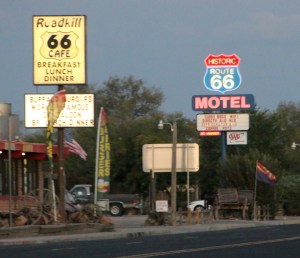
Route 66 scene in Seligman, Arizona.
many metal Historic Route 66 signs, however, the designation is now usually made by markings on the roadway itself.
I am sure many a modern-day road trip has been planned around following some of the existing sections of the old pavement. If you’re contemplating that, here’s a good link for maps and tips. For those inclined to a two-wheeler, there is also a USBR 66 these days, a bicycle route that runs along or parallel to former segments of the route for most of its length.
In its heyday, Route 66 stretched 2,448 miles from Chicago to Santa Monica, through Illinois, Missouri, Kansas, Oklahoma, Texas, New Mexico, Arizona and California. It was designed to pass through a lot of towns that at the time were not connected by a major highway and it therefore spurred the growth of the communities it passed through.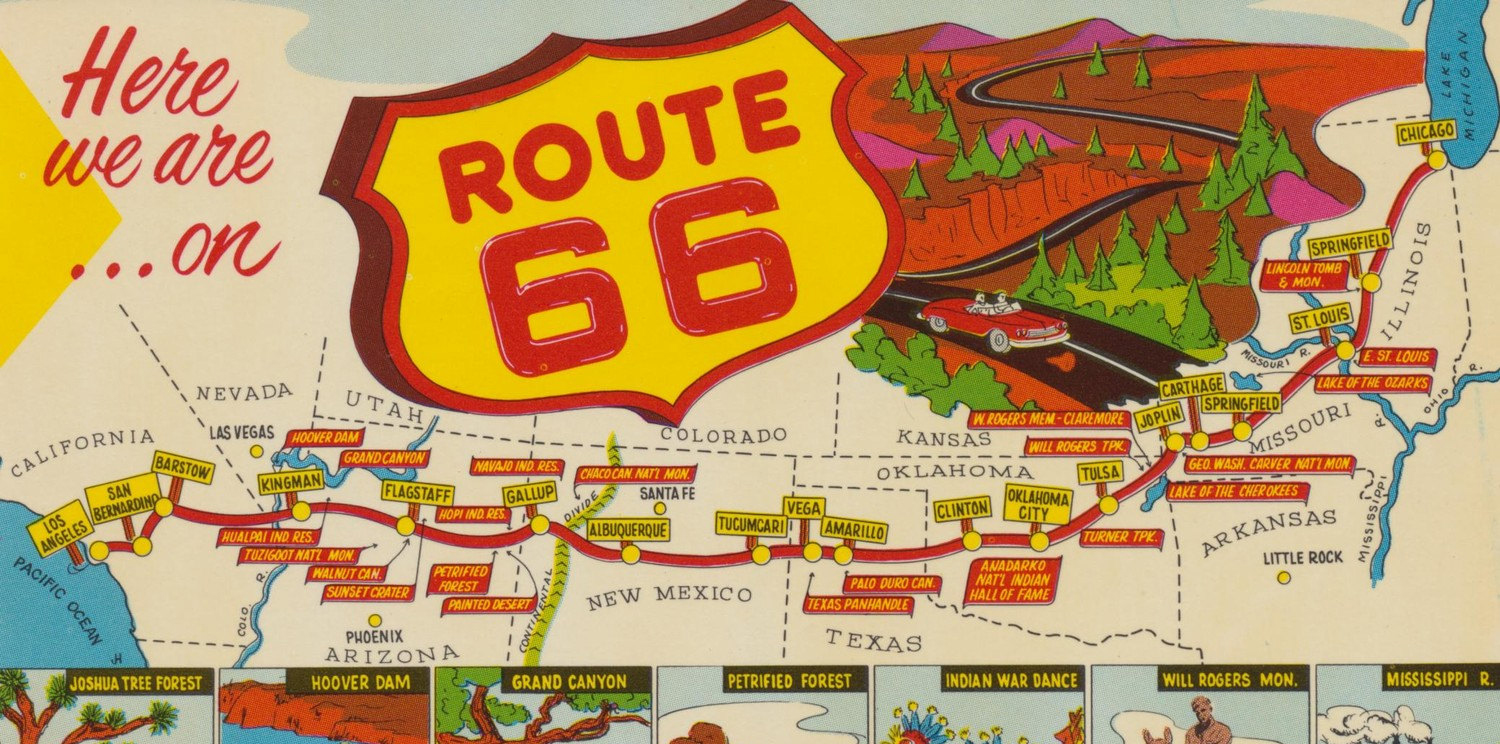
In the 1930s it was the favored route for those heading west, many driven by the Dust Bowl that struck the plains in the latter part of the decade. The route was mostly flat and thus favored by truckers and in the postwar era it became a popular automobile tourist route. To serve and entertain all the travelers, motels, stores, restaurants, gas stations and roadside attractions sprang up, many with iconic architecture worthy of eventual historic preservation status. The fast food industry was basically born along the route.
Firmly linked to the growth of the automobile, the route also became part of the culture.
“(Get Your Kicks on) Route 66,” composed in 1946 by songwriter Bobby Troup, was recorded that same year by Nat King Cole and it quickly became a hit. Troup got the idea for the song on a cross-country drive from Pennsylvania to California with wife Cynthia. 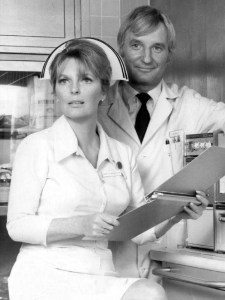
They began on US 40 and continued along Route 66. Troup considered a tune about US 40, but Cynthia fortunately saw the potential of the catchy phrase “Get Your Kicks on Route 66.” Of the eight states the route passes through, only Kansas is not mentioned in the song.
Troup, by the way, who yearned to become a Hollywood songwriter, also got some acting roles, most memorably perhaps as Dr. Joe Early in the 1970s TV show Emergency! He is shown here with his second wife, actress Julie London, who played nurse Dixie McCall in the series.
The route also lent its name to another TV show, Route 66. The 1960s series was set and 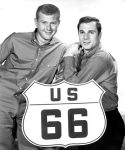 filmed in a different location every week, but ironically barely mentioned the real-life Route 66. Series stars were Martin Milner and George Maharis, who had to quit because of hepatitis during the run. A character played by Glenn Corbett became Milner’s new traveling buddy. Milner and Maharis are in the photo at left
Finally, I must mention the Chain of Rocks Bridge, because it is at the intersection of two major US landmarks that have figured into my life: Route 66 and the Mississippi River.
Historically, the Chain of Rocks Bridge carried Route 66 across the river on the north side of St. Louis. It was replaced by a new bridge just upstream in 1966 and the old one now carries only bicycle and foot traffic.
It must have been a white-knuckle ride across that 24-foot wide, two-lane span back in the day. It’s a mile long and has a 22-degree bend in the middle.
Did I paddle under it on my Mississippi River trip? No, I went around it.
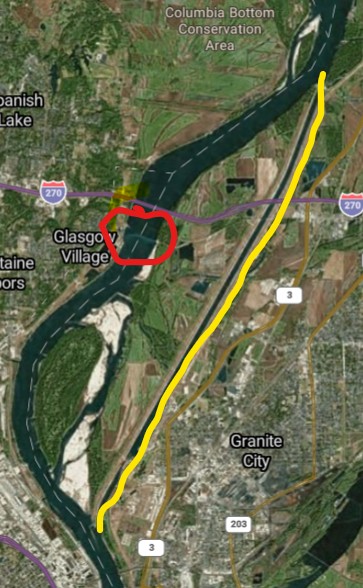
The Chain of Rocks stretch of the river is a series of rock ledges, resulting in shoals and rapids that rendered it unnavigable for commercial shipping. In the 1940s and 1950s, the Corps of Engineers built an eight-mile canal to bypass that reach, with a lock and dam at the downstream end of it. A small, low-water dam was built just downstream of the bridge to keep the water level up and force some flow into the canal.
It is possible to canoe under the bridge and over the rapids created by the low-water dam, or portage around. But I have no experience with rapids and I’d done enough portaging up in Minnesota to last a lifetime. So I chose to use the canal and the locks when I paddled through the area.
I did get to walk across a bit of it though. A friend in nearby Alton, Illinois, who I stayed with on my way downstream, took me there for a look during my visit with him.
Here’s a Google Earth view of it. The new bridge is at top, the old one below and the low-water dam below that: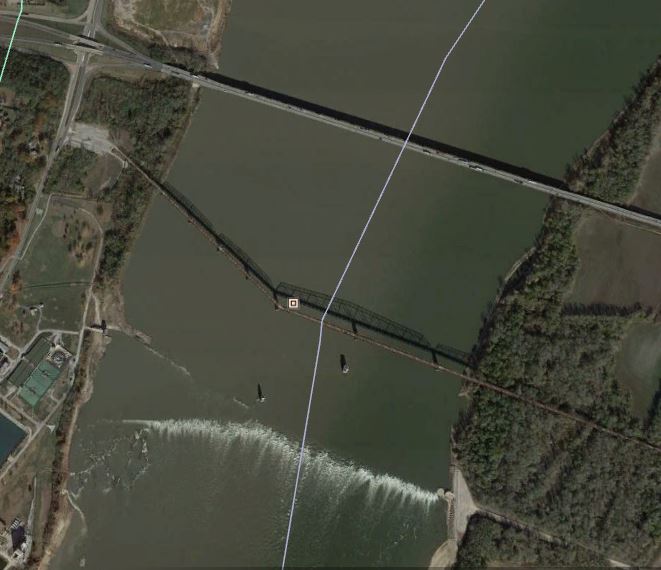
Below, the Chain of Rocks area is circled in red and a yellow line shows where the bypass canal runs.


 The Urge to be Someplace Else
I used to watch Route 66 on tv and in fact followed the road quite a way hitching from NY to LA in 1965.
Regarding those rapids, I cant imagine risking that stretch with a canoe full of all my worldly possessions.
Leslie
>
LikeLike
I also skipped the rapids in St. Cloud, MN, for the same reason. A good Samaritan intervened and carted me and my stuff around them in his pickup truck.
LikeLike