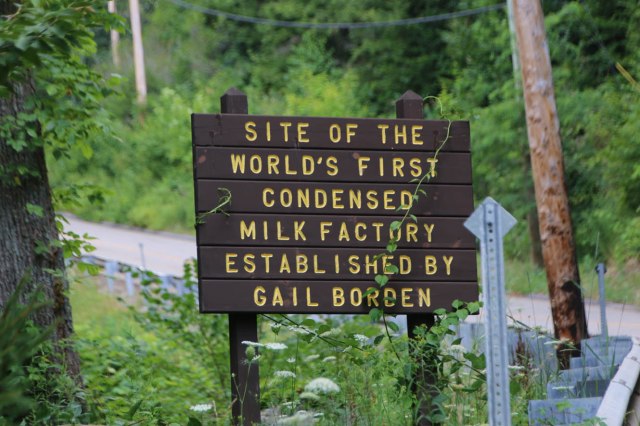
The name Borden is high enough in my memory banks that this sign caught my attention 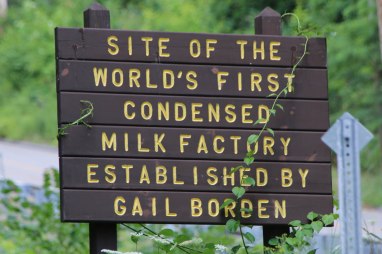 as I navigated along Burr Mountain Road in Torrington, Connecticut, the other day on my way to check out the paddling conditions at quiet little Burr Pond.
Perched behind a guardrail along the narrow road, it sits in a thickly wooded area and is itself in danger of being overtaken by the growth. Hidden in the woods, however, runs a small stream, complete with the waterfall which once provided the power for the world’s first condensed milk factory.
Gail Borden Jr. wasn’t from Connecticut. He was born in New York in 1801 and lived in 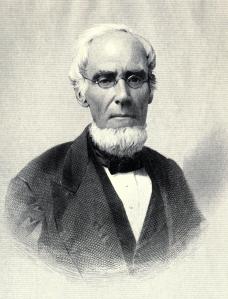 Kentucky, Indiana, and Mississippi before following his brother and father to Texas in 1829, where he became a surveyor, a newspaper editor and a businessman/real estate agent.
And, along with all that, he was a tinkerer, experimenting with disease cures, food processing and mechanics. He never made any medical breakthroughs and his terraqueous, sail-powered wagon never took off–in fact capsized, but his dehydrated beef product, dubbed the “meat biscuit,” was a modest hit, especially with pioneers headed west.
The meat did better in Europe however, and it was on a voyage back from business there in 1851 that set Borden on the path that today keeps him in my brain. Disease had stricken the cows that were aboard to provide fresh milk. The cows died, and so did several children who drank the contaminated milk.
Borden set about finding a way to preserve milk. He was inspired by the vacuum pans used by the Shakers to condense fruit juice. By 1856 he had obtained a patent for his process of condensing milk by vacuum. In 1858 he teamed up with a New York financier and they formed the New York Condensed Milk Company–it wouldn’t be called the Borden Company until 1919. Their first factory was in Burrville, where the sign stands today.


The Civil War in 1861 brought with it a large demand for the product from the Union Army. Borden expanded and soon there were condensed milk factories in upstate New York and Illinois, then the dairy centers of the country.
The company thrived. Between 1927 and 1930, Borden Company bought more than 200


companies around the U.S. and became the nation’s largest distributor of fluid milk. Elsie the cow came along in 1936, followed by husband, Elmer the bull, who became the symbol for the firm’s chemical division.
Following another wild acquisition period in the 1950s and then again in the 1980s, Borden became a massive holding company, with such food brands as ReaLemon, Wylers, Ronco Pasta, Cracker Jack, Beatrice, Meadow Gold, Wise Foods, Cremora creamer, and Campfire marshmallows, as well as such diverse products as PVC piping, printing inks, fertilizers, X-Acto knives and meat rendering.
The company began disintegrating in the 1990s, however, and it passed through a dizzying array of companies and venture capitalists before a final merger in 2005 meant Borden no longer existed, save for its brand name and a few isolated spinoffs.
Hexion Specialty Chemicals, as the final merged company was named, still owns the Borden name and Elsie the cow, which it licenses to a Mexican dairy company, Grupo Lala. And the spinoffs? They would include Elmer’s Glue and the use of Elsie on Eagle condensed milk products, which are owned by Smucker’s. The food business is pretty incestuous!
Borden was no philanthropist as far as I know, but he does have a library named after him in Elgin, Illinois. Here’s why. Borden’s third wife was a former Elgin resident, a widow with two sons. She described the area as beautiful and when Borden was expanding he decided to locate a factory there in 1865 and he eventually bought a house there too.
Many years later, 1892 in fact, when the town was looking for a library site, his stepsons bought a local mansion for that purpose, stipulating that it always be known as the Gail Borden Public Library.
In flashbackland, I recall always wondering, as I sat at the family breakfast table looking at Elsie the Cow on the Borden’s milk container, if there was any connection between that and the famed parent-slayer Lizzie Borden.
In fact, that very thought flashed through my mind when I saw this sign along Burr Mountain Road the other day. Surely it’s a monument to Lizzie Borden, was my first thought. 
Well, lo and behold, there is a connection! Turns out that Lizzie Borden, and Gail Borden Jr. are fourth cousins!
Lizzie, as you know, was charged with the 1892 axe murder of her stepmother and father. Acquitted by an all-male and mustachioed Fall River, Massachusetts, jury after just 90 minutes, she 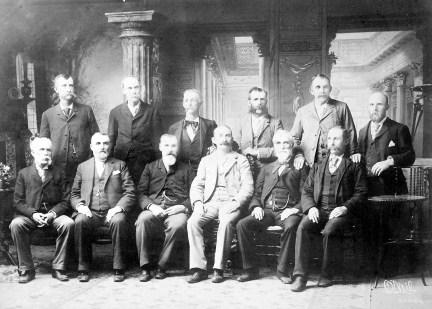 stayed in the area.
The court of public opinion was against her, however, and she remained an outcast until her death in 1927. No one was invited to her burial.
At right are the gentlemen of the Lizzie Borden jury.
So try getting this out of your head:
Lizzie Borden took an axe,
And gave her mother forty whacks;
When she saw what she had done,
She gave her father forty-one.


Once again I’ve learned something about a something I never knew I needed to learn more about!
LikeLike
That’s me, cramming knowledge down your throat until you gag…
LikeLike
Love that story.
Joan Latta
LikeLike