I recently had the pleasure of watching a family of robins from egg-laying through leaving the nest. The mother very conveniently built her abode right outside my Connecticut apartment’s second-floor bedroom window.
Robins are certainly devoted parents. Though the female alone does the nest building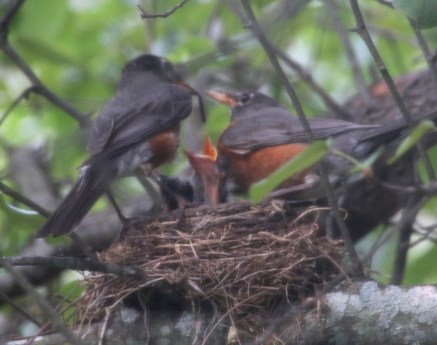 and the sitting, once hatching happens the feeding of these naked, needy and helpless offspring becomes a full-time job for the both of them, at least during daylight hours when I could see what’s going on.
The whole process from egg laying to fledging takes robins roughly a month, two weeks for the eggs to hatch and two weeks for the chicks to grow up and leave.
The gestation period for an elephant, by the way, is a year and a half.
The American robin’s formal name is Turdis migratorius. (That is not why this post has the word diaper in the title, however. Turdis is Latin for thrush, so stop snickering Mr. Bannister. I will get to the diapers in a moment)
The state bird of Connecticut, Michigan and Wisconsin, robins settle in communal roosts of tens of thousands during in the winter, and pair off when back in their northern areas.
A well-known harbinger of Spring, they nest and breed early, late March or April, and I always thought that was it for the season. So I was puzzled at seeing this new nest and family in mid-July. Turns out that robin pairs are known to produce up to three broods in one year. On average, only about 40 per cent of nests produce young robins and only 25 per cent of the fledged young make it to November.
The new and well-crafted nest in the tree outside my second-floor window was on a branch just a bit above my eye level, so I could not see inside it but it was obvious there was some egg-sitting happening.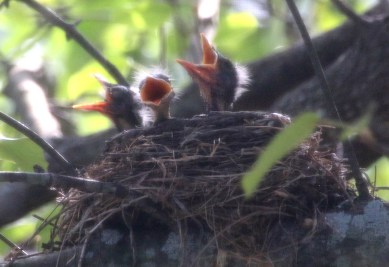
And after the hatching, I had a nice view of the three newborns as they stuck their heads up with their mouths wide open every time a new shipment of food arrived.
The heads, bare at first, grew downier as the days moved along. The feeding was constant. One or another of the parents always seemed to be perched atop the nest with the gaping mouths of the youngsters wide open below them. Often one parent would be arriving as the other was leaving.
As one week moved into the next, they grew bigger, and louder, and more aggressive when food arrived. The actual leaving of the nest took two full days. I had noticed the afternoon before that they were really looking big and occasionally I’d see some wings flapping.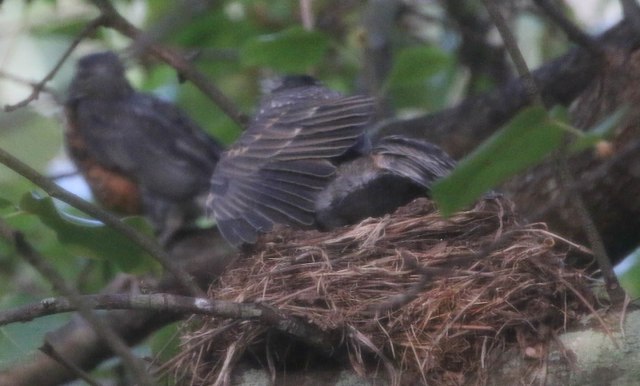 That final day I woke up just before dawn. The window was open and it was noisy out there. It was still too dark to see anything, but there was a lot of calling and flapping a mere 15 feet from my window. I dozed off after a bit and when I woke up again it was light enough to see that all three youngsters were standing up in the nest and flapping their wings occasionally. Then they would settle back down for a spell.
The parents still came by with food during the final day, but spent a lot of time sitting on nearby branches shouting what I guess was encouragement.
About mid-morning one baby stood teetering and flapping on the edge of the nest and quickly hopped onto a nearby branch. It took him several hours of hopping and flapping his way to an outer branch of the tree and then finally he flew off.
It was after lunch before the second one hopped out of the nest and another hour or so before he too flew off.
The third one was still in the nest at nightfall, like the last remaining adult child living in the parents’ basement. He didn’t take off until the afternoon of the second day.
The old song “Rockin’ Robin” sprang to my mind during all this. In my research I never  found what it was about robins that inspired song writer Leon Rene to pen this, but I’m thinking it comes from the bird’s distinctive hopping walk behavior–and the alliteration. Leon by the way seems to have been captivated by birds. He also wrote about those swallows coming back to Capistrano.
And Rockin’ Robin, in case you’re interested, is also the moniker of professional wrestler (well, WWF) Robin Denise Smith, who retired in 1990, and of another equally un-famous celebrity, a singer/dancer in the rock band Radioactive Chicken Heads.
Oops, almost forgot that other Robin tune, “When the Red, Red Robin (Comes Bob, Bob, Bobbin’ Along).” Harry Woods wrote the words and music to that back in 1926. It became the signature song for singer/actress Lillian Roth in the 20s and 30s, and even inspired the name of the Red Robin restaurant chain.
It began as Sam’s Red Robin in Seattle in 1969 because owner Sam was in a barbershop quartet that sang the tune a lot. He was bought out eventually, his name was dropped and eventually there were little franchised Red Robins all over the place.
Now to the point of all this: During my week of nest watching I noticed that one or the other of the parents occasionally had something white in its beak. At first I thought it was a bit of a white flower or even a small bit of discarded bread.
And then I happened across this passage on a website:
“Nestlings produce a ‘fecal sac’ – a white bundle of poop wrapped in a clean, tough 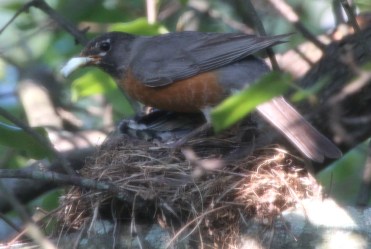 gelatinous membrane – after each feeding.” One of the parents can just pick that up and trash it. A single nest can produce 60 to 70 such bundles a day.
Makes the term ‘sack of shit’ come to life, doesn’t it?
How convenient! About the equivalent of a human baby pooping promptly after every meal and delivering a tidily wrapped disposable diaper to the kitchen garbage can, I guess. Wouldn’t that be nice?
Except for this icky factoid: Because baby robins’ digestive tracts aren’t very efficient and there is often some nutrient value left in the sac, robin parents are known to eat them.
I once owned three dogs who had the run of a fenced-in yard. They almost succeeded in completing such a closed circle.
Icky yes, but it kept the yard pretty clean. Not as clean as a robin’s nest though.
All of the photos are below. Just click on one and you can scroll through all them in a larger format. (All Photos by Ron Haines)


 The Urge to be Someplace Else
Wow, Ron!
A simply fabulous documentary this time. You outdid yourself!
Thanks for all your observation, photography, and research efforts, and for sharing with us.
LikeLike