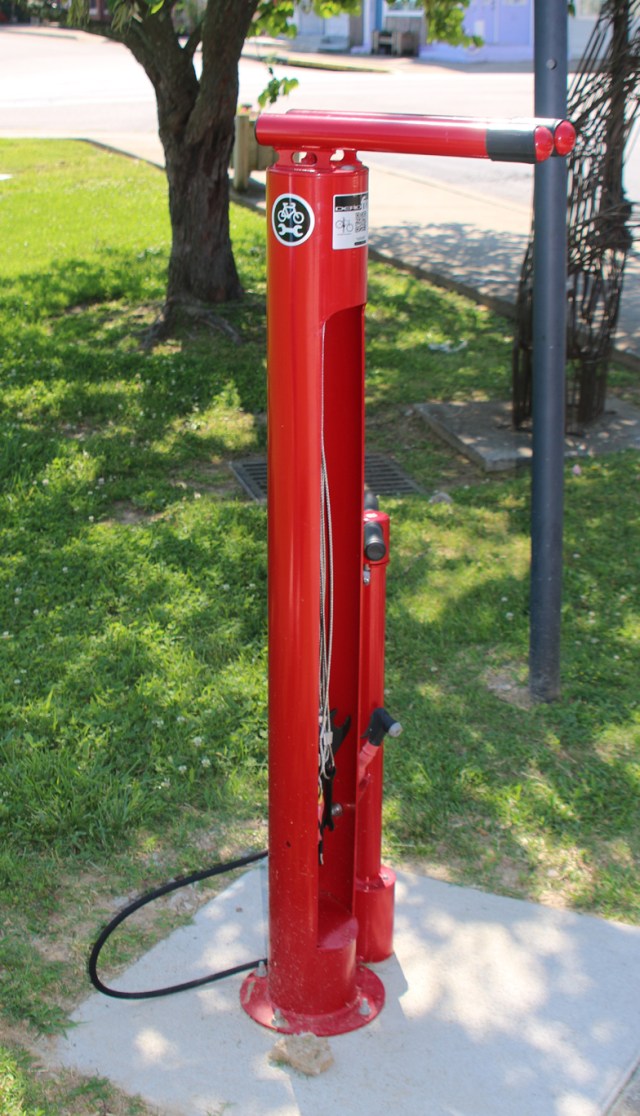
I encountered this fancy bicycle repair station on a drive through Kentucky. It’s one of  four on or near the campus of tiny Berea College in the small town of the same name about 50 miles south of Lexington on I-75.
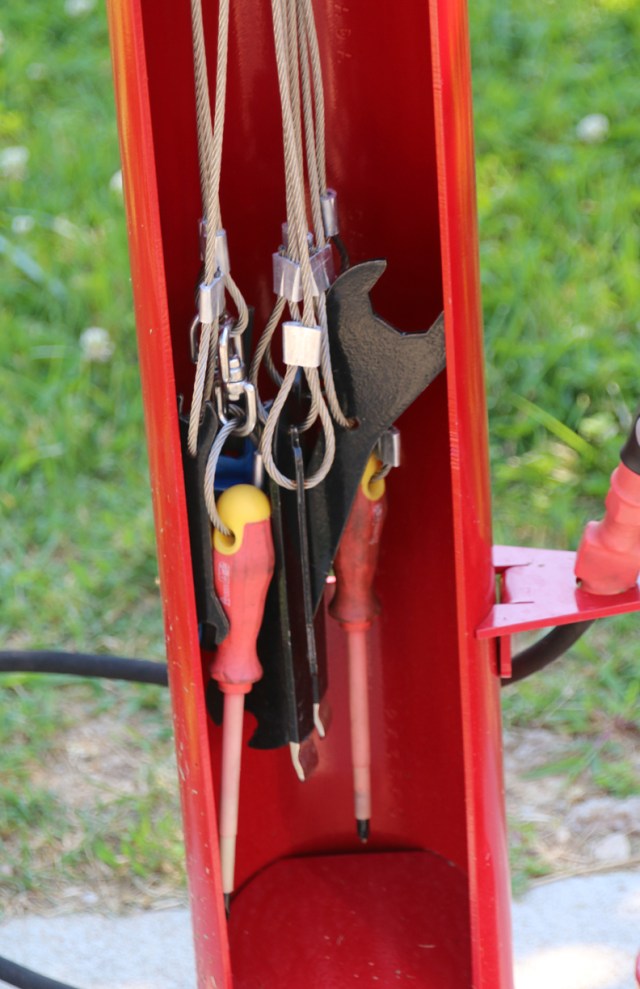
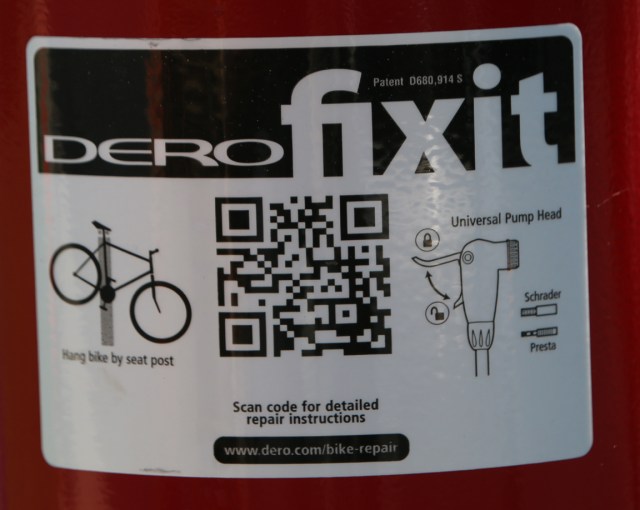
The device includes a bike hanger, tools, an air pump and a savvy smart phone link to repair instructions. It’s manufactured by Dero, a Minneapolis-based producer of all sorts of bicycle racks, shelters, lockers, bikeway materials and other cycling-related items.
A pretty pricy avant-garde piece of equipment to find in a southern, middle-of-nowhere town I thought to myself. I’d pulled off the highway to take a look at the town’s renowned Kentucky Artisan Center and I certainly hadn’t seen enough bicycle traffic to warrant such an installation.
A little research opened my eyes though.
Berea College, with enrollment just under 1,700, is a private, non-denominational Christian college. Its history is closely entwined with that of the town of Berea, population about 14,000, and its student transportation policies explain the presence of the high-tech bike repair stations.
A little history first. In 1853, Cassius Marcellus Clay, a wealthy Kentucky anti-slavery landowner (not the boxer, who came along later) offered John Gregg Fee, a noted abolitionist minister, 10 acres on the edge of the mountains if Fee would take up permanent residence there. Fee accepted and with the help of local supporters and other abolitionist ministers he established two churches and a one-room school in a settlement they named “Berea,” after the biblical town whose populace was open-minded and receptive to the gospel.
Berea’s first teachers were recruited from Oberlin College, an anti-slavery stronghold in Ohio.
Fee’s goal was to found a college “which would be to Kentucky what Oberlin is to Ohio, anti-slavery, anti-caste, anti-rum, anti-sin.” The first articles of incorporation for Berea College were adopted in 1859. But that also was the year Fee and the Berea teachers were driven from Madison County by pro-slavery activists.
Fee spent the Civil War years raising funds for the school. In 1865, he and his followers returned to Kentucky and by 1869 Berea College was a reality.
It was the first college in the southern United Sates to be coeducational and racially integrated. It charged no tuition; every admitted student got a four-year education in exchange for working at least 10 hours per week in campus jobs.
All was not smooth however. A new state law in 1904 meant the end of desegregated education in Kentucky. Berea College challenged the law all the way up to the U.S. Supreme Court, but lost. It was forced to segregate, and in reaction helped fund the Lincoln Institute in Louisville for black students. When the state law was amended in 1950 to allow integration, Berea promptly returned to its original policies.
Today it enjoys a good national and international reputation and is one of only nine “work colleges” in the nation. They are defined by the U.S. Department of Education as distinctive liberal arts colleges that promote the purposeful integration of work, learning, and service.
And where do the bicycle repair stations come in? Here’s how: Students are not allowed to have cars on campus without a special permit, and permits are rarely granted to first- or second-year students.
As noted in the student handbook: “College policy is to discourage unnecessary ownership and use of personal vehicles by students. It is also College policy to provide an educational and social situation in which the ownership and use of personal motor vehicles by students is not normally needed. Ecological and environmental effects, loss of open space, costs of parking, and increased traffic hazards associated with a large number of motor vehicles are also factors influencing the College’s policy of restricting student vehicles.”
The college offers sustainable transportation resources such as campus bike racks and carpool parking, a campus shuttle system to surrounding communities, and a student-led community bike program. In addition, the college and Enterprise Car Rentals provide an on-campus car for student use and in partnership with Zimride, it offers a free ride sharing and carpooling service.
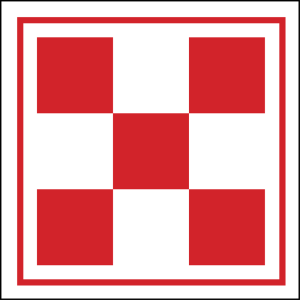 No, I have not forgotten the Ralston-Purina checkerboard logo. Today that company is part of the Nestle conglomerate and the logo is used far less prominently than it was at its peak of popularity. But it was once ubiquitous. And remember the ‘Checkerboard Square’ address of the company back in the day? I do.
The pattern became the logo in the late 1800s because of company founder William Danforth’s childhood memory of a family dressed in clothing made from a bolt of checkerboard cloth.
And why do I think that is relevant here? William Danforth is an alum of Berea College.
More photos of the Dero Fixit below. All photos by Ron Haines.


 The Urge to be Someplace Else
Most interesting article yet, IMHO.
LikeLike
Who knew? BTW, have toy ever been to Mound Key? Florida State Parks | | | | | |
|
| | | | Florida State Parks
| |
|
|
Leslie
Sent from Yahoo Mail for iPad
LikeLike
Nope, never been there.
LikeLike
Thank you, Ron. Very much enjoy learning new & interesting facts – thanx to your wonderful
travels & observations.
LikeLike
Thanks, love to read all the little known facts of small town America.
LikeLike