
I’ve been drunk in my life. Many times. But I had never seen a pink elephant.
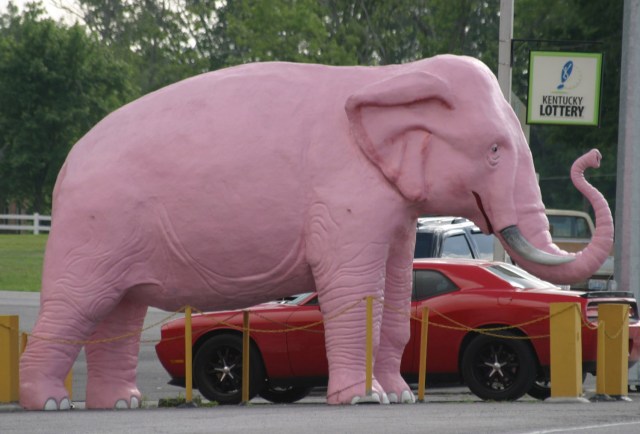
Until one day, stone sober, I came across this one in Guthrie, Kentucky.
It appears to be the mascot for a gas station. And my guess is that it’s also a great landmark for the 1,500-some folks living in Guthrie when they give directions.
Situated at the site of an 1840s-era stagecoach stop, Guthrie also has a huge cow with glasses, located just down the road from the pink elephant.

And that little burg is also the birthplace of All the King’s Men author Robert Penn Warren.
Other than that, this line from the town’s website seems to sum it up: “Nestled outside of Clarksville, TN, in the state of Kentucky, the City of Guthrie is waiting to be discovered.”
So what’s a pink elephant doing in a nice little town like Guthrie? I haven’t the foggiest idea, but I have discovered that large plastic pink elephants aren’t all that rare in the US. This website lists about 20 of them.
And how did they end up being what a drunk sees? For a long time those who chose to imbibe to excess reported seeing snakes during their alcoholic hallucinogenic state. Why did pink elephants replace them?
There was even a physiological explanation offered for the snakes. In 1902 a doctor in London treating sufferers of delirium tremens from too much alcohol examined the eyes of patients with an ophthalmoscope and found that the minute retinal blood vessels were congested. The vessels appear black and are projected into the field of vision, where their movements resemble squirming snakes, he reported.
But the seeing of snakes eventually become a pretty hackneyed alcoholic description, and writers started making increasingly elaborate modifications to the standard drunken scenarios. They changed the snakes to rats, monkeys, giraffes, hippopotamuses or elephants – or combinations thereof; and added color – blue, red, green, pink – and many combinations thereof.
An early known example was one of Henry Wallace Phillips’ “Fables of our Times” which referred to a drunken man seeing a “pink and green elephant and the feathered hippopotamus.”
In 1913, Jack London, in the autobiographical John Barleycorn, describes an alcoholic “…who sees, in the extremity of his ecstasy, blue mice and pink elephants.”
Eventually, according to the thinking of those who spend time thinking of the origins of things in our language, pink elephants emerged as the popular favorite. They became the animal of choice in drunken hallucination descriptions.
But all that still doesn’t answer the question of why pink elephants, does it? How did we come to know about pink elephants. It turns out that the color comes from white elephants, which weren’t really white.
We can thank showman extraordinare P.T. Barnum and his hankering for a white elephant for introducing America to the concept of a pink elephant. The existence of albino, or ‘white’ elephants had been known for hundreds of years in Asia. They were rare, sacred and much prized in the Southeast Asian monarchies of Burma, Laos, Thailand and Cambodia.
Here’s the rub: Although described as white, and depicted in drawings as white, they were actually a soft reddish-brown, turning a light pink when wet.
As P.T. Barnum found out. After much effort and a lot of money he convinced the King of Siam to send over a white elephant and he found out it was really a dirty grey in color with a few pink spots.
As one reporter at the time put it: “He has got a pink patch across his face and trunk, little pink dots on the outside of his ears, yellow toe-nails and a handsome pair of tusks. Standing in front of him, a person would believe that he was a pink elephant dotted with slate-colored spots . . . .”
As with everything that P.T. Barnum did, the arrival and display of what he had billed as the “Sacred White Elephant of Burma” and the subsequent realization that it was sort of pink in actuality, received massive publicity, and, the theory of word origins goes, introduced the ‘pink elephant’ concept to the American populace in the mid-1800s. And it became a handy euphemism for an alcoholic hallucination in subsequent years.
And why does the term ‘white elephant’ mean something useless and hard to get rid of, a meaning that’s been around since the 1600’s, way before P.T. Barnum? It all goes back to those Asian monarchs and the rare albino elephants. They were sacred and prized, remember. And elephants were then and still are very expensive to maintain. A crafty monarch would often gift someone with a white elephant, especially someone he didn’t like very well and someone for whom he knew the maintenance of the beast would be a huge financial burden.
Now you understand the true meaning of those white elephant gift party games, right?
But back to the pink elephants for a moment, to wrap this up.
Does anyone remember good old Sarah Palin? Well, she introduced a whole new meaning for pink elephant during her vice presidential campaign. She, quite seriously, used the phrase “pink elephants” to refer to conservative women. Playing on the elephant being the Republican Party symbol and pink being the stereotypical feminine color, she warned Washington of a “whole stampede of pink elephants.” Now there’s a vision to stir the soul and rally the troops!
I’ll bet there are a lot of Republican women who are happy that that concept didn’t stick, about as happy as are all those Democrats that Sarah Palin didn’t stick.


 The Urge to be Someplace Else
Wow! Impressive research, Ron!
I feel so very much enlightened about pink (and white) elephants.
Thanks! You Da Man.
LikeLike