
The National Mustard Museum was a must visit during my recent whirlwind tour of 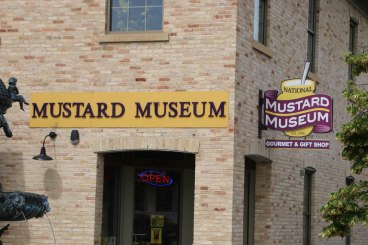 offbeat places in the Midwest.
Why?
For the simple reason that mustard has become a standing joke with me and granddaughters Margeaux and Simone. It started a year or so ago when I said I didn’t like mustard. We were probably having hot dogs or something.
It’s been a running gag ever since, popping up now and then. It’s usually in the context of “We know what to get you for your birthday, Grandpa,” or somesuch. It’s one of those pleasant jokey things we have in common and use to amuse each other with once in a while. The utterance ‘mustard’ never fails to get the three of us laughing. They have a similar thing going with Sue and her dislike of marshmallows.
So that’s why I couldn’t resist a visit to the National Mustard Museum in Middleton a suburb of Madison, the capital of Wisconsin. The small town calls itself ‘The Good Neighbor City,’ has a population just under 20,000, and is supposedly named after a town in Vermont, though I couldn’t find one with that spelling in the Green Mountain State.
The museum, located in the heart of historic Middleton, turned out to be a great place.
It’s a very serious place, with its thousands of brands and flavors and mustard pots from all over  the world. But it’s downright delightfully hilarious at times with its several tongue-in-cheek exhibits. And there’s the totally unexpected. When I bought a sampler box in the gift shop I got to squeeze the store’s large ooga horn (see it in photo at right).
What a sweet sound!
My sampler box had eight flavors and we made good use of them at a mustard tasting session with family in New Hampshire, complete with homemade soft pretzels.
The museum was the brainchild of Barry Levenson, who started collecting mustard while he was an assistant attorney general for Wisconsin. One night in 1986, despondent because his Boston Red Sox had just lost the World Series, he was wandering the condiment aisle of an all-night grocery store. As he passed the mustards, he heard a deep voice say, “If you collect us, they will come.”
The final straw came later when he was in Washington, D.C, to argue a case before the Supreme Court. At the hotel he spied a mustard jar on a discarded tray and pocketed it. “I argued a case before the Supreme Court with a mustard jar in my left pocket,” he says. “We won.” In 1992 he left the law and opened the museum
Today it boasts about 6,000 mustards, from all 50 states and 70 countries, hundreds of
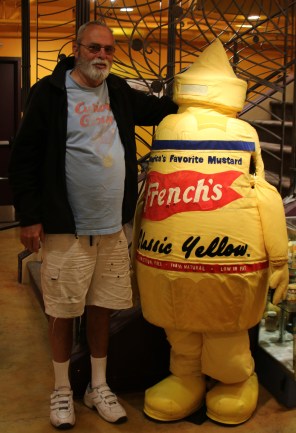
Me and a buddy at the museum
mustard pots and other mustard memorabilia, a well-stocked gift shop, and the ever popular Poupon University: “Lowering the bar in higher education.”
And a modest online store: “If you can’t find it here you won’t find it anywhere.”
And a newsletter, The Proper Mustard, “Yellow Journalism at its Best.”
You see what I mean about the place. It’s serious, but fun. It’s in that vein that I now omit all the boring stuff about the history of mustard (it’s been around since before 1800 BC) and all that, and go right to the point of all this: Why does the term “cut the mustard” mean to succeed or of high quality? Amazingly, the most probable explanation makes literal sense, in several ways.
Mustard stalks are thick and stringy, hard to chop. Mustard seeds are small and shiny, tough to cut with a knife. And finally, this: Back in the day, mustard was made in large oak barrels, and as the barrel matured a thick leathery crust formed at the top. This had to be very carefully removed before the contents could be tested, for if a piece of crust fell into the mustard it would lose some of its distinctive flavor. Over the years a specialized tool was developed, with a blade that had a very thin and extremely sharp leading edge, widening in the middle and tapering but not sharp at the back edge, allowing it to skim most of the crust off, leaving a only a very thin slice.
And the mustard maker, the Mustardeer, could tell by a look at the blade if his assistant hadn’t sharpened it properly, and on such an occasion would hand it back with the comment, “this doesn’t cut the mustard.”
I will leave you with this: Remember Grey Poupon mustard from the ads with the friendly folks in the neighboring Rolls-Royces? Developed in the 1860s, the name comes from two men, Maurice Grey, who had come up with a machine that dramatically increased the speed of Dijon mustard production, but who needed financing, and Auguste Poupon, another Dijon producer, who supplied the money. They lived, of course, in Dijon, France.
Mark your calendar: National Mustard Day in 2018 falls on August 4.
Some random museum photos:
Here are some of the mustard pots on display:
And a bit more of the always present humor of the place:
A comic strip from the place, from back at the beginning of it when the museum was in Horeb, WI:
And finally, a slide show of the sampler box I bought and all of us up at Rick Haines’ house in New Hampshire for the homemade soft pretzels and mustard tasting party:


 The Urge to be Someplace Else
Was just scrolling down through facebook, saw a photo of the Mustard Museum and without even looking, knew it had to be you! Sure enough. Love the way you turned that visit into a family event!!!
LikeLike
Awesome, Ron! How I wish we could’ve joined you all for the great pretzel/mustard feast in Contoocook! Maybe next time…
LikeLike
Moi, j,adore le moutarde. Quand j,habitais a Besancon, pas loin de Dijon, Je mangais souvent le lapin prepare avec un bon moutarde qui me toujours fait pleurer, C,etait tres,tres fort❗️Dommage que tu n,apprecies pas beaucoup. Je la manges presque touts les jours! 💁
LikeLike
Pretty sweet, and I am also not a
fan of mustard.
LikeLike
Funny, neither I, who supplied the mustard for the tasting party, nor you, who supplied the venue for it, is a fan.
LikeLike