
Another byway with a warning sign, this one in Exeter, Rhode Island.
An appropriate signpost I guess, given that this small settlement of 6,000 or so is the site of one of the best documented cases of vampire exhumation. No, I do not know if the exhumation occurred on this particular road.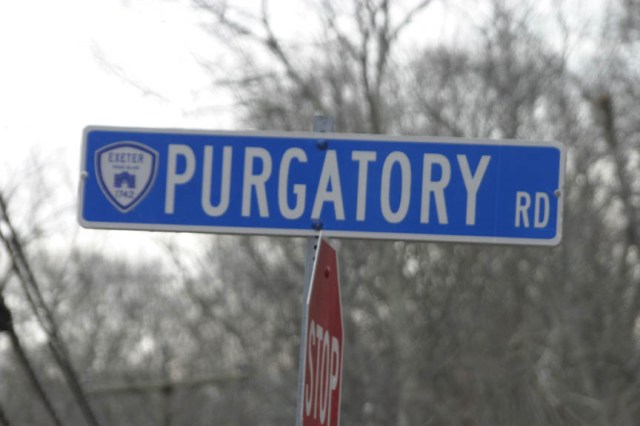
The Mercy Brown vampire incident occurred in 1892 and wasn’t an isolated occurrence. Indeed, it was part of the wider New England vampire panic that accompanied a large outbreak of tuberculosis in the late 19th century.
The cause of the disease, called ‘consumption’ because it appeared to consume the body, was unknown at the time.
Now known to be bacterial, the illness spread easily within families of course. When one died, others soon took ill. Folks began to believe the deceased were draining the life from other family members.
So to protect the living the dead were exhumed. A corpse was deemed to be feeding on the living, or “undead,” if it seemed to be unusually fresh, especially if the heart or other organs contained liquid blood.
If so, the simplest remedy was to just turn the body over in its grave. Or the fresh organs could be burned and everything reburied. Decapitation was also performed, as well as inhaling the smoke or consuming the ashes of the burned organs.
Back to Exeter, Rhode Island. Mary Eliza, the mother in the Brown family, was the first to die of the disease, followed in 1886 by eldest daughter Mary Olive. Another daughter, Mercy, was then stricken and died, and soon son Edwin became ill.
Friends and neighbors believed one of the dead family members was a vampire and had caused Edwin’s illness. Father George Brown was persuaded to allow exhumations. It was done on March 17, 1892.
The bodies of the mother and daughter Mary Olive were suitably decomposed, but that of Mercy showed almost no decay, and still had blood in the heart. (This sign that she was undead was probably because her body was stored in freezing temperatures above ground for two months after her death.)
Her heart and liver were burned and the ashes mixed with water to make a tonic, which Edwin drank. His disease nevertheless progressed and he died two months later.
Sounds rather quaint in the context of today, doesn’t it?
Some perspective:
The oldest evidence of the disease has been found in the remains of bison in Wyoming dated to around 17,000 years ago.
In 2017, there were more than 10 million active cases and 1.6 million deaths from tuberculosis, making it the number one cause of death from an infectious disease.
More of my street warning signs are here.


 The Urge to be Someplace Else