
On a drive through Williamsport, Pennyslvania, I happened upon this statuary.

What’s that for? It took a few seconds for the synapses to work and then the light came on. Duh! Williamsport is the home of Little League Baseball. That connection’s been buried in my brain for decades and I hadn’t exercised it in a very long time.
Williamsport (town motto, “The will is in us”) was founded around 1800 and has a population just under 30,000, down from a peak of 45,000 in 1950 .
In 1939, native son Carl Stotz was looking for a way to inject some adult supervision into 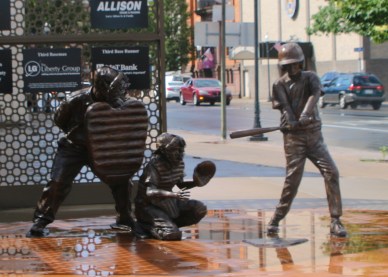 the sandlot baseball games played by his nephews and their friends. He wanted to eliminate the on-field bickering. So he and the boys started experimenting with various playing field dimensions, the mother of his nephews sewed the bases and Carl himself carved home plate and the pitcher’s mound.
He also attracted sponsors and other parents and soon had three teams set up, the Lycoming Dairy, Lundy Lumber, and Jumbo Pretzel. The first League game took place on June 6, 1939, with the Lumber defeating the Dairy 23-8.
Today, Little League is huge. Its umpteen divisions in various age groups for girls and boys, encompassing baseball, softball, and even T-ball, include nearly 2.6 million players divided geographically into eight regions in the U.S. alone and another eight covering over 80 countries around the world.
The main stadium for Little League Baseball’s World Series is named after Howard J. Lamade, which leads me nicely into the other interesting thing I found about Williamsport.
It’s the birthplace of Grit, which was a national weekly newspaper popular in rural areas for more than 100 years. It carried the claim, “America’s Greatest Family Newspaper.”
It was founded in 1882 as the Saturday edition of the Williamsport Daily Sun and Banner, and its typesetter was a young German immigrant by the name of Dietrick Lamade. He left that job in 1884 to work for the newly launched Times newspaper, but that venture soon failed. At age 25 with two children and no job he teamed up with a couple of partners, bought the Times’ equipment and the Grit name and became a publisher.
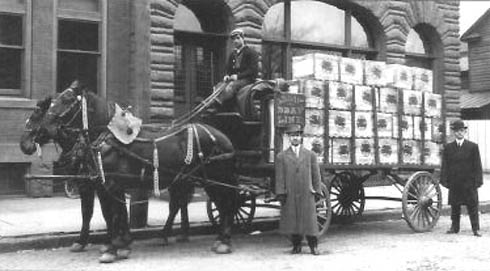
With rapid expansion, a wagon of Remington typewriters was delivered to the Grit offices in 1892 (Wikimedia Commons)
By 1887 he had a weekly circulation of 20,000. He targeted small towns and rural families with a thick package of general news, features, comic strips and serials. By 1900 circulation was at 100,000 a week.
His editorial policy was clear: “Always keep Grit from being pessimistic. Avoid printing those things which distort the minds of readers or make them feel at odds with the world. Avoid showing the wrong side of things, or making people feel discontented. Do nothing that will encourage fear, worry, or temptation… Wherever possible, suggest peace and good will toward men. Give our readers courage and strength for their daily tasks. Put happy thoughts, cheer, and contentment into their hearts.” (Huh? Not too dissimilar from the philosophy of a certain tabloid titan I began work for in the late 1970s)
Sales were propelled by direct mail delivery and a national newsboy sales force (Those ads in the comic books about how you could make extra money delivering Grit were still running well into my childhood). By 1932, it had a circulation of 425,000 in 48 states, and 83% of its circulation was in towns of fewer than 10,000 population.
At its peak in 1969, Grit sold 1.5 million copies a week. It stayed in the family until 1981 and, after changing hands several times, it survives today as a small circulation bi-monthly magazine, part of the stable at Ogden Publications in Topeka, which also publishes American Life & Traditions, Farm Collector, Mother Earth News and Utne Reader.
Founder Dietrick Lamade died in 1938. It was one of his sons, Howard J., who as a vice-president was the Grit tie to Little League Baseball, serving the fledgling organization as an executive. The main stadium used for the league’s world series was built on land donated by the Lamade family, and it is named after Howard J.
 I will leave you with this one last bit about Williamsport. It once had more millionaires per capita than anywhere else in the world. This is why the sports teams at Williamsport Area High School are known as the “Millionaires.”


 The Urge to be Someplace Else
These are fascinating little pieces you are posting. Is the flow a sign of inclement weather in CT?
Leslie
LikeLike
Precisely. The paddles are still packed in the trailer, which itself is in the garage unopened because it’s just been too damn cold in the unheated garage to unpack it. Yesterday I barely bothered to get out of my pajamas. Ergo plenty of time to dig out some pix from trips past and roam the internet for interesting factoids.
LikeLike
Yes, Williamsport! As you already probably read…
Today, the Little League World Series is truly worldwide and very, very popular. It’s setup such that the finals pit the winner of an all-USA Bracket against the winner of a bracket consisting of all “international” teams. The non-USA team nearly always wins the title.
The final 4? 8? teams travel to Williamsport to play for the championship.
It gets ESPN coverage and everything!
All of the teams are basically all-star teams, picked from various leagues or municipalities or such.
A truly great American tradition!
LikeLike