
I usually take municipal slogans—the ones you see on the ‘Welcome To’ signs on the way into town—with a huge grain of salt, and rightly so.
For example, I once found the Blueberry Capital of the World in Maine (Cherryfield)…
 …only to discover later that two other towns, one in New Jersey (Hammonton) and one in Michigan (South Haven), made the same claim.
Ditto Sheldon, NC, and Virginia Beach, VA. Yes, the former claims to be the Rockfish Capital of the World and the latter the Stripped Bass Capital of the World, but geez, they are the same fish!

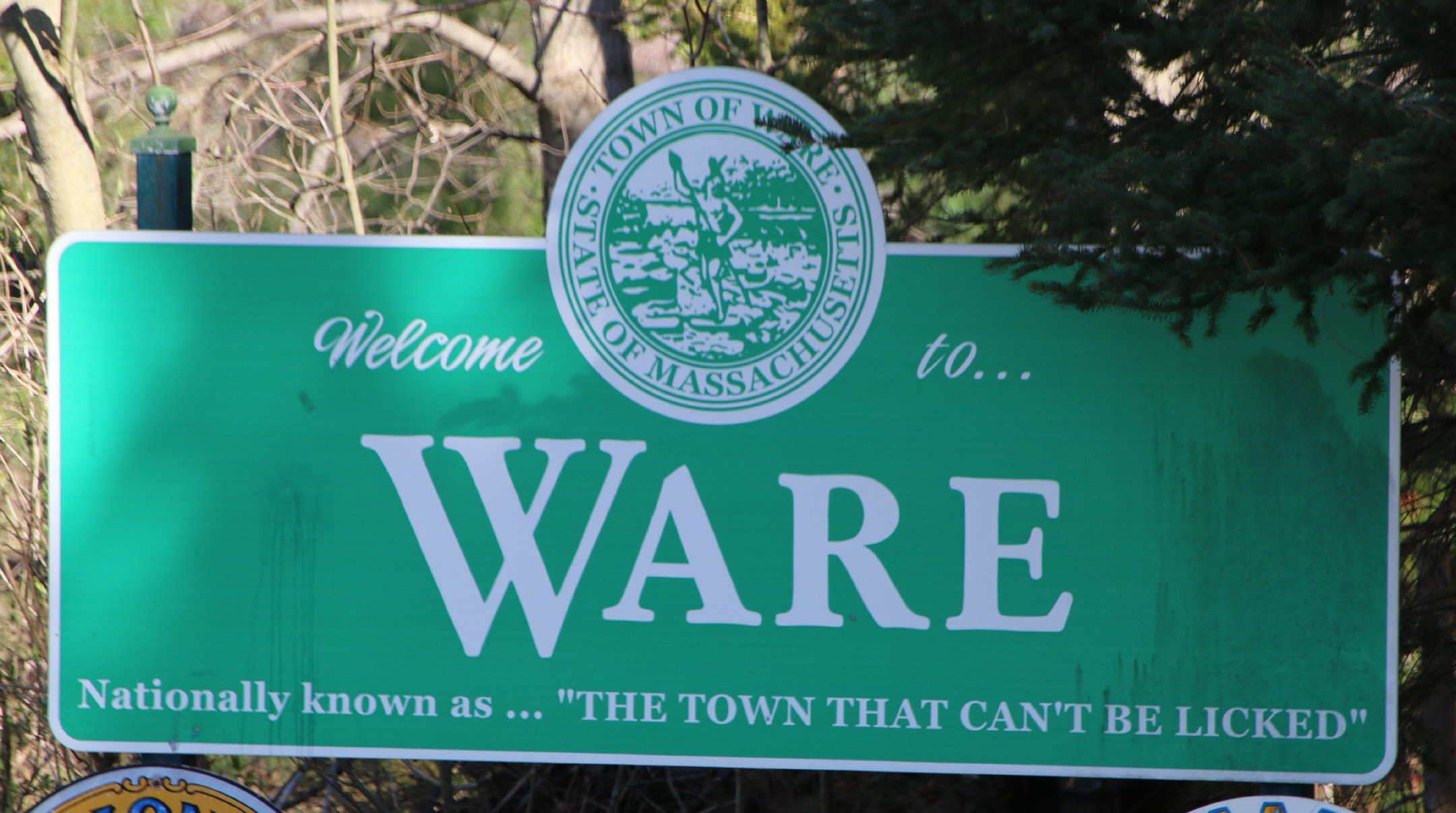
So, pardon my skepticism when I drove into Ware, MA, and saw this sign: “Nationally known as…’The Town That Can’t Be Licked.’” Indeed! I’d never heard of it.
Turns out it’s true. Google “the town that can’t be licked” sometime. Ware, and only Ware, pops up.
But it’s also true that the label was applied, and yes, known nationally, nearly a century ago.
It was back in the mid-1930s when the owners of the Otis company, a textile firm that had been Ware’s single largest employer for some 100 years, decided to call it quits in the face of competition from southern mills and lack of modern machinery.
They arranged a quiet sale to some southern interests and by the time the townspeople found out what was going on it was nearly a done deal.
Ware citizens rallied quickly and with the backing of the Ware Trust Company bought the mills, which became Ware Industries Inc., preserving the livelihood of thousands of families.
Police Chief Bartholomew Buckley coined a new phrase for Ware, calling it “The Town that can’t be licked!” And townsfolk were so giddy with success they celebrated with an original musical entitled “We’re Happy About The Whole Thing,” which documented their victory and lampooned the mill’s former owners.
 Life Magazine heralded the event in the May 23, 1938 issue with an article entitled Life Goes to a Party: Ware, Mass. Celebrates Comeback. That was the 1930’s equivalent of going viral.
Click on one of the photos below to page through all of the article full-size.


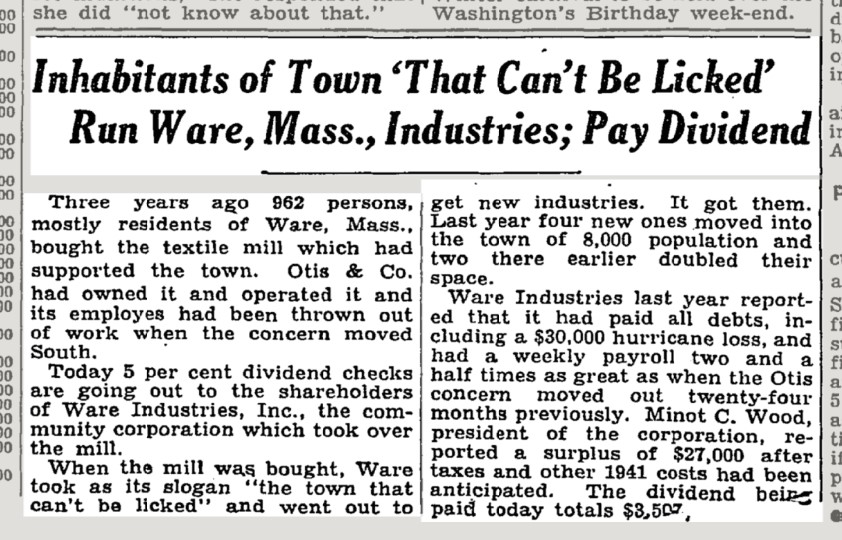
And here’s a followup story, from the New York Times on February 12, 1944:


 The Urge to be Someplace Else
This was a nice read before going to sleep tonight. Thanks, Uncle Ron!!
LikeLike
Ron, I enjoyed your story. When I was in college thinking about being a Home Ec teacher I went out to the Mills and watched the production of Textiles. By retirement I would guess that the workers had serious eye problems. they used magnifying glasses to correct any flaws in the weaving.
LikeLike